
REVIEW: Wicked 2 changed me for good
By Evan Zhang ‘26
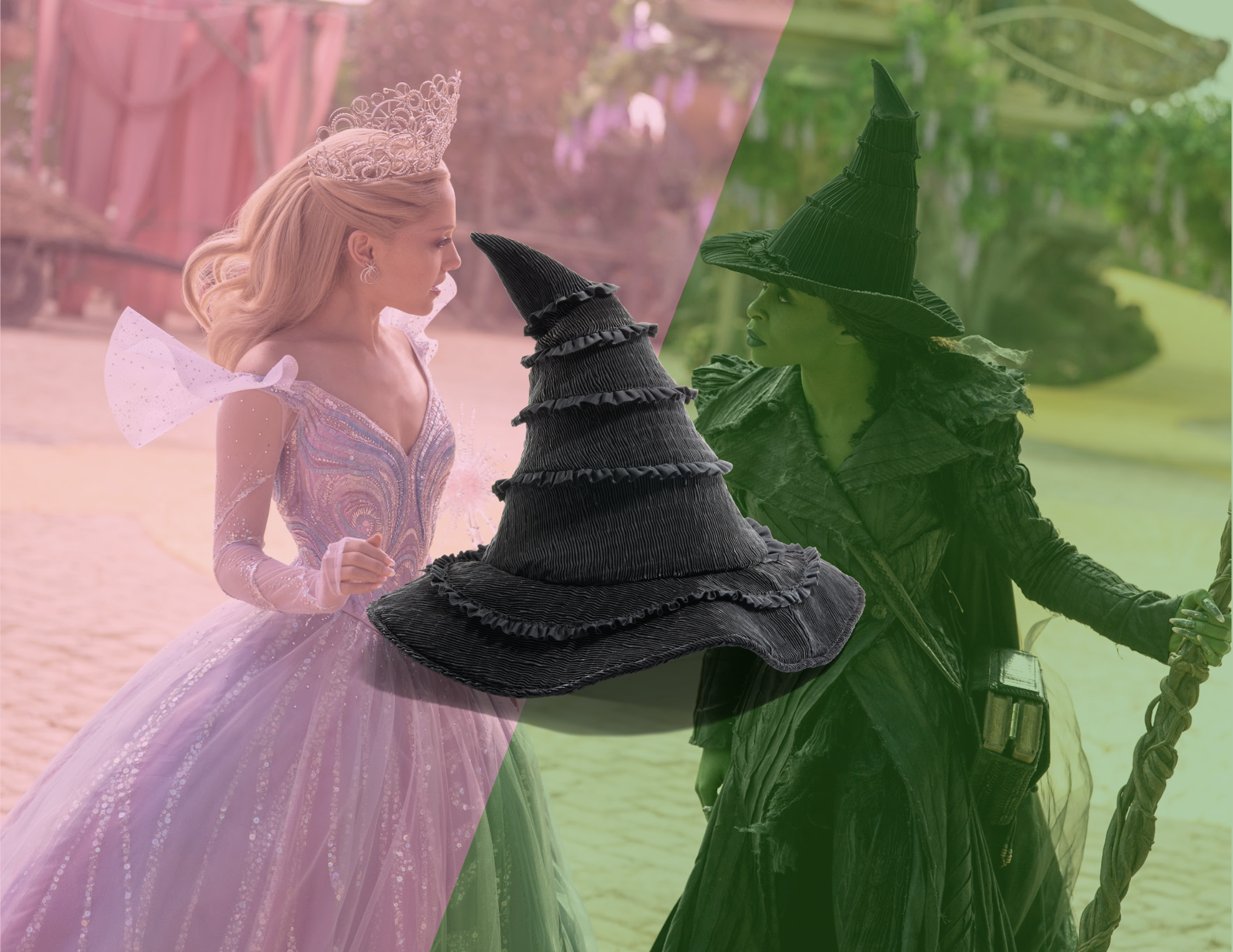
Courtesy of Evan Zhang.
I couldn’t be happier to announce that Wicked: For Good, the long-awaited second part of 2024’s Wicked 1, finally hit theaters last winter. For those unfamiliar with the film, Wicked: For Good is an adaptation of the Broadway musical Wicked’s second act, which in itself is a retelling of L. Frank Baum’s classic The Wizard of Oz. Recalling my Wicked 1 review last year, I decided to take its sequel for a spin.
Serving as an origin story for the Wicked Witch of the West, Wicked: For Good tells the intertwined stories of Elphaba, a magical woman being persecuted for witchcraft by the government of Oz, and Glinda, her ex-friend who has gained power as a political figurehead under Oz’s ruler, the Wizard. Through allegories involving wand-waving and talking animals, the film also tackles real, timely issues such as ethnic erasure, mass propaganda, and the descent of governments into fascism.
Given its predecessor’s critical reception and box office records, Wicked: For Good had its work cut out for it before the film was even released in late November. Fortunately, following a smashingly successful opening weekend that saw a $226 million global gross, the adaptation went on to make more than $523 million worldwide. In fact, according to The Guardian, both Wicked: For Good’s domestic and international openings topped records set by Wicked 1 for stage-to-screen musicals.
On the whole, the film was received well by audiences, earning a 93% “Verified Hot” rating on Rotten Tomatoes. Positive reviews praised the performances of the musical’s two leads, played by Cynthia Erivo and Ariana Grande, accuracy to the original work, and cinematography.
However, critics’ responses were not just bubbles and rainbows, with one Rotten Tomatoes critic deeming the movie “immensely slow and ill-conceived” and another claiming that the franchise “fired its best shots the first time around.” Witnessing the movie’s somewhat mixed reception, I set out on the Yellow Brick Road to the theater.
My thoughts are gathered in the review below, rating Wicked: For Good in terms of the following four categories: Singing & Choreography, Acting, Cinematography & Editing, and Design. By the end, I hope to determine for good whether watching the film is as wonderful as fans make it seem, or no good deed at all.
Singing & Choreography
As with Wicked 1, Cynthia Erivo remained an absolute powerhouse in terms of vocal prowess throughout Wicked: For Good. Her range, including an ability to belt for songs like “No Place Like Home” and a measured softness for quieter tunes like “For Good,” proved incredibly versatile. Specifically, I found myself captivated in the theater as Erivo delivered a showstopping take on “No Good Deed,” full of the anguish, bitterness, and frustration of Elphaba in that climactic moment.
Likewise, Ariana Grande brought the same vocal elegance to Glinda as in the first film, which was especially required given the character’s stronger presence. Grande’s signature light voice lent itself favorably to songs such as “Thank Goodness” and the reprise of “I’m Not That Girl.” I was particularly struck by her debut of “The Girl in the Bubble,” in which she displayed both impressive high notes and a gentle pensiveness that offered the viewer an empathetic look at Glinda’s character.
Together, the pair harmonized beautifully, with Erivo’s deeper voice grounding Grande’s falsetto one during tracks like “For Good” and “A Wicked Good Finale.” Another notable duet was “As Long As You’re Mine,” featuring Erivo and Jonathan Bailey as her love interest, Fiyero. Here, Bailey sang with gusto, though it was Erivo’s vocal trills and higher range that injected the song with the passion it needed.
The rest of the singing cast fulfilled their duties nobly. Surprisingly, Marissa Bode’s breathy voice fit the emotional, raw nature of “The Wicked Witch of the East.” Ethan Slater, too, brought necessary vitriol to the voice of Boq, shifting from an innocent sound in “The Wicked Witch of the East” to a darker, embittered tone in “March of the Witch Hunters.”
To his credit, Goldblum’s cheery vocals complemented the jolly tune of “Wonderful” nicely, as Grande helped to cover the more demanding notes.
Alas, it is time to address the elephant in the room: Michelle Yeoh’s singing.
Widely criticized online for, as one X user put it, possessing a “singing voice [that] is unforgivable,” Yeoh made valiant efforts to bring the grandiosity of Madame Morrible to the silver screen, yet fell short. The actress herself, in an interview on The Late Show with Stephen Colbert, admitted to feeling “terrified” of singing live, and her brief parts in “Every Day More Wicked” and “Thank Goodness” sounded dull at best and halting at worst.
Compared to its predecessor, Wicked: For Good contained fewer actual dance numbers, with the only three being those of Glinda’s cabinet in “Every Day More Wicked,” the Munchkins in “Thank Goodness,” and Elphaba and Glinda in “Wonderful.” These I found to be well-choreographed, with each cleverly paralleling a scene in the first part. While the majority of the movie was dance-free, the lack thereof was not disconcerting, instead befitting its serious, realistic feel.
Though Yeoh’s vocals were a definite sore spot, the musical excelled overall in terms of singing and choreography. I give it a solid 8.5 out of 10 broomsticks in my book—not to be confused with the Grimmerie.
Acting
Although the two witches’ dynamic was relatively similar to theirs in the first part, Erivo and Grande were both tasked with playing more mature versions of their characters. In my opinion, Erivo excelled in her portrayal of Elphaba, depicting the character’s emotional struggle with nuance as she fought between maintaining hope for a better day and sinking down to her enemies’ level.
Grande, whose role plot-wise was expanded from Wicked 1, was tasked with a greater character journey: transforming Glinda from a charismatic coward into a redeemed resistor of fascism. She proved herself up-to-the-task, displaying her character’s vulnerability to manipulation but also showing her quiet strength as the movie progressed.
Together, the duo brought the arc of their friendship to a beautiful conclusion, with an emotional send-off that admittedly made me a bit teary-eyed. Throughout the movie, Erivo and Grande spoke to each other as concerned friends, political foes, hurt lovers, and finally reconciled companions, showcasing a deep understanding of their characters’ relationship that changed the film for the better.
As for the supporting cast, there were a few lackluster performances, though Wicked: For Good generally spent less time with some characters for the plot’s sake. For instance, Bode and Slater were only prominently featured in the first and last quarter of the film; Bode did well to portray the spoiled side of Nessarose, and Slater was truly chilling as the scorned Boq. Bowen Yang and Bronwyn James, who reprised their roles as Glinda’s obnoxious sidekicks Pfannee and Shenshen, shone in terms of comedic timing at the movie’s start.
Outside of the two leads, Bailey, Goldblum, and Yeoh had the biggest silver slippers to fill. In general, I felt that Bailey gave his character more depth this time around, showing the audience his commitment to justice and genuine love for Elphaba. Goldblum, as well, peeled back the curtains on the darker aspect of the Wizard’s personality, juxtaposing his humorous affectation with conniving power-hungriness.
Once more, it was Yeoh whose acting I found to be slightly sub-par. While her portrayal had all the intimidation required for a character like Madame Morrible, Yeoh’s line delivery came across as missing emotion and occasionally inappropriate for the movie’s grimmer scenes. Due to Morrible’s importance in the movie’s plotline, these moments were distracting and de-suspending of my disbelief.
Yeoh’s flat delivery aside, the rest of the cast gave stellar performances that earn the film 8 out of 10 broomsticks for theatrics.
Cinematography & Editing
Given the fast-paced plot and heavy fantasy elements of Wicked: For Good, the movie needed to have swift camerawork and advanced special effects. Additionally, in light of the criticism Wicked 1 received for its dull, gray color grading, I hoped to see more colorful shots as I returned to the theater. Thank goodness, I was not disappointed.
To begin, the film cleverly used a variety of extreme long shots and close-ups for its most cinematic scenes, with some of my favorite shots being Elphaba’s opening chase with the flying monkeys, the “Wonderful” dance, and Glinda’s wedding scene. While the scenes of Munchkinland, meant to occur in broad daylight, appeared as visually unstimulating as those in the original, the majority of the movie was much more vibrant.
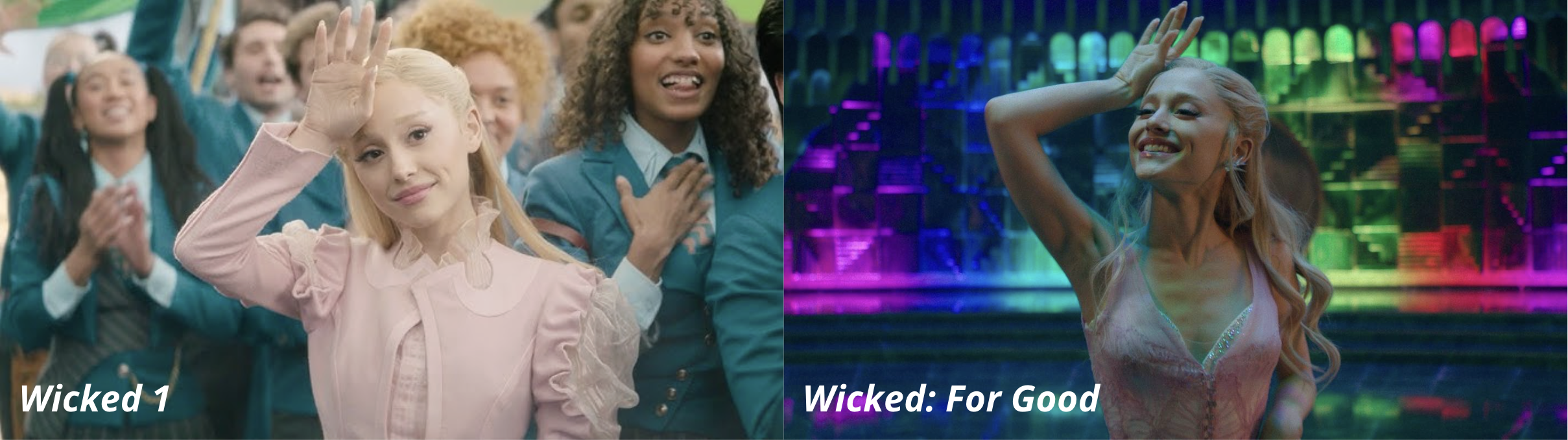
A side-by-side comparison of the first and second movies’ frames shows the improvement in color grading. Courtesy of Evan Zhang.
Moreover, through expert transitions and editing, Wicked: For Good’s filmmakers were able to keep up with the quick plot of the second act. I particularly enjoyed the parallel cuts between Glinda walking down the wedding aisle and Elphaba navigating the Wizard’s dungeon of caged animals, along with the finale’s shot of the pair side-by-side. The inclusion of flashbacks in “No Good Deed” was especially powerful, an effect that would not have been possible on the Broadway stage.
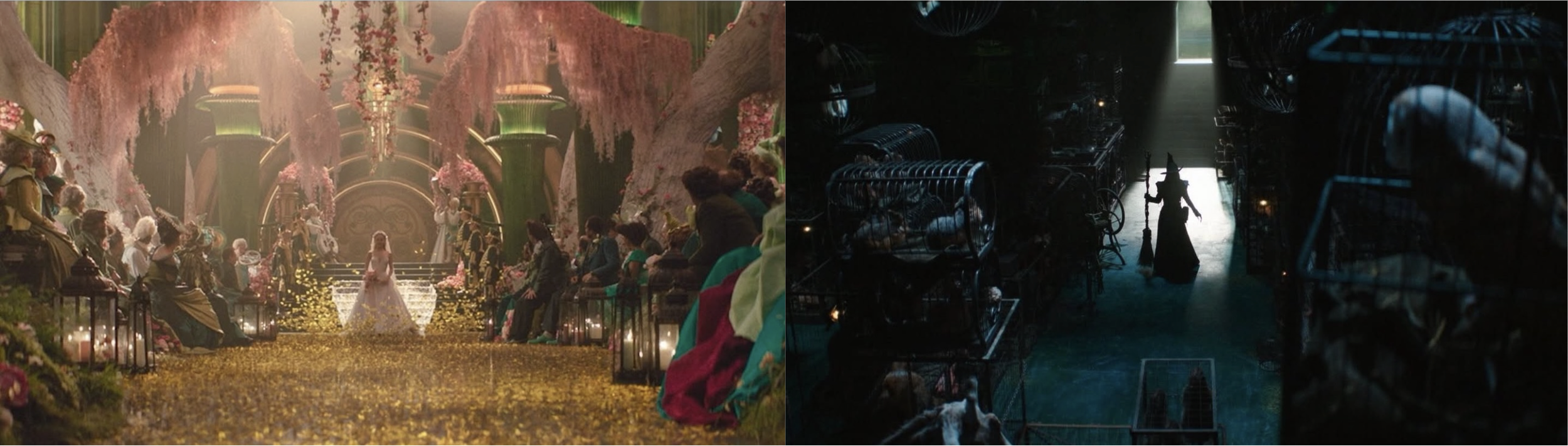
Parallel editing helped to reinforce the musical’s message in a way that onstage adaptations could not. Courtesy of Universal Pictures.
Though the movie leaned on CGI throughout in order to depict the Wizard’s flying monkeys, Morrible’s tornado, Glinda’s floating bubble, and Elphaba’s antics in the sky, these effects were virtually seamless; Director Jon M. Chu’s reliance on primarily physical set pieces and costuming definitely helped to avoid some CGI disasters.
For cinematography, the film achieves a high 8.5 out of 10 broomsticks, docked one and a half points for the lifeless color grading that intermittently persisted.
Design
There’s no place like home, and as Wicked: For Good makes abundantly clear, there’s also no place like a real set. As with its predecessor, one of the second part’s marked strong suits was its use of hand-crafted film sets. By revisiting certain set pieces, such as Munchkinland and the Wizard’s hall, and introducing new ones, the movie both maintained canonical consistency and immersed audiences in never-before-seen corners of Oz.
For example, the Emerald City, first shown in Wicked 1, was expanded to include all-pink palatial chambers for Glinda and draped in floral decorations to resemble a wedding hall. To create Nessarose’s office as governor, production designer Nathan Crowley repurposed components of the Shiz University set, according to Architectural Digest. By revitalizing previous set pieces, Crowley helped to curate a continuous aesthetic that reinforced Oz’s worldbuilding.
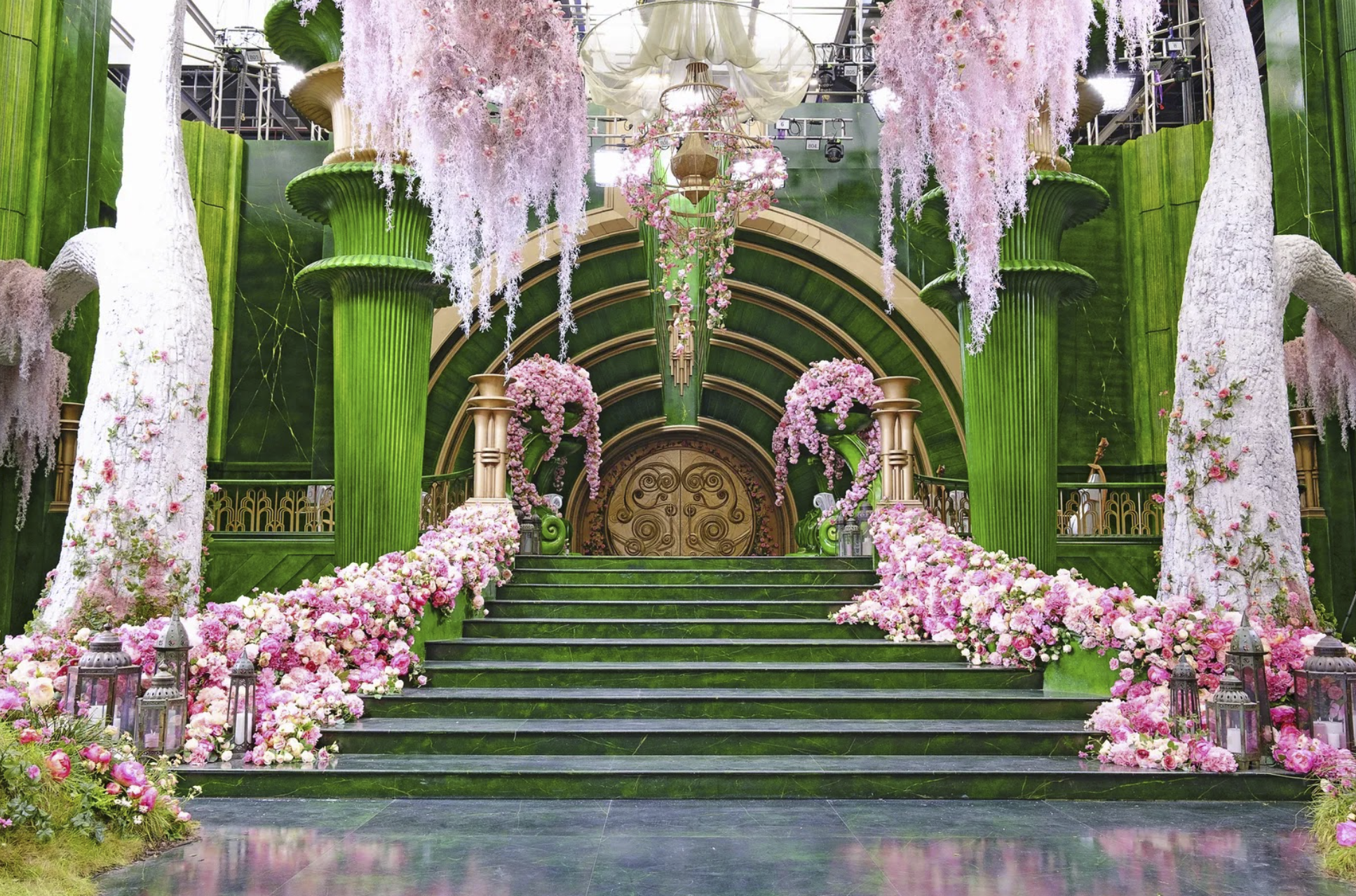
The Emerald City set was adorned with pink and white embellishments for Glinda’s wedding scene. Courtesy of Architectural Digest.
Where Wicked: For Good really shone, however, was within the detailed sets of Elphaba’s hideout and castle that took my breath away. Built out of an intricate network of 3D-printed leaves and branches, Elphaba’s retreat in the forest was filled with tiny add-ons like spice jars, posters, and wooden tools that made the environment pleasing to the eye—and a romping ground for easter eggs. Likewise, Kiamo Ko Castle was constructed of blue brick that foreshadowed the witches’ somber farewell and, as Crowley told Elle Decor, resembled the deep hue of the monkeys’ wings.
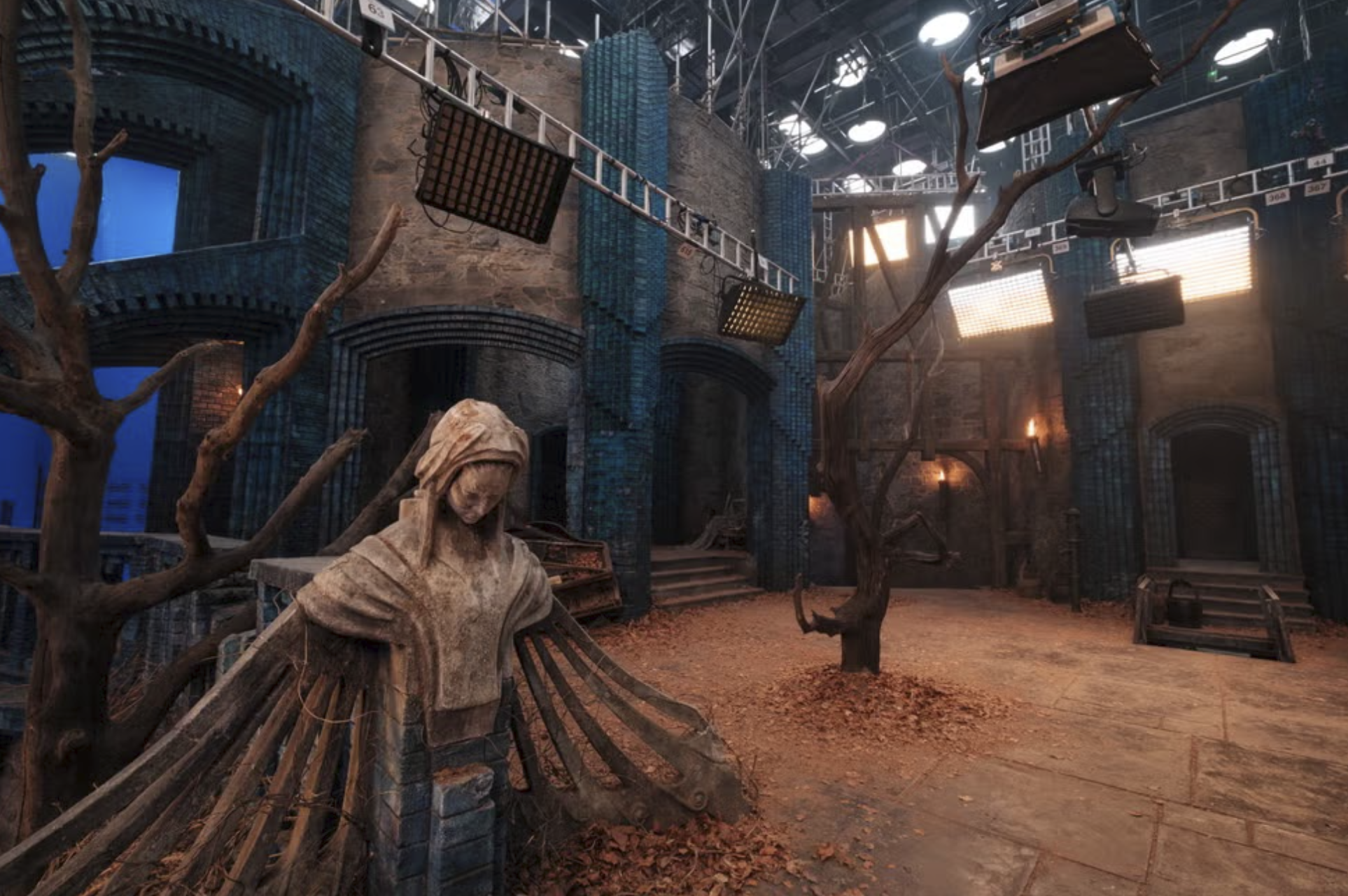
Kiamo Ko Castle contained a mix of blue brick and granite that gave the set an aged touch. Courtesy of Elle Decor.
At the same time, I felt that the film’s costume design was not as show-stopping as it could have been. Though costume designer Paul Tazewell defied gravity with Erivo’s cloak and dress, Goldblum’s gilded coat, and the verdant outfits of the Emerald City’s citizens, there were notable costumes that were sorely lacking.
Some of Yeoh’s dresses, along with Grande’s main gown, appeared uncharacteristically tacky. Depicted below, these frocks were covered in plastic sequins and simplistic designs that exuded cheapness over regality.
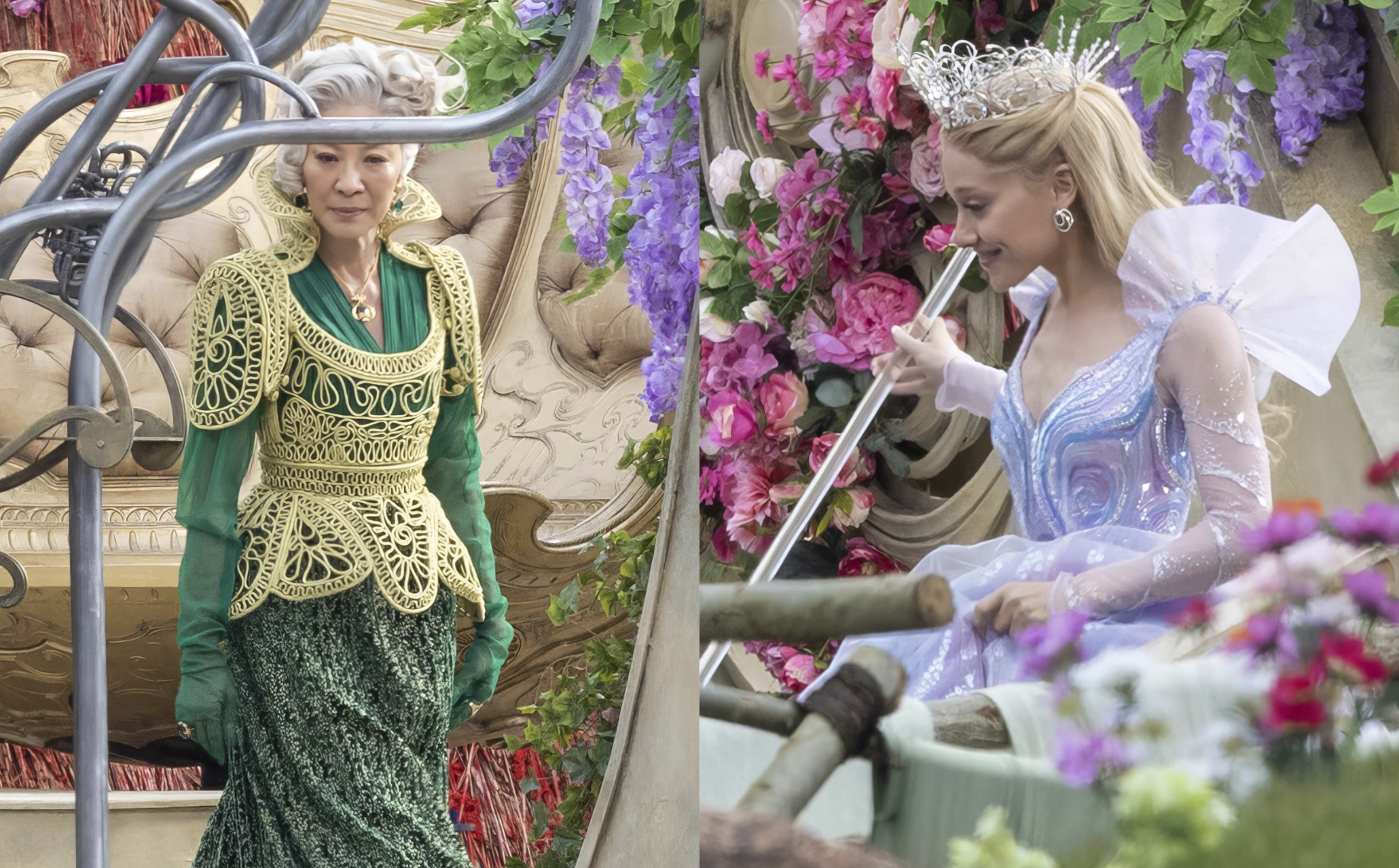
A couple disappointing looks worn by Yeoh and Grande in “Wicked: For Good.” Courtesy of Splash.
That said, Tazewell, as interviewed by Vogue, was tasked with the difficult work of constructing costumes for (spoiler alert) Bailey as the Scarecrow and Slater as the Tin Man. With these costumes, he aimed “to reflect the original Baum book,” in reference to L. Frank Baum’s The Wizard of Oz. Tazewell met the mark, fitting both actors with practical outfits that harked back to their counterparts in the original novel nostalgically.
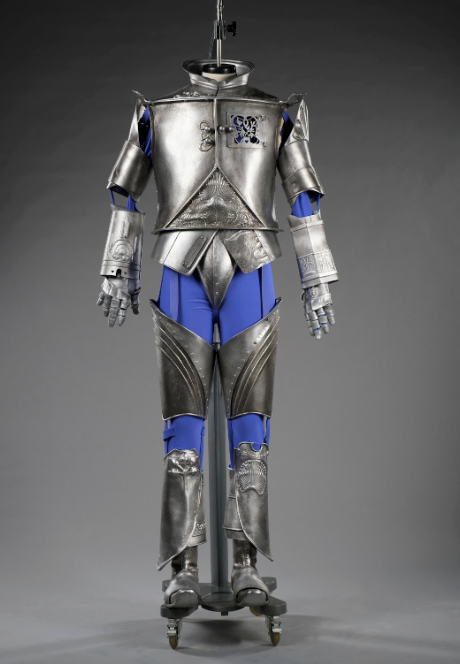
Tazewell designed a realistic, metallic costume to be worn by the Tin Man with minimal special effects. Courtesy of Vogue.
Overall, in the realm of set and costume design, I grant the movie musical 7 out of 10 broomsticks for incredible set pieces and inconsistently good costuming.
Changed For the Better or For the Worse?
And now, for the moment when all your dreams come true. All things, both good and wicked considered, Wicked: For Good receives 32 out of 40 broomsticks for an overall rating of 80%. While the film stunned with mostly phenomenal performances from its main cast, excellent cinematography, and breathtaking sets, aspects such as Yeoh’s singing and acting, gray color grading, and crude costuming should not go unpunished.
Nevertheless, for the avid filmgoers out there, I would still highly recommend viewing Wicked’s second part before it leaves theaters for good. Maybe I’m brainless, maybe I’m wise, but I couldn’t be humbler to admit that I’m limited, and this review should be taken with a grain of (pink) salt. At the end of the day, though the movie was, I admit, the tiniest bit unlike I anticipated, who can say if you’ll be changed for the better until you watch it yourself?