
The illusion of love in Bridgerton
By Prisha Garg ‘26
Courtesy of Zoe Jognston.
When Bridgerton first premiered, it felt like a fairy tale. There were lavish dresses, elegant balls, and lots of scandalous romances in Regency-era London. But beneath all those glittery gowns and swoon-worthy love stories, this show tells a story that hits closer to home than you might expect.
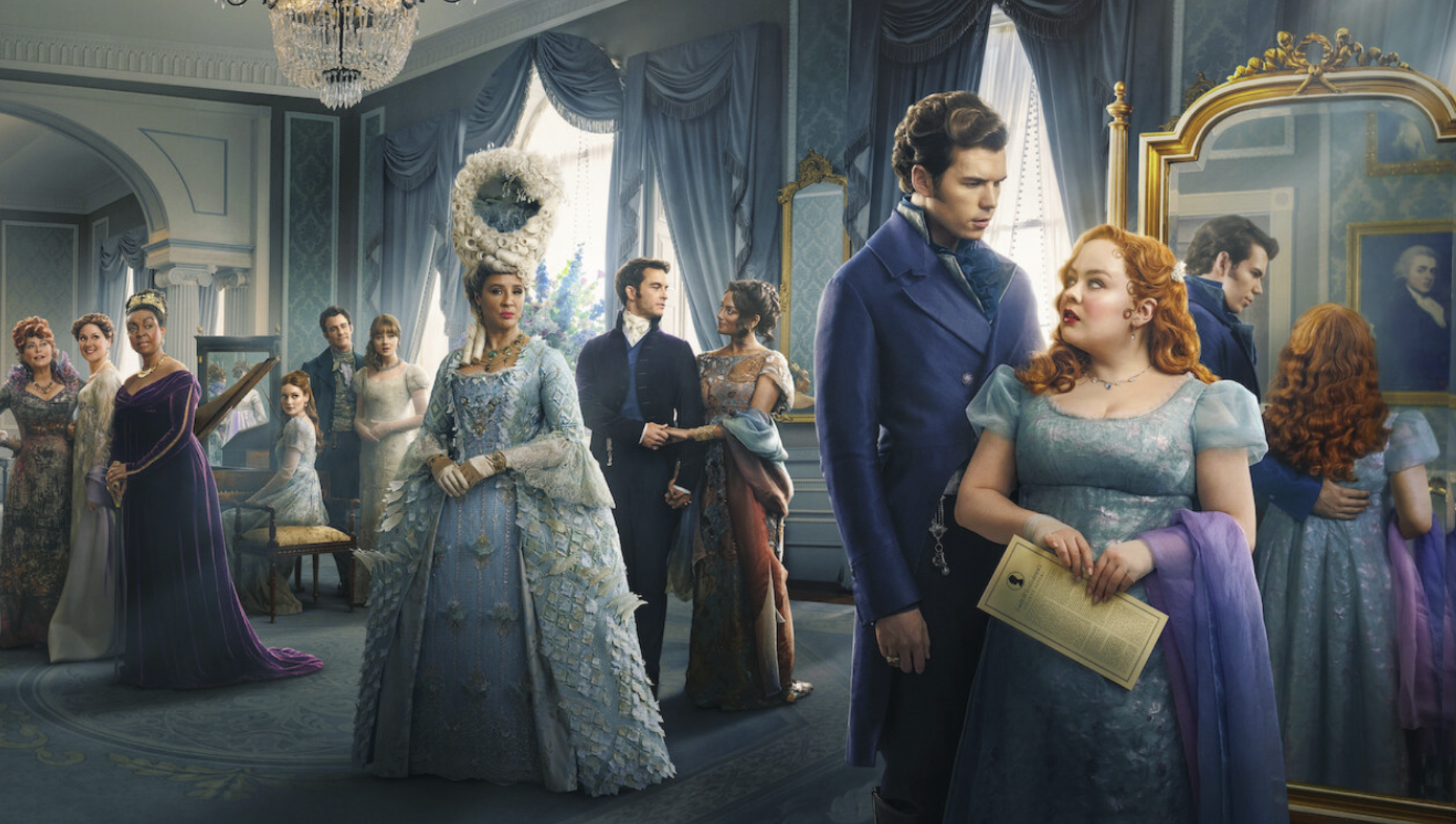
To provide some context for those unfamiliar, Bridgerton started in 2020 and features many popular actors such as Nicola Coughlan, Jonathan Bailey, Simone Ashley, and Luke Newton. The show follows the wealthy Bridgerton family as each sibling enters London’s high society in search of a spouse, with each season focusing on a different character.
Even if you’ve never watched Bridgerton, you’ve probably heard or seen clips of it: perfectly styled hair, dramatic slow-burning romances, and people staring at each other across the ballroom for suspiciously long times. Taking it for face value, it feels like just another fun show to watch on a weekend with your friends and laugh and fawn over the romances. Everything is so polished, and it presents a romanticized version of Regency-era London where everything is beautiful, and everyone somehow ends up finding their soulmate.
While this may sound simple, the process is anything but. Marriage in Bridgerton is not just about love; it is deeply tied to status and reputation. Bridgerton uses its romantic storylines to reflect deeper issues of image, gender roles, and societal pressures that still exist today.
Overseeing everything is Lady Whistledown, an anonymous gossip writer whose publications have the power to shape public opinion and ruin lives. Her precedence reinforces one of the show’s central ideas: in the world, perception matters more than truth.
But once you look past the surface, Bridgerton becomes something much more complex.
Across all four of its current seasons, Bridgerton explores the pressures of social expectation, the weight of one's reputation, the upholding of gender roles, and the complicated laws of life. Many of these pressures feel all too modern.
Season 1 follows Daphne Bridgerton and the Duke of Hastings. Their story is more than a romance; it's a commentary on marriage as a contract. Their initial courtship is staged to manipulate public perception, immediately showing that relationships in this society are shaped less by genuine connection and more by external expectations.
When Daphne is discovered alone with the Duke in a garden during a ball, she is forced into marriage, not because of her own desire but because her reputation has been compromised. As Hadley Cress ‘27 (an avid Bridgerton enthusiast) explained, “If you do something, it reflects on all your siblings; scandal is a big deal.” In this sense, the show highlights how individual actions are never truly individual; they carry consequences for entire families, reinforcing a system where women, in particular, are judged based on how well they uphold societal standards.
The Duchess of Hastings may be glamorous, but her love story exposes the rigid expectations placed on women: marry well, maintain appearances, and prioritize duty over desire.
Gossip is especially prevalent, whispered through Lady Whistledown's pointy pen, and wields more power than any character’s personal feelings, showing just how much public opinion can dictate personal choices.
Season 2 shifts to Anthony Bridgerton and Kate Sharma, highlighting the tension between personal duty and happiness. Anthony is not simply choosing between love and indifference; he is trying to balance his personal happiness and the expectations placed upon him as the head of his family, which underscores the restrictive nature of masculinity and inherited responsibility. His character reveals that while men in this society have more freedom than women, they are still constrained by responsibility and tradition.
Kate, meanwhile, represents rebellion. She challenges the norms imposed on her, while showing that rebellion does come at a personal cost, as her lack of financial security makes her defiance risky.
Amanda Perez ‘26 noted that while she appreciates Kate for initially resisting societal expectations, her character ultimately shifts from independence “to becoming boy-obsessed.” This transition highlights the limits of rebellion in Bridgerton’s world. Even those who challenge social norms are gradually pulled back into them, suggesting that conformity is not always a choice but a necessity for survival and acceptance within the Ton (another name for English society).
This contrast between Anthony and Kate emphasizes that while everyone is affected by societal expectations, those without wealth or status face far greater limitations.
This idea becomes even more pronounced when looking beyond the Bridgertons themselves, particularly at their neighbors, the Featherington family. Characters like the lady of the house, Portia Featherington, and her daughter, Penelope Featherington, offer a much more realistic perspective on the society the show portrays. Unlike the Bridgertons, who have the privilege to prioritize love, the Featheringtons are focused on survival.
Portia's constant scheming is a response to the system that offers her few alternatives. Without wealth or status, marriage becomes a necessity rather than a choice. Cress mentioned how “[The show shows] a difference in wealth… and a class system that shows how people are looked down on.”
This class divide is central to understanding the show, as it reveals that the freedom to choose love is itself a form of privilege.
Penelope’s storyline in Season 3 further complicates this dynamic. As Lady Whistledown, she operates as both an outsider and an insider, controlling the very system that marginalizes her. Her double life reflects a society obsessed with appearances, where those who are overlooked often find alternative ways to assert influence.
Her relationship with the third-oldest Bridgerton boy, Colin, is not just a romantic arc but an exploration of her identity. The season suggests that social identity is not defined solely by who one marries, but by how one is perceived and whether one is truly seen.
This aligns with what Cress said when discussing modern parallels, which is that “Rumors spread a lot… and that can really tarnish someone’s reputation.” In both the show and real life, reputation becomes a form of currency, shaping opportunities and relationships alike.
Perez added onto this by saying that on social media, we simply post our highlight clips, which is “not showing our true personality,” and the same is true for Bridgerton; everyone puts on this front that doesn’t reflect their reality.
By the time Season 4 shifts focus again, the tone of the show begins to change. With its more overtly fairy tale elements, particularly in Benedict's storyline, the show leans further into romantic fantasy, with the fourth season being inspired by the story of Cinderella.
Even discussions in media, like commentary from the podcast 2 Black Girls, 1 Rose, a pop culture podcast that recaps and critiques romantic shows, have suggested that this shift toward a more fairy-tale narrative risks simplifying the more critical social commentary that defined the earlier seasons. Yet even within this more idealized narrative, the underlying structures of class, reputation, and expectation remain intact.
The story may appear softer, but the system it operates within has not changed.
What makes Bridgerton so compelling is how closely these dynamics and themes mirror the world we live in today. The fear of public scrutiny, the need to maintain a certain image, and the influence of social hierarchy are all still present today.
Cress mentioned that you can watch it as a love story or dive into its social implications. This duality is precisely what allows the show to resonate with such a wide audience; it functions both as entertainment and as a reflection of ongoing societal issues.
It's easy to sit on your couch and find humor in the idea of a scandal ruining someone’s entire life, but is it really that different now? We see it in cancel culture, gossip, and the prevalence of judgment in general. Except now we don’t have the fancy dresses and elegant balls to attend weekly.
In many ways, the transition from Lady Whistledown’s pamphlets to modern social media is not as drastic as it may seem. Both serve as platforms where information spreads rapidly, often with little regard for its impact on individuals.
The consequences of gossip and public judgment, while perhaps less formally structured today, remain significant. The idea that one’s reputation can be shaped and damaged to a great degree by external narrative and platforms is just as relevant now as it was in the world Bridgerton portrays.
And while the Regency era setting adds sparkle and glamorous dressing to it, those human struggles are still visible. Balancing happiness with societal expectations, finding your voice in a restrictive world, and feeling that pressure to succeed socially and romantically.
Ultimately, Bridgerton is more than a romance drama; it's a social commentary on how deeply society influences personal choices, particularly in matters of love, identity, and power. The show's appeal comes from its ability to reflect the tension between individuality and expectation, while its aesthetics and dramatic love stories also help.
The ballrooms may be gone, and the dresses may be less extravagant, but the pressure to maintain a certain image and live up to social standards has not disappeared. If anything, it has simply taken new forms. And that is what makes Bridgerton feel less like a distant fantasy and more like a mirror that reflects not just the past, but the present as well.