
What the 2025 “Denim Ad Debacle” really says about polarizing gender dynamics.
By Maddie Snyder ‘26
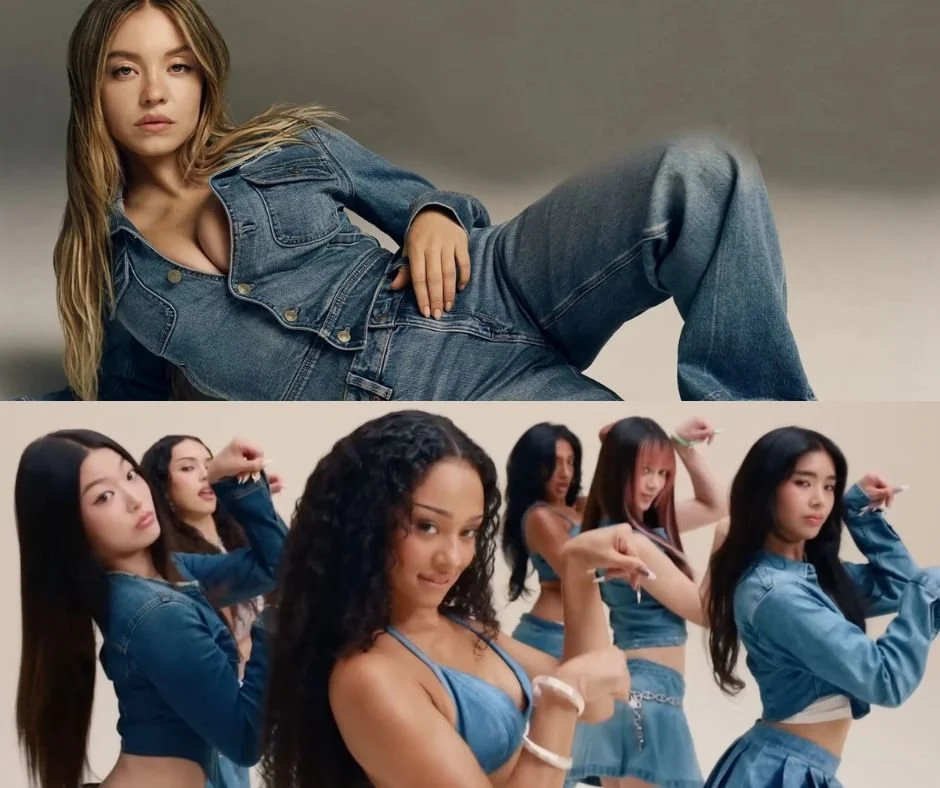
Top: Sydney Sweeney in an image from her American Eagle campaign. Bottom: A screenshot from a Katseye and GAP video advertisement. Image Courtesy of Maddie Snyder ‘26.
If you were on social media last summer, you probably saw one of the many videos contributing to a swarm of conversation around something we wear every day: jeans.
In July 2025, American Eagle Outfitters launched its campaign with actress and model Sydney Sweeney, featuring the tagline, “Sydney Sweeney has good jeans.” The ad faced massive backlash on social media for both the oversexualized nature of the camera shots and the tag line: “Sydney Sweeney has great jeans.” Many called out the campaign’s wordplay on “genes” paired with Sweeney, a white, blonde, and blue-eyed model.
Just a few weeks later, in August, GAP launched its own campaign. Tag line? “Better in Denim.”
Their ad featured a trendy pop girl group called Katseye performing a choreographed routine to “Milkshake” by Kelis. The now Grammy-nominated sextet was assembled by a collaboration between an American and Korean-Pop label and includes members of different ethnicities, including Indian-American, Latino-American, Chinese-Singaporean, Swiss-Ghanian, Filipino, and Korean.
With the backlash from American Eagle’s campaign still ongoing, social media went crazy for Gap’s ad featuring a diverse group of girls just having fun, feeling confident, and doing splits in denim. The two marketing moments were instantly pitted against each other, creating a pop culture internet feud that brought major publicity to both sides.
The attention the American Eagles’ campaign received raises the question: Is all publicity really good publicity? By the end of the summer, American Eagle’s stock had soared by 30%, but their in-store visits were down by 9%. According to a survey referenced in a Forbes article, “39% of young women and 42% of Democrats said the ads made them less likely to buy American Eagle jeans.”
There are those on both sides of the political aisle whose preferred denim store was not affected by the advertisements, but the boost GAP received is undeniable. The ad racked up 500+ million views, drove up comparable sales by 7%, and generated 1.7 million USD off media engagement alone.
Although the online debate generated much publicity for both companies, the direct competition and comparison probably were not intended. GAP didn’t plan, choreograph, and shoot their campaign in the month following Sweeney’s controversy, and whether American Eagle meant for the ad to be a dog whistle is up for debate.
But the truth is, no matter the intent or lack of sensitivity, the jean ad controversy in the summer of 2025 is a prime example of an escalating, divisive gender climate.
An article from Forbes observed that “It’s clearly left-leaning consumers that are objecting to the campaign. And given the ascendancy of the right in our politics right now, avoiding American Eagle is one way consumers can exercise power when they are feeling powerless.”
Most of that powerless feeling among young women stems from the results and insights from the 2024 presidential election. Gen-Z was once hailed as the new, progressive generation, but the 2024 election proved that young people are not a monolith, especially when it comes to gender divides.
The current administration’s efforts to get rid of diversity and inclusion programs, coupled with support for Trump, despite his former comments about women, are also making women feel increasingly disrespected. Even at the start of the 2024 election, before Joe Biden receded from the race, young women supported him by 28 points. Men of the same age supported Donald Trump by 11 points.
Media coverage after the election was over called this demographic of young conservative Gen-Z male voters the “bro” vote. When Kamala Harris pulled an overwhelming majority of support from young women, Trump’s campaign focused on young male voters. In the end, Trump's attendance at sports games and UFC fights, speaking on conservative podcasts like Joe Rogan, appealed to the “Alpha-Male” toxic masculinity already growing in many young men, drawing in voters that were critical for his campaign’s success.
Amidst the ongoing Male Loneliness Epidemic, partially caused by societal expectations that men suppress emotion, conservative patriarchal values that give meaning to a man’s life by putting them on top of the social structure become more appealing. But even as the rise of those beliefs shows up in phenomena like the trad-wife trend, many young women continue to reject it instead.
The combination of social and economic pressures is why movements like the 4B Movement are finding a new home in the United States. The 4B movement originated in South Korea, an OECD country with the largest gender pay gap over the past 30 years. The “B” in the name stands for the Korean words Bihon (no marriage), Bichulsan (no childbirth), Biyeonae (no dating), and bisekseu (no sex).
It’s a feminist movement that calls for women to separate themselves entirely from men and the patriarchy that doesn’t seem to serve them. After Trump’s victory and the overturning of Roe v. Wade, it’s caught traction in the United States on social media. One 36-year-old woman explained to CNN in November of 2024, “We have pandered and begged for men’s safety and done all the things that we were supposed to, and they still hate us.”
In addition to an increasing sense of social inequality, there is an economic context to this issue as well. 2025 marked the second consecutive year the gender gap in income worsened, increasing from 17.3 percent in 2023 to 19.1 percent. If the United States sustains this same rate of growth, women won’t achieve pay equity until 2071.
Although the 4B movement serves as a more extreme example, the general desire to be separate from men and the male gaze has grown among young women in the past year.
It’s been popping up in new social media trends like Vogue author Chanté Joseph discussed in her opinion called “Is having a boyfriend embarrassing?”, in statistics like the US fertility rate being at a record low of 1.6, and most definitely in pop culture.
The Katseye campaign, truly, wasn't something GAP had done before. The clothing outlet has been running campaigns promoting self-confidence in denim for decades now. It’s not their messaging that changed to create the massive boost they saw, but instead the audience itself that has shifted.
So, for anyone still wondering: No, it wasn't just jean ads.
It was a case study in a shift towards a more divisive political gender climate and a showing of an increasing frustration among young women with a societal and economic position they feel constricting around them.