
How Catlin Gabel’s administration is responding to AI in the classroom
By Joshua Chun ‘27
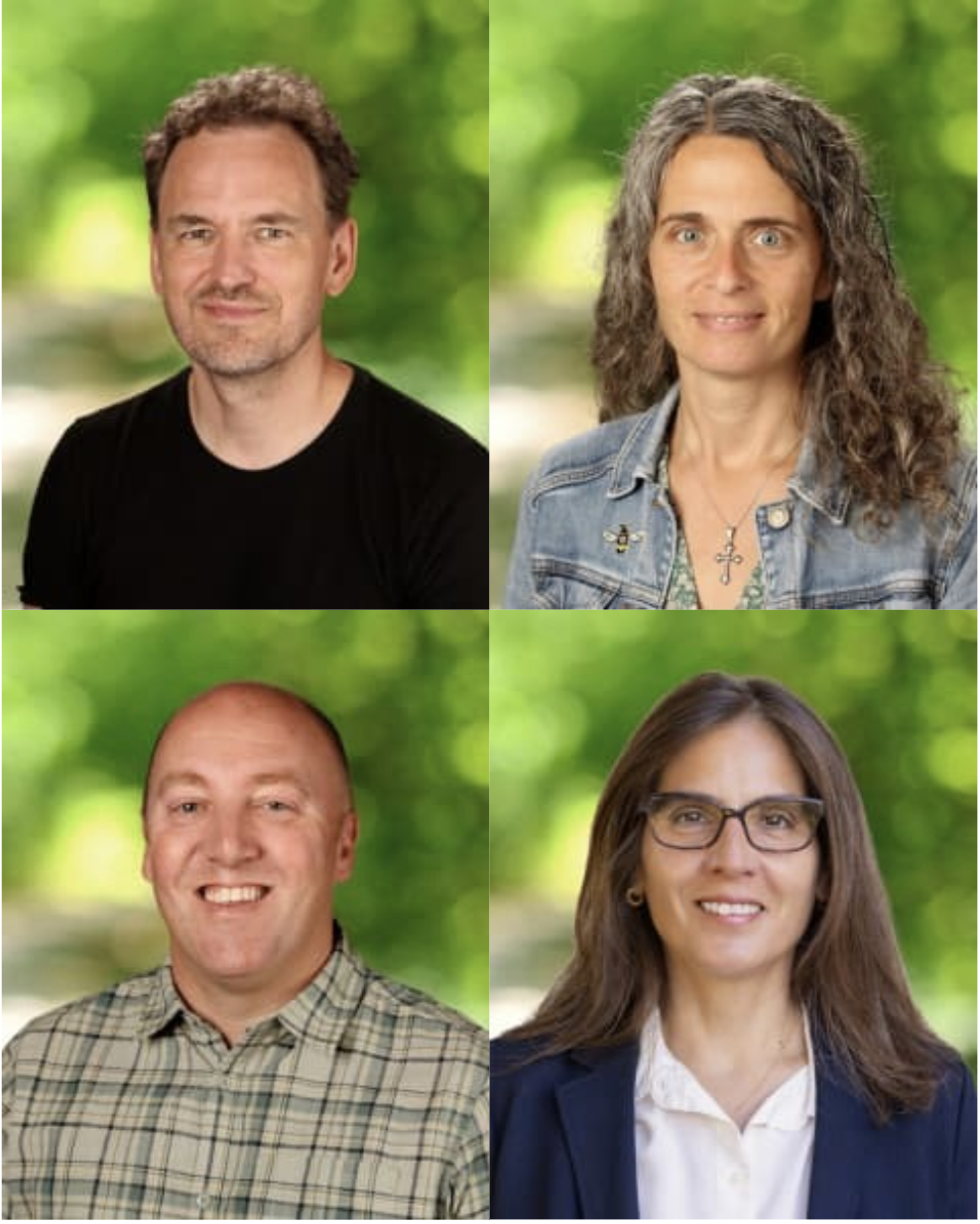
Clockwise from top left: Rob van Nood, Shannon Rush, Derek Kanarek, and Aline García-Rubio. Images courtesy of Catlin Gabel directory.
In 2023, Catlin Gabel School (CGS) formed an “AI task force” composed of CGS Administrators and faculty members with technical expertise. Their goal was to learn more about Large Language Models (LLMs), more commonly known as artificial intelligence (AI), evaluate the pros and cons of its presence at CGS, and to begin the early stages of deciding official school rules about it.
Rob van Nood, the Instructional Technologist at CGS, was a founding member of the task force. According to him, the task force “didn’t really want to set policy…because [they] knew how fast things were changing.” As such, early conversations were less about deciding hard policies, and more about “best practices primarily to support faculty and students.”
While the task force was largely dissolved by the start of the 2026-27 school year, van Nood has continued to research AI and how it could be used to help or harm students.
He brought up the concept of “cognitive offloading,” where somebody could make an AI model do most of their difficult mental work for them. As van Nood put it, “school is about the friction of things that are complicated, and if you take all those complicated things away, you’re not really learning the skills that you would need.”
This sentiment was echoed by Shannon Rush, the Upper School Academic Dean. She stated that relying on AI can be especially disruptive to the process of learning certain skills for the first time.
“When you are a novice learner, and you offload some of the cognitive process with AI, it can shortcut your learning,” she said, “so you don’t actually develop the skills that you are aiming to develop.”
Understanding this, CGS administration decided to prevent students from freely using AI. According to the Upper School Community Expectations, “the use of generative AI tools is prohibited on any assignments and submitted work unless specifically approved by your teacher.”
However, Derek Kanarek, Head of the Upper School, stated that CGS administration was open to allowing teachers to use AI in a very limited capacity. He claimed that “supporting teachers’ innovation was something that we always committed to doing as a school.”
Regardless of how faculty members choose to use AI in a classroom setting, there are certain stipulations that they are bound to both by CGS policy and Oregon law, such as not disclosing any sensitive information from CGS community members to AI models.
Aline García-Rubio, Head of CGS, had similar thoughts to Kanarek on the matter. She believes that AI “may augment what teachers are able to do by facilitating some of the tasks that teachers use tedious time doing.” However, her and her fellow administrators are also committed to avoiding using AI to replace the work of teachers. “When I think about teacher use, I think about ‘is the work of teachers still the work of the teachers?’” she said.
Prior to returning to CGS, García-Rubio was the Associate Head of School at Oregon Episcopal School (OES), another local private school and CGS’s historic rival. At OES, she helped draft guidelines around AI use. She stated that, because of her work at OES, she believes that she “understand[s] the guidance that students and teachers need, as it relates to AI.”
Three years ago, García-Rubio took it upon herself to learn as much as she could about AI, and to think about how it could apply to schools. She does not consider herself an expert, but is committed to learning as much as she can to better guide her peers and students. When describing her learning process, she said “I pretty much read or listen or watch videos about AI every day…and I have gone deep in thinking about education, as it relates to AI.”
She wishes for CGS as a whole to be mindful of the various ethical concerns raised by using AI. Among these, she mentioned the environmental impact of data centers required to run AI models. She said that “in terms of environmental impact, I think of data centers, and what is powering data centers, and who is impacted by the fact that these exist.”
Kanarek agreed that considering the environmental impacts of AI use were important. However, he believes that the negative repercussions are not as serious as some may believe. He stated that, “when it comes to Gemini or ChatGPT creating text, based on everything I’ve read, the overall resources…that are used are quite, quite small.”
In addition to discussing the matter with faculty and administrators, Kanarek also wishes to include student voice in the decision making process. In an interview, he brought up the open letter about AI use by teachers written by a group of students in March of 2026 Because of it, he says that the decision making process around AI has been “about more open discussion with students and having different listening sessions.”
Despite the reservations that CGS administrators have with AI, they still believe that it is important to teach students about it. According to Rush, CGS wants to ensure that students are informed about AI so that they can engage in conversations about it in the future. “In order to be an informed citizen…I hope that all of our students know what [AI] is, how it works, what are the concerns, so that they can be actively in conversation with communities.”
While many of these conversations are still ongoing, there are some choices that CGS Administration is ready to move forward on. Recently, a 22-page document was shared with CGS teachers that contained guidelines around acceptable uses of AI for teachers and students.
According to the document, Upper School students and teachers will learn about how Large Language Models (LLMs) work and the considerations that come with it, such as water usage and potential biases. Additionally, teachers are guided to “assume that Upper School students use AI independently outside of school work and often for school work.” The document also adds that, while some courses may be taught about or with AI, “the student remains the primary thinker.”
Administrators have poured large amounts of time and care into thinking about AI’s place at CGS. They have balanced the many considerations that they see as coming with AI, and have engaged in dialogue with faculty and students. While they have come to some conclusions at present, they expect that their stances will need to change as AI models continue to advance.
Regardless of how AI models continue to change, CGS administrators are wholly committed to the wellbeing of the school and its students. They are steadfast in prioritizing the education and preparation of their students for the future.