
How Portland organizations are responding to food insecurity
By Priya Klein ‘26

Courtesy of Hayley Schaaf ‘26.
When the U.S. government shut down in October 2025, uncertainty about the Supplemental Nutrition Assistance Program (SNAP) skyrocketed, organizations and individuals across Portland stepped up and found their own unique ways of combatting food insecurity and supporting their communities.
On October 1st, the United States would begin its longest government shutdown yet, putting tight restrictions on government funds and services until the shutdown was resolved. Among these restricted services was SNAP, a federally funded and state-administered food assistance program, crucially providing low-income families and individuals with financial assistance to buy food.
The SNAP plays a major role in keeping Americans fed and healthy, providing assistance to 1 in 8 Americans. “SNAP lifts families out of poverty, reduces food insecurity, and lowers health care costs,” said Sara Beich, a professor of public policy at the Harvard T.H. Chan School of Public Health.
The U.S. Department of Agriculture, which administers the SNAP, maintains a contingency fund, reserved for providing resources during emergencies or natural disasters. Though it was expected that this fund would be used to continue SNAP benefits during the government shutdown, the Trump Administration initially declared that it would not tap into this fund.
Countless lawsuits brought by over two dozen states would eventually lead to the restoration of most SNAP benefits by mid-November. But the month and a half where SNAP recipients were left in limbo, wondering when and if their benefits would return, worsened already dire food insecurity across the country.
Uncertainty surrounding food accessibility has been especially pronounced in Oregon. Over 750,000 Oregonians did not receive their SNAP benefits at the end of October, more than half of whom were elderly, children, and people with disabilities. This delay in benefits puts pressure on other public health services, as a loss of aid in turn has residual effects that threaten the economic stability of families across Oregon.
Even before the shutdown, food insecurity in Oregon had been steadily on the rise for years. In 2024, the Oregon Food Bank Network saw 2.5 million visits to food assistance sites—a record number of visits. Across Oregon, more than 1,200 markets, pantries, and meal sites work to combat this growing threat of food insecurity.
In the Albina neighborhood of Northeast Portland, the Northeast Emergency Food Program operates as a shopping-style pantry where families can select food that matches their dietary and cultural needs. With the help of community volunteers, they serve roughly 5,000 families each month.
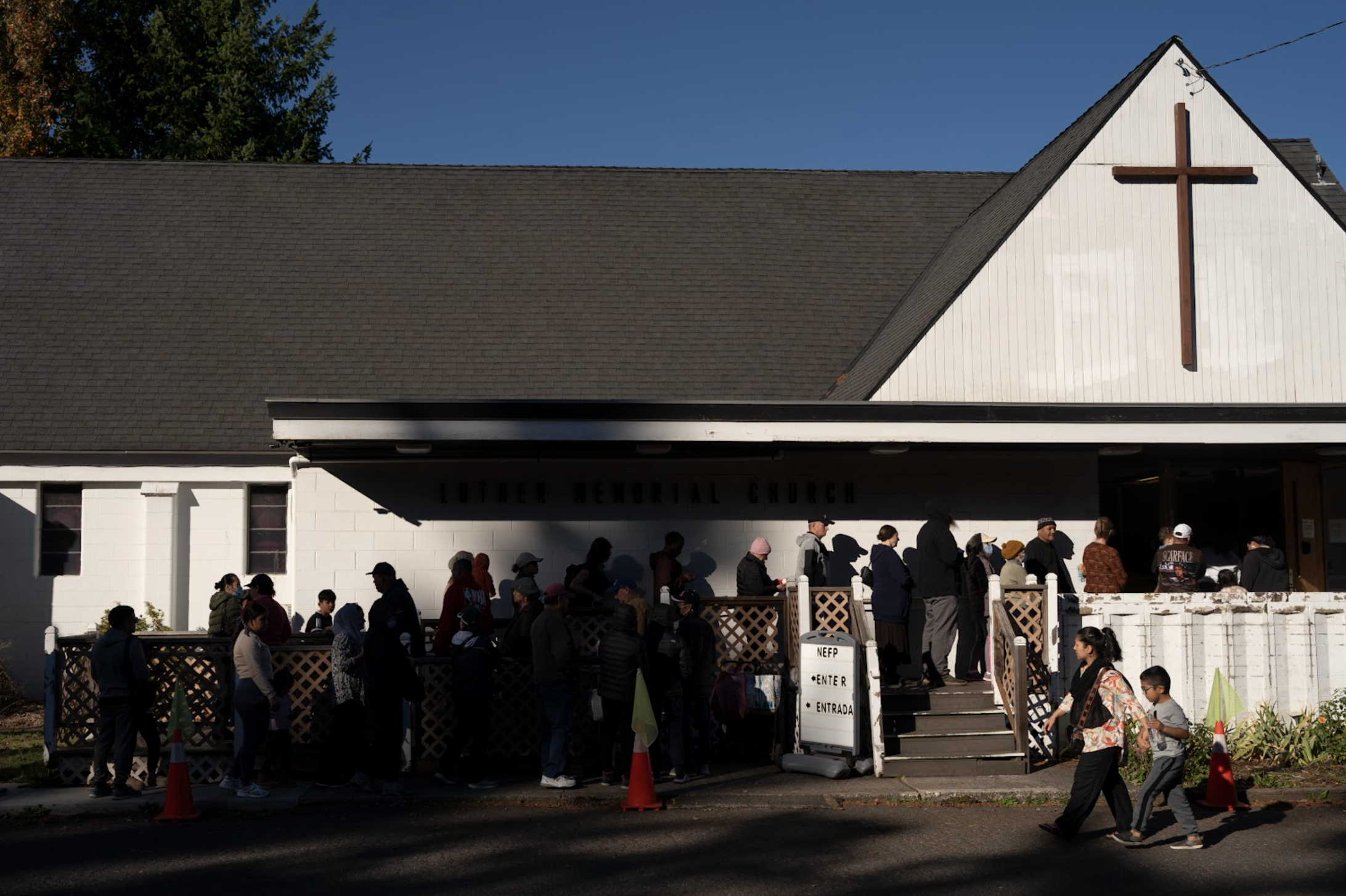
Line to get food in front of Northeast Emergency Food Program food bank on Tuesday, October 21st, 2025. Courtesy of Eli Imadali at OPB.
Jon Makler, the pantry's program director, noticed a significant increase in visitors after SNAP benefits were cut in October. The pantry went from serving 900 visitors per week to roughly 1,200.
Makler identified the housing crisis in Portland as a primary factor driving food insecurity. “If someone comes to the pantry every week for a month, they might save $1,000 on groceries,” said Makler. “That's going to be money that they can use [for housing and other needs].”
Across Portland, local businesses have taken it upon themselves to fight food insecurity in the tri-county area, offering free meals to Electronic Benefit Transfer (EBT) cardholders or free food items to passersby. While most accommodations were started in response to SNAP cuts, many have continued to provide assistance even after the government reopened.
For example, Mirisata, a vegan Sri Lankan restaurant located in Southeast Portland, began offering free community bowls to anybody who presents an EBT card after noticing a distinct lack of affordable vegan options in the area. “The idea that people in our community are going hungry is not something that we wanted to allow to happen—even if it's only a few dozen people who we could help,” said co-owner Alex Felsinger.
Before SNAP benefits were restored, the restaurant served about 200 community bowls to patrons in need. Noticing the overwhelmingly positive response from the community, Mirisata decided to continue offering free or subsidized meals on a sliding scale, meaning that prices are dependent on how much someone is able to pay.
For some small business owners, the fight for food assistance was a personal one. Cyndi-Lynne Reynolds, who co-operates Hawaiian bakery Ō and Kō in Gresham with her husband, noted that she grew up on food assistance and emphasized the significance of community support throughout her childhood. “It was always nice to have other people in our lives and in our community that helped us out when we needed it,” Reynolds said.
The couple set out a community table in front of their store, stocked with dry foods and household items that passersby could pick up—no questions asked. Quickly, the local community joined in, with individuals donating items to the table themselves.
Supporting the community is also a driving factor for BBQ restaurant Miss Delta in Northeast Portland, which began offering free po’boy sandwiches to anyone with an EBT card when SNAP benefits were cut. “I felt drawn to do it because the community in this neighborhood really supports us—and so we thought we'd give back,” said owner Marcus Oliver.
The community response was substantial, with the restaurant serving roughly 600 meals after they announced the meal option. They decided to extend their offering to January 1st, citing that there’s still uncertainty about SNAP benefits and explaining that they wanted to help out through the holiday season.
If you’re interested in supporting these businesses or other businesses that offered free community meal options during the shutdown, I recommend visiting this list of resources from Portland Community College.
At Catlin Gabel, a similar urgency was felt when the government shut down. Upper School Librarian Sue Phillips and Upper School Social Studies Teacher Patrick Walsh started a food drive in the Upper School, collecting dry food items and hygiene products.
The two, aware of the CGS community’s privileged circumstances, recognized that it was time for the community to get involved. “I felt like there was a lot of pent-up desire to help our neighbors,” said Walsh.
Soon after announcing the drive, the community started to step in. Upper School student Ian Wiltz ‘27 took it upon himself to buy $630 worth of food and hygiene items using his own money to donate to the food drive. “I found it hard to sit around as someone privileged enough not to be affected by this,” said Wiltz. “My mentality was if I am in a place where I can provide this for people, why not?”
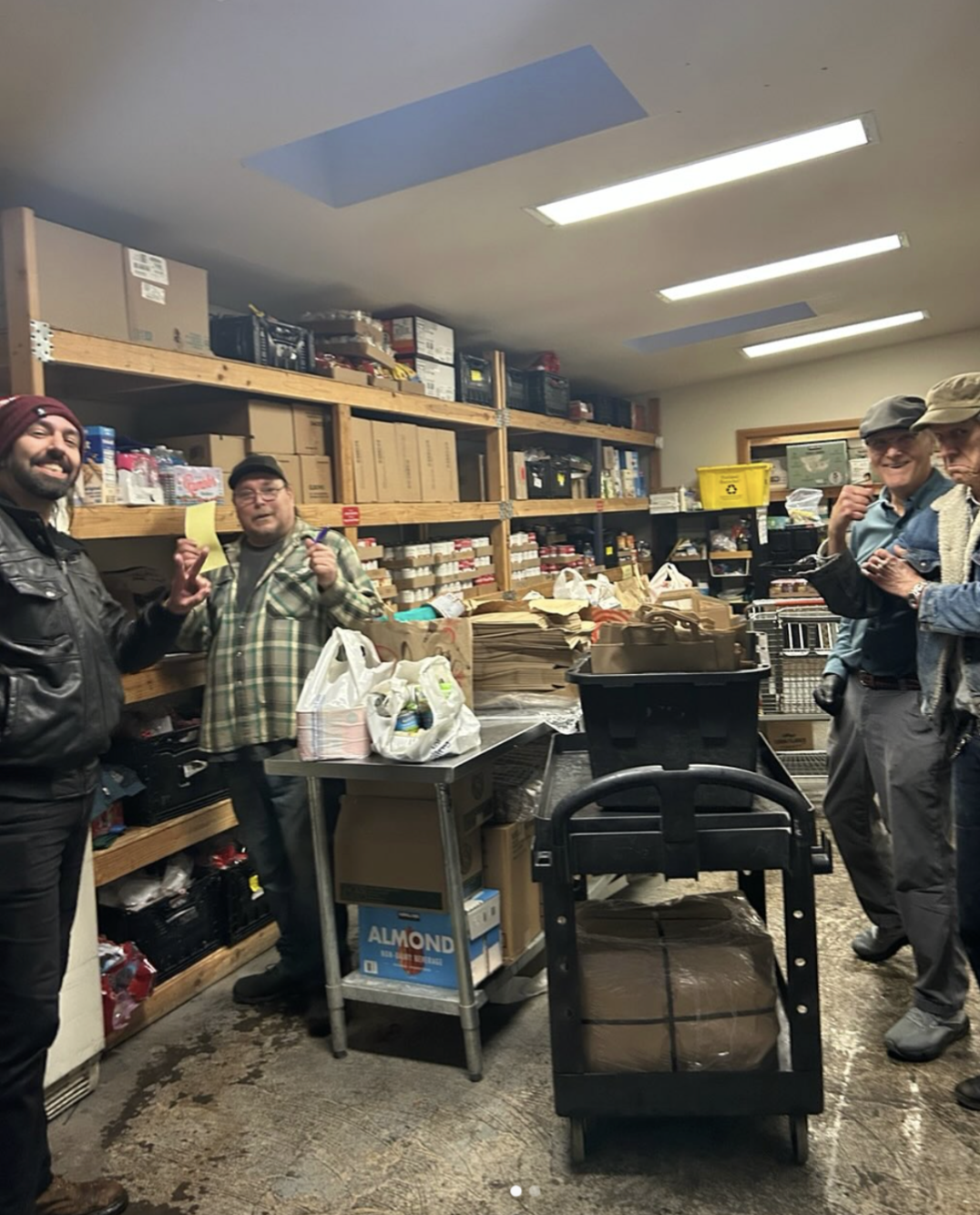
Workers at the Neighborhood House receiving items from the CGS food drive. Photo by Patrick Walsh.
In the end, the drive collected 1,610 pounds of food to donate to the Neighborhood House, far more than Phillips and Walsh had initially expected. “After being here for 22 years, a moment like this just makes me so happy and so glad to be part of this community,” Phillips said.
Across Portland, organizations and individuals like these are finding unique ways to support their neighbors and combat growing food insecurity. By lending support to those most vulnerable, they are fostering stronger connections within the local community.