
Less scrolling, more schooling: Inside Catlin Gabel’s new Opal phone policy

Image Courtesy of Opal.
Administrators at Catlin Gabel School (CGS) are rolling out a completely new way to regulate phone use during school hours. This has sparked intense discussion among students about not just phone use but also privacy, Artificial Intelligence (AI), and the power of students' voices.
Opal is an app designed to limit phone use and increase social engagement during the school day. It’s customizable for independent users, and you can collect gems as rewards for certain accomplishments, such as being off your phone for a certain number of hours.
Dean of Students John Harnetiaux sent an email on March 11, 2026, asking for 35 students to pilot Opal. "The goal of the app is to take an educational, non-draconian approach to managing phone use on campus,” Harnetiaux summarized in the email, “aiming for the middle ground between an all-out phone ban and a total free-for-all.”
According to Shannon Rush, the Academic Dean, Harnetiaux was the first administrator to hear about Opal, and spoke to the independent Harvard Westlake school in Los Angeles early in the process. During an interview, Rush emphasized the importance of finding “a much better middle ground that allowed people to make choices [and] think about their choices, without it being [a] lockdown.” An example of a “lockdown" might be something like secure fabric bags equipped with magnetic locks, called Yondr pouches.
This choice came after administrators decided the current policy– a gaming ban and “cell motels” on the door– was too lenient and caused “in some cases, [an] adversarial relationship between teacher and student,” claimed Rush. She further explained that when the first thing teachers tell their students is to put their phone away, it prevents other, more positive connections.
CGS will utilize “Opal for Schools”, a program designed for all students and controlled by administrators. When installed on a phone, “Opal for Schools” blocks certain apps for a scheduled time period, preventing students from accessing gaming apps, shopping apps, social media, and more during the school day.
After summer break, one of the first assemblies of the 2026-27 school year was about Opal. Head of Upper School Derek Kanarek, Rush, and Harnetiaux all emphasized the importance of community on campus. Harnetiaux used Global Education trips as an example, claiming that he saw happier and more engaged students without their phones, especially on the trip he took to Japan.
In October of 2026, Kanarek sent an email to the Upper School student body confirming that Opal will be enacted. He followed with another email sharing the date and time of an upcoming info session on Opal.
The session felt more like a debate than a civil discussion, with students demanding answers about privacy, AI, and culture at CGS. The majority of students who attended strongly opposed Opal and insisted that the decision to implement it be revoked.
Among the many students who disagree with Opal for a variety of reasons, Semra Tesfu, a sophomore at CGS, was interviewed.
She is against Opal as a whole, and believes that our current “cell motel” system is a perfect in-between. “It's not like a Yondr pouch,” says Tesfu, “but it's also not installing something like a third-party software in your phone.”
Her main concern with Opal is privacy. When she first heard about Opal, she didn’t even ask herself why it was getting implemented, but was more worried about a third-party app getting downloaded onto her phone.
When asked about the phone use crisis, Tesfu agreed it is a problem but claimed Administrators didn’t fully understand it. She zeroed in on the point Harnetiaux made about global education trips. “On a global trip, you leave behind all your responsibilities, everything,” argued Tesfu, “So…I don't think leaving behind your phone…symbolize[s] turning off social media.”
Another student who strongly opposes Opal is senior Brandon Harad.
He presented screenshots of Opal's marketing and website, which particularly alarmed him. One image had the claim “Social media causes ADHD,” which was advertising Opal to neurodivergent people.
Harad then showed the study cited on the website, which shows a correlation, but “obviously it’s not causal,” he says. “People with ADHD have a greater likelihood to get lost in doomscrolling.” In other words, many people who struggle with pulling themselves out of social media have ADHD and other neurodevelopmental disorders, not the other way around.
Now that a certain decision about CGS’ usage of Opal has been made, Rush added, “the next really key place for student voice is for students to help us think about if it's effective or not.” Rush hopes that once students try it, “they'll realize it isn't that big a deal.”
The plan, according to Rush, is as follows: Administrators will give students a fortnight to download Opal. This grace period is to help out students with parental controls installed on their phones. After that, they will give students a chance to try out Opal and decide if they want to keep it or do the alternative: turn in their phone to Administrative Coordinator Alexis Doling every day. “[Students] wanted a chance to try it before they committed,” explained Rush.
When students discovered that Opal for schools didn’t have a privacy policy, they immediately spoke to Administrators, who agreed that one was needed to move forward. “Our students' questions really pushed us to push the company to provide us with more updated information for the schools,” said Rush.
In response, a survey was sent out to understand the CGS student body’s perspectives on Opal. The survey asked questions on support, productivity, and concerns about the upcoming policy.
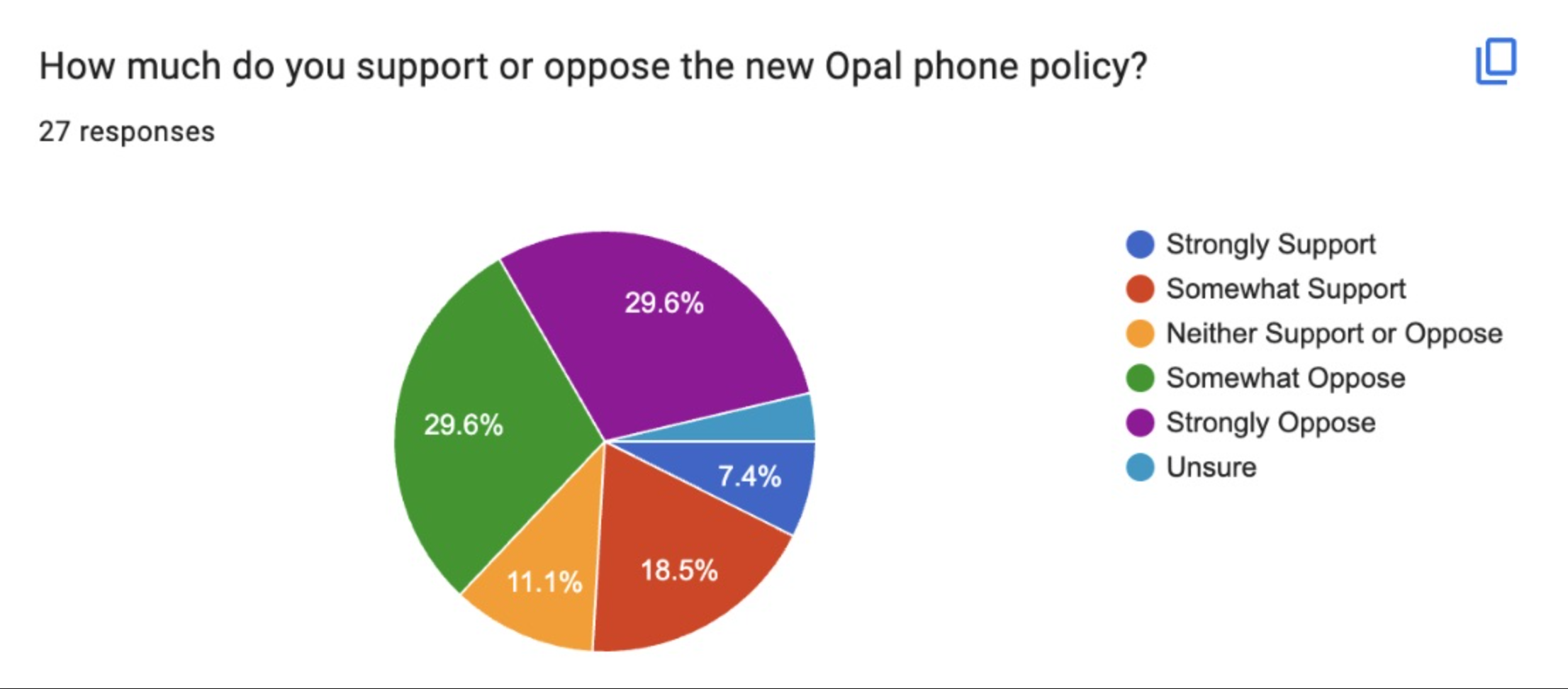
Results based on a survey of 27 students, conducted in October 2026. This pie chart presents student opinion on the newly introduced Opal phone policy. Survey results by Nelle Harris and Olivia Oreste, 2026.
When survey participants were asked how much they support or oppose the new Opal phone policy, 59.2% expressed either strong or slight opposition to CGS’s introduction of Opal.
In addition, 48.1% had concerns about the policy. When explaining their choice, some trends were concerns about privacy, Opal’s use of AI, and their parents further monitoring their online activity.
The majority believed that Opal wouldn’t help their productivity during school hours. Several students claimed that they wouldn’t need Opal, as they already manage their screen time effectively.
When asked if they would prefer Yondr pouches over the Opal policy, 55.6% selected that they supported Opal more. Some elaborated that this was because it felt much more extreme than the Opal policy.
Digging deeper into positive opinions, many students support Opal at CGS, and many already use Opal on their phones. Opal has become part of senior Hadley Cress’ daily life. After being part of the pilot last spring, Cress decided Opal was right for her.
“I think it makes total sense that schools should be trying to find ways to get kids off their screens,” said Cress. She emphasized the Upper School environment a few years ago, claiming that “you would walk into the Dant lounges and everybody's just sitting on their computer,” she said. “Like, that sucks.”
Cress also heavily prefers Opal over the alternative: turning in your phone every day to Doling. She needs her phone for checking the time, texting home, getting into her car, and using Google Maps.
Junior Maia González González also supports the administrators' decision. There are two main factors that influenced how she feels. First, she’s considered the alternatives at other schools, like Yondr pouches and complete bans. “[Opal] is a very chill rule compared to any other rules that I have heard.”
Second, “we're in a time where we're so constantly addicted to our phones,” said González González. To her, administrators have to move beyond the current policy, and Opal seems like the best solution.
Overall, the CGS Upper School student body has a wide range of opinions. Some are vehemently against Opal, both the company itself and its implementation. Others support Opal and are confident it will increase productivity and reduce phone use.
In addition to this, it is important to understand how CGS’s upcoming Opal phone policy compares with policies at other Portland schools. Students from Saint Mary’s Academy, Ida B. Wells High School, Lincoln High School, Jesuit High School and Oregon Episcopal School (OES) were interviewed about their experiences and opinions.
A Saint Mary’s Academy senior shared that students put their phones in their locker during the majority of the school day, except during lunch and last period.
After being informed about Opal, she shared, “I don’t really know how the app is going to help, because I feel like people might find ways around it,” suggesting get-arounds, such as installing Opal on an old cell phone. After reflecting, she deduced that she preferred Saint Marys’ phone policy over Opal.
Afterwards, juniors from Ida B. Wells High School and Lincoln High School were asked about their phone policies. At these schools, Yondr pouches are used to store mobile devices during the entirety of the school day. This is due to an executive order implemented in late 2025 by the Governor of Oregon, Tina Kotek, which prohibited all cell phone use within Portland Public Schools (PPS).
When asked about their opinions on the PPS phone policy, both students expressed their discontentment with Yondr pouches. This was because of components like cost, bulkiness, and inefficiency. As well, both reported seeing various students finding ways to unlock Yondr pouches during school hours.
Regarding Opal, the Ida B. Wells student commented, “I don’t like it at all, it seems invasive,” showing concerns about privacy, ultimately coming to the conclusion that he would like to have neither Opal nor Yondr pouches applied at his school. However, the Lincoln student emphasized that she would very much prefer Opal to be implemented over Yondr pouches.
Two seniors from Jesuit High School and OES were also interviewed. By chance, both of these schools have similar “off and away” policies, where students are expected to silence their phones and keep them in their bag the whole school day.
When asked for his perspective on Opal, the Jesuit student remarked that the app seemed “pretty good”, just as long as “you're able to stay in communication with your friends and family in case of an emergency.”
The OES and Jesuit students both voiced privacy concerns, settling that they would not install Opal over their “off and away” policies. However, the Jesuit student shared that he would be open to Opal being added to Jesuit’s policy.
In all, most students from other Portland schools preferred their current phone policy over CGS’s proposed Opal policy, except for one voice from Lincoln. However, some students did appear to be open to Opal being tested or even implemented at their school, despite minimal concerns for privacy. Many intriguing perspectives on CGS’s new policy were provided by these students.
CGS students/admin and PPS students agree that excessive phone use is a serious problem among teens. However, the friction starts when discussing a solution. Instead of arguing about whether or not Opal is ethical or useful, conversations should be about searching for a creative solution to an issue everyone can agree on: Screens are addictive, and we need to use them less.