
OPINION: Art is far more than a pleasurable pastime
By Meret Pajkic ‘26
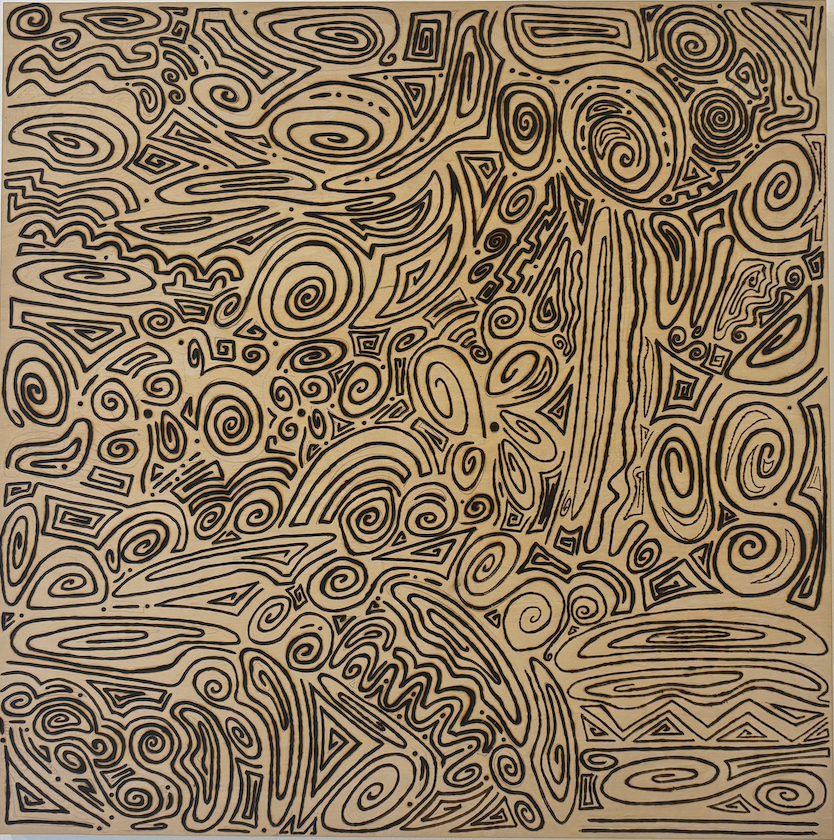
Woodburning piece by Meret Pajkic ‘26. Courtesy of Meret Pajkic ‘26
Humans have been expressing themselves creatively for millennia. Whether it be figurative or abstract art, the process of creation has evolved alongside the human race until the present day.
From a time before verbal language became universal, when hand-prints were found in caves over 50 thousand years ago, to the likenesses created by Frida Kahlo, a consistent theme remains: humans turn to art when they quite literally fail to find the words.
This reality prompts me to question: Why do we as a species continue to make art? What is there to gain?
However, it is important to preface that this piece will focus only on why it is beneficial to create tactical art. This is not to say other art forms do not benefit those who create them. I am inclined to believe it is quite the opposite, but as a tactile artist myself, who has been drawing alongside my father for as long as I can remember, my particular fondness has been and will most likely remain in the visual arts.
Every time I create, I am filled with a calmness that settles my nerves and grounds me during even the most stressful of days. It is a time I cherish due to the fulfillment I feel seeing my vision for a piece materialize on paper, canvas, or wood. Through conversations with classmates and family members, I have come to realise that this phenomenon is not a unique experience.
Subconsciously, I believe that I have always understood art to be beneficial for my mental health. My goal is to put words to a sensation that often remains woven through a brush stroke or etched in a rubber stamp.
The process of creation goes beyond being a purely enjoyable pastime. As Christianne Strang, a professor of neuroscience at the University of Alabama, Birmingham, notes, “Creativity in and of itself is important for remaining healthy, remaining connected to yourself and connected to the world."
Now, let’s unpack the benefits:
It helps you imagine a more hopeful future.
Art prompts a person to use their imagination, which researcher Girija Kaimal, a professor in the PhD program in Creative Arts Therapies at Drexel University, believes is one of the main reasons our species has been making art since the cave ages. Our imaginations serve an evolutionary purpose, a purpose which art furthers by helping a person “navigate problems that might arise in the future.”
Kaimal’s theory is based on the understanding that the brain is a "predictive machine,” which makes decisions on what a person might do next and, most importantly, how that decision relates to their survival. She continues to say that making art prepares a person “to imagine possibilities and hopefully survive those possibilities," hence why making art can help a person think more positively of their future.
2. It activates the reward center of our brain – ultimately making you happier.
Although many budding artists might initially be overwhelmed by the vastness of possibilities that come with making art, studies have shown that “engaging in any sort of visual expression results in the reward pathway in the brain being activated.”
Kaimal found this to be true after conducting a study, which was published in The Arts in Psychotherapy. In the study, she and fellow researchers “measured blood flow to the brain's reward center, the medial prefrontal cortex” as 26 participants “completed three art activities: coloring in a mandala, doodling, and drawing freely on a blank sheet of paper.”
The results found that all participants experienced an increase in blood flow to the prefrontal cortex while making art. This, in short, demonstrates that art makes a person feel good and is therefore a pleasant experience, no matter the skill level; saying you are bad at art is not an excuse.
3. It lowers stress.
Art has been clinically proven to lower stress levels. During a study, researchers found that even 45 minutes spent creating art “in a studio setting with an art therapist significantly lowered cortisol levels.”
Clinical psychologist Dr. Anne Samson explains that when the brain is “left to its own devices and free to roam while doing an art project, the brain will seek to pull life experiences and balance perspective.” She continues by saying that “a fully accessed brain, and hands, and/or feet in motion while creating any type of art helps create healing, balanced thinking, and emotions.”
These benefits emerged no matter a person’s skill level; the health outcomes remain the same for experienced artists vs. people who identify as novices. Plainly, art makes a person feel good.
4. It lets you focus deeply.
The creation of art induces what is commonly called the flow state. “The sense of losing yourself” and “losing all awareness,” in Kaimal’s words.
But what is actually happening to a person’s brain when they reach flow state?
Making art activates many networks, such as a “reflected state, focused attention to task, and sense of pleasure.” Specifically, a 2018 study from the journal Frontiers in Psychology found that flow was distinguished as being increased theta wave activity within the frontal areas of the brain, alongside “moderate alpha wave activities in the frontal and central areas.”
In conclusion, by making art, humans can reach a state of flow in which they are fully immersed in their work, allowing for intense, fulfilling concentration and reduced self-consciousness.
5. It helps many people express themselves without having to use words.
For example, throughout Samson’s time as a clinical psychologist, she used art therapy as a means of helping patients during sessions. One of these patients was a young 5-year-old boy who came to therapy due to consistently being angry at school.
Samson turned to art as a means of helping the boy verbalize the root causes of his anger. The boy created a large monster with huge claws and feet that had the ability to kick down a school. Even though this drawing initially prompted Samson to think that the boy had been bullied, he later explained that he was, in fact, the monster.
Over time, as the boy's anger subsided and he identified his feelings and generated solutions, the monsters he drew shrank in size until they disappeared from his drawings completely. In the end, it turned out that he felt understimulated at school, causing him to feel trapped, a conclusion that would have been much more difficult to discover without having had the opportunity to turn to art when expressing himself verbally was difficult.
Concerning this experience, Samson says that “participating in art work projects in a safe, secure environment often brings out some walled-off fears, anger, grief, that can then be addressed, and patients often feel a sense of great relief to know what was ‘behind’ their feelings.” This is a testament to the power of art in allowing a person to express themselves, no matter their circumstances or verbal blocks.
Art is a powerful tool for good. Luckily, along with being mentally advantageous, it is also easily accessible for those who want to reap its benefits. In its simplest form, all one would need to create art is a pen and paper or possibly even less – our ancestors in the cave ages used a rock canvas and natural pigments such as charcoal.
However, Catlin Gabel School (CGS) offers resources far more vast than simply paper and pens, with the Creative Art Center (CAC) filled to the brim with art supplies. From printmaking to wood burning, art is an important element in the CGS community.
CGS art teacher Chris Mateer reiterates this point, noting the importance of just having “some time to decompress or relax,” while making art. This reality was a core reason he and Charlie Grant, CGS counselor, began a recent art initiative at the school.
“I wanted to provide a space where people can come and make art and be creative and connect,” Mateer recalls. Mateer and Grant hold the space every Monday to create on campus during CoCu’s A and B.
As famed painter Pablo Picasso said, "Art washes away from the soul the dust of everyday life." And so, I implore you to begin making art. Even if it is just a small doodle for a short amount of time, I guarantee you will experience the advantages that making art provides.