
REVIEW: The CG Players take on ‘Hadestown’
By Priya Klein ‘26
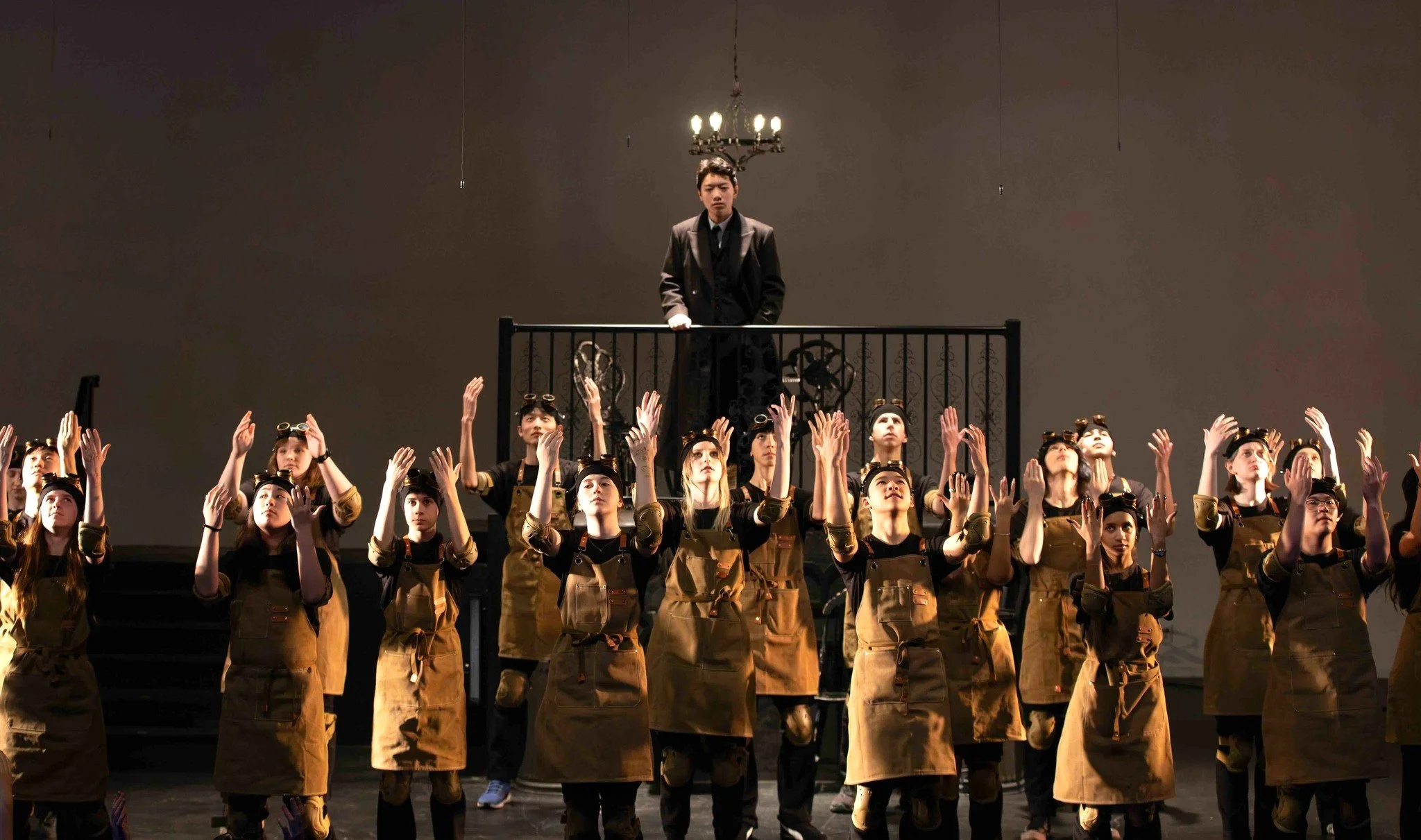
Lucas Zhang ‘28 as ruler of the underground Hades and his workers in ‘Hadestown’ on February 27th, 2026. Courtesy of Catlin Gabel.
CG Players’ new production of the Hadestown musical debuted on Friday, February 27th at Cabell Theater, offering audiences a visual treat and a new take on the elaborate epic.
The story is perhaps as simple as a Greek myth can be: in an overworld that is plagued with bad weather and famine, naïve musician, Orpheus (Alex Wyspianski ‘28), falls in love with the practical Eurydice (Isabel Doogan ‘26) and proposes to her, promising that his new melody can bring back the spring and good fortune.
Driven by financial worry, Eurydice descends to underground factory Hadestown after overhearing its owner, Hades (Lucas Zhang ‘28), promise economic prosperity and protection, ignoring the warnings of the tycoon’s stressed-out lover, Persephone (Elise Steinauer ‘27), who describes the never-ending labor for workers.
Throughout the production, Hermes (Mira Herman ‘26), narrator and mentor to Orpheus, guides the musician on his quest to find and save Eurydice from Hadestown while the Fates (functioning as a Greek chorus) serve to challenge all of the main leads on their decisions.
Written in 2006 by Anaïs Mitchell, Hadestown eventually found itself on Broadway by 2016, garnering immense acclaim. Its positive reception from critics and audiences alike eventually led to a teen edition in 2024, a full-length adaptation of the original musical with modifications for family audiences. Finally, it has found its way to the stage of Cabell Theater, where the artists of the CG Players are performing it as their annual winter musical.
On the surface, Hadestown imagines Greek mythology through a lens of sociopolitical and environmental anxieties, highlighting contemporary issues like exploitative capitalism. But at its core, it’s a story of hope in the face of inevitable failure; Orpheus tries to change a broken world despite the odds being stacked against him. Through its storytelling, Hadestown is able to communicate timeless lessons of resilience that now, more than ever, resonate with modern audiences and political tensions.
On Friday, the CG Players performed over 20 distinct musical segments with the help of over 50 student performers and technicians. Additionally, the production plays alongside live professional musicians, a feature that’s a first for the winter musical. The production's standout lead performances, sizable cast, and impressive technical execution combined make this one of the CG Players’ most ambitious productions yet.
The story of Hadestown is difficult to follow: grafting two separate ancient myths together, and all in a way that tickles the eardrums just right. Fortunately, Hermes guides the audience through the complex story well — and actress Herman does it even better. Herman is so expressive in both body and voice that it’s impossible to miss what she’s trying to say.
Herman is able to take an otherwise sidelined character and create a strong individualized character through everything she does — from the bright white pantsuit she wears to her gleeful dancing during upbeat musical numbers. Herman is undoubtedly one of the highlights of the show.
Much of Herman’s early narration is focused on introducing the love story between characters Eurydice and Orpheus, two performances that are strong off the bat and continue to hold their own well into the later numbers of the production.
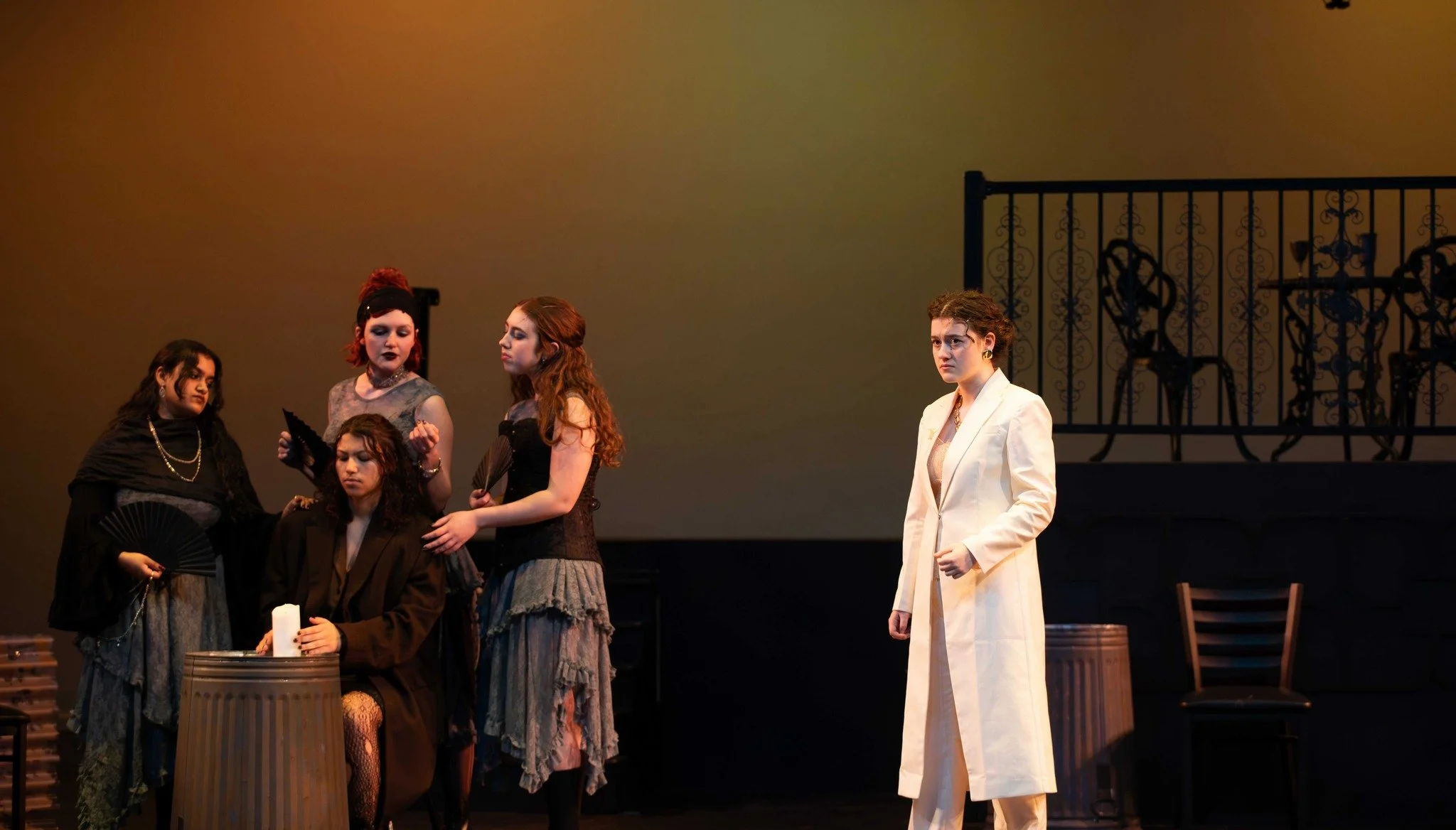
Standing from left: Nivriti Behera ‘26, Scarlett Keys ‘26, and Bel Stenger ‘28 as the Fates, Isabel Doogan ‘26 as Eurydice, and Mira Herman ‘26 as Hermes. Courtesy of Catlin Gabel.
Doogan, who plays Eurydice, is a consistently outstanding performer whose years of experience with the Catlin Gabel School (CGS) theater program is more than present in her depiction of Eurydice. She’s excellent at communicating her character’s complex emotions — a skill that is especially apparent in the later number “Flowers.” With Doogan’s expansive vocal range, this song held an emotional weight that the audience genuinely resonated with, something exemplified by the overwhelming applause afterwards.
Wyspianski, who plays Doogan’s co-lead, is on the other hand, new to CGS theater. Rest assured, he does not make a meek introduction. His especially strong performances in “Chant” and “Wait For Me,” confirm to me that he will be a voice to be reckoned with in the years to come.
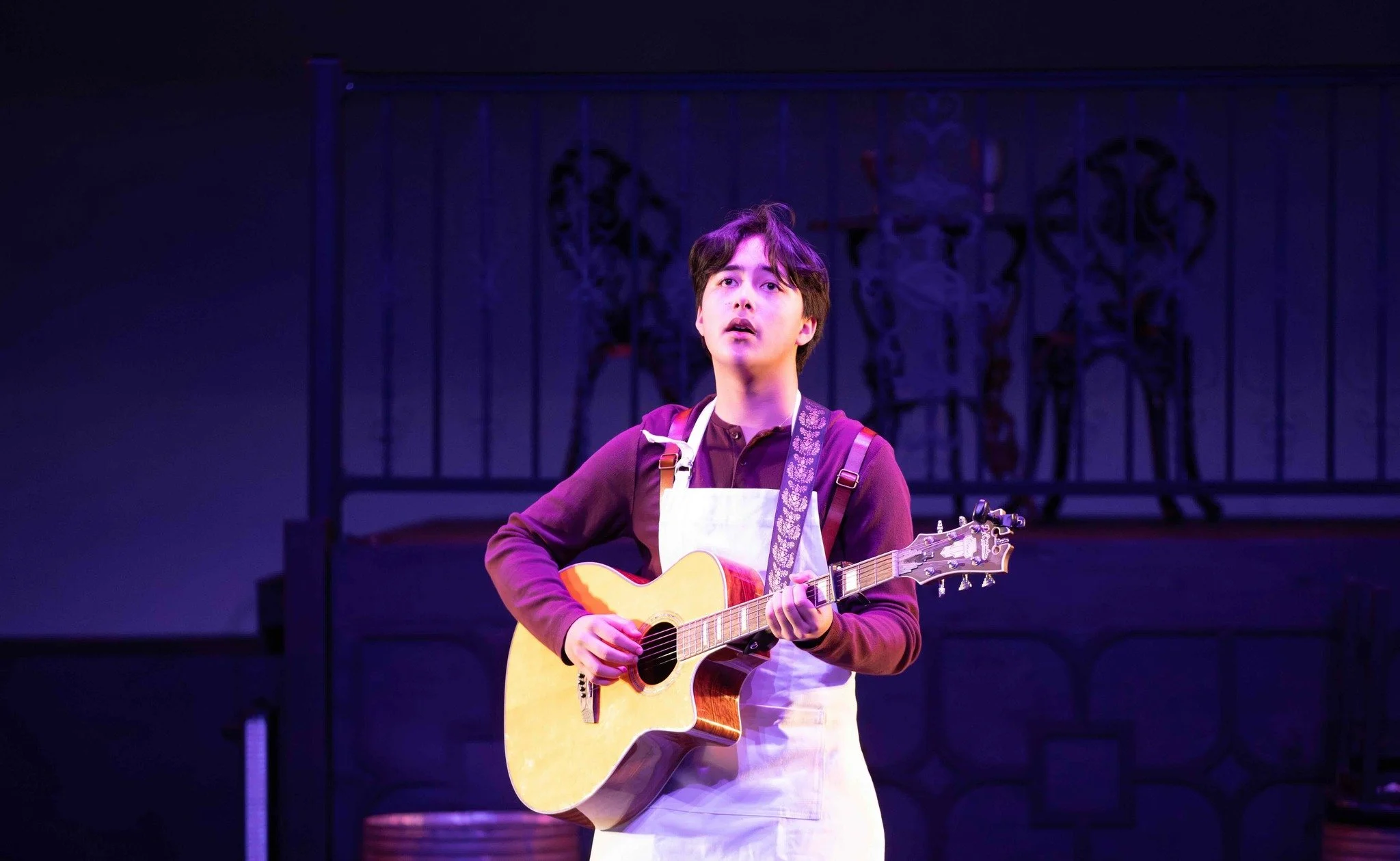
Alex Wyspianski ‘28 as Orpheus. Courtesy of Catlin Gabel.
The workers — often found chanting rhythmic choruses or harmonizing with Wyspianski — make for an interesting collective. Given the sizable number of them, they’re effectively used as a manipulable set piece that the other performers can work around. Their unique arrangements, both on stage and among the crowd, help to visually differentiate scenes.
For many audience members, their choreography — especially in the crowd — was a high point of the production. “The workers doing the same moves in sync made it look interesting visually and it was fun when they came into the audience,” said audience member Amanda Perez ‘26.
They weren’t always in sync in Act I, but generally found their footing by Act II. I’d imagine that moving around on set was difficult given the overwhelming number of them and the limited stage space.
The workers were also commonly found in combination with their boss, played by Zhang, who — and I cannot stress this enough — is so fun to watch. Zhang brings a sort of playfully evil personality and quippy humor to this production that makes the storyline truly compelling.
This charisma is best exemplified in “Hey, Little Songbird” in the way that his character interacts with Eurydice — looming over her shoulder, circling her, and all the while singing such a low melodic tune.
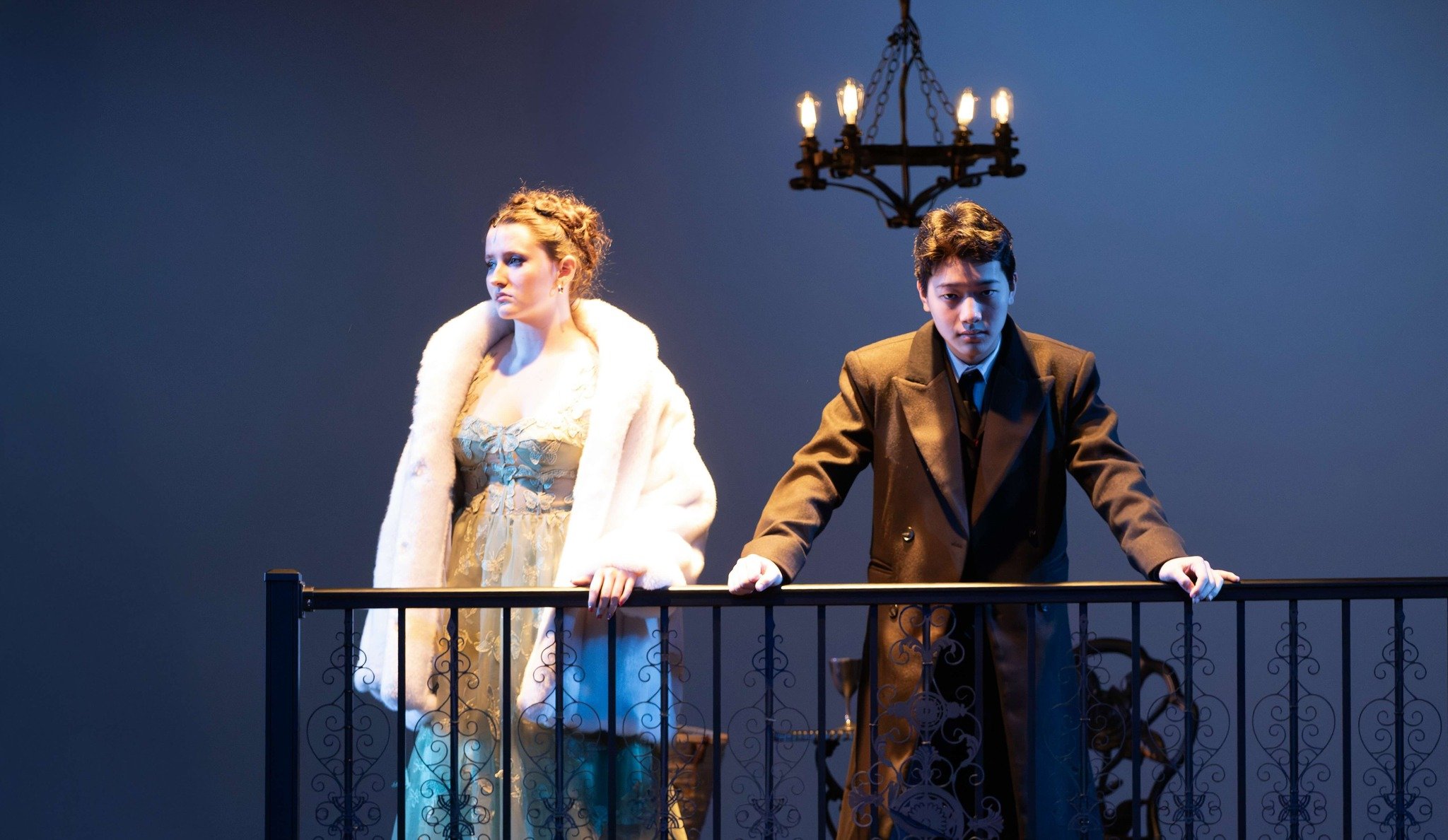
Standing from left: Elise Steinauer ‘27 as Persephone and Lucas Zhang ‘28 as Hades. Courtesy of Catlin Gabel.
His low voice works especially well in combination with the forceful vocals of his counterpart, Steinauer. Steinauer’s contribution to the production, both in vocal heavy lifting and humor, cannot be understated. Her choice of mannerisms and emphasis add a whole new level of nuance and depth to her character, Persephone.
The Fates, played by Nivriti Behera ‘26, Scarlett Keys ‘26, Bel Stenger ‘28, Alina Gungor ‘26, Carlyn Herman ‘28, and Charlotte Garcia ‘29 contributed a soulful and mischievous energy to the production. They shined in the numbers “Way Down Hadestown” and “When the Chips are Down,” capturing a hypnotic quality through their fluid movements and harmonies.
The Fates’ costuming is perhaps the clearest example of the real thought put into the production’s costuming: it’s detailed and highly individualized for each character. “It’s really cool that every single Fate is a little different, but still all very on point,” said audience member Lexi Ye ‘26.
Additionally, many of the characters had multiple costumes, including all of the workers. The costume designers did an excellent job of establishing a cohesive color palette of blacks, grays, and browns.
This theme continues with the surrounding set, a grim industrial factory floor and balcony. At times, the prominent blacks and grays blend in with each other, and some distinct visual details can be lost — but perhaps that’s the point when depicting the eternally gloomy Hadestown.
This issue is, however, cleverly mitigated by the use of colored lighting to distinguish scenes and emotions. I especially liked the decision to leave the Fates backlit at the end of “Wait For Me,” a moment that really made the number stick in the audience’s minds.
The live instrumental backtrack may be the most impressive technical aspect of the production, lending a lively and immersive atmosphere to the entire production. When you can hear the drums, pianos, and saxophones in the background, it really makes the jazz of Hadestown feel all the more enchanting. In the best way possible, you feel like you’re in an underground speakeasy that you’re definitely not cool enough for.
On the other hand, there were a couple of moments towards the end of the production where the sound effects used felt out of place — specifically a glockenspiel. While a minute detail, it was enough to pull me out of the magic for a moment and wonder what that was even meant to represent.
Smaller qualms aside, this production of Hadestown is one of my favorite productions that I’ve seen in recent years and will undoubtedly be remembered favorably by many in the CGS community for its outstanding performance, meticulous production, and live soundtrack.