
OPINION: The performance of having the “right” opinion
By Romy Harad ‘29
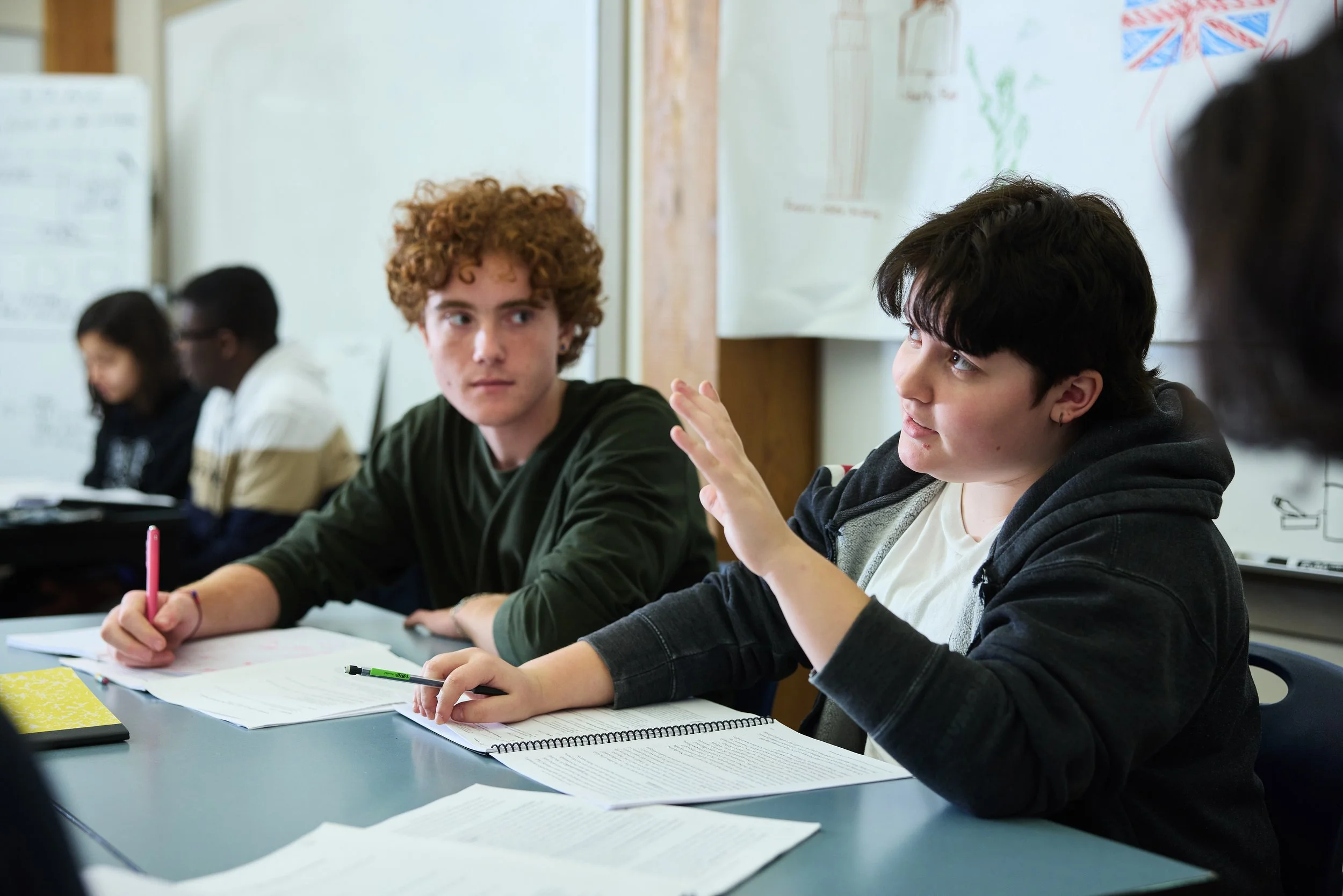
Photo depicting Nico Howlett 25’ (left) and Nick Miner-Winter 25’ (right) engaging in academic discourse. Photo by Hannah Lee, Web and Graphic Designer for Catlin Gabel School (CGS).
I recently partook in a conversation with my peers about current American politics. Shortly after that conversation, one of my friends pulled me aside to tell me she felt like she couldn’t express her true opinions without being shamed, and honestly, I felt the same way. Not just in that particular instance, but within most of my conversations and discourses throughout my social and academic interactions in the Catlin Gabel School (CGS) Upper School.
The pressure to believe the ‘right’ opinion is becoming increasingly common amongst the student body. Because of this, Upper School students at CGS aren’t learning how to respectfully participate in a discussion where there are a variety of opinions and perspectives.
I sent out a survey to 64 randomly chosen CGS students - 16 from each grade - asking about their perception of the political environment within CGS's student body and if they think this environment needs to change. 29 students replied.
Of the 29 responses, more than 50% said that they feel pressure to have a similar opinion to everyone else. More than 95% of them said they think it's productive to have multiple opinions within a discussion.
The sheer amount of students that indicated the same pressure that I had experienced is baffling. This problem is widely recognized, and yet, I haven’t seen any progress being made to mitigate it.
Kei Bernstein, a junior at CGS, sat down for an interview with me to share her perspective of the student consensus.
She expressed that she felt CGS wasn’t a safe space to express opinions that aren’t the most common ones; however, Bernstein noted that “As long as you don’t speak on certain political topics, you’re not pressured to believe a certain way.” This makes me think about the environment we’re living in, and the environment I want to be living in.
I want to be a part of a school that welcomes all opinions and forms of discussion, as long as they’re respectful. It seems that Bernstein shared a similar opinion.
She also outlined how she believes that CGS doesn’t have a diverse political landscape, “I think that since we’re a school that’s very liberal, in a way, it kind of pertains to those voices. So you won’t find people who vote differently or have different opinions here because the majority is like that.” She added, “I know that there are some, but I think it’s primarily just similar viewpoints—mainly Democratic.”
Bernstein’s outlook is that “Multiple perspectives help us prepare for the actual world because, obviously, not everyone has the same opinions elsewhere. So, I think having those different and hard conversations about topics is really important.”
Expanding on this topic, she described CGS’s lack of political diversity as “a bubble of beliefs and opinions.” At CGS, she believes, “if you appear not to know everything about a certain topic, it can seem like your opinion doesn’t matter.”
Bernstein felt deeply that CGS needs to be working to improve this problem. She shared my belief that the CGS student body and faculty needs to be actively fighting these issues. Bernstein called for greater respect for differing beliefs and entreated faculty to make space for difficult political conversations.
Nuri Sahavi, a junior at CGS and one of the leaders of the Political Spectrum Club provided me with his point of view. According to ClubHub, the Political Spectrum Club’s “mission is to increase political engagement. Given the hostility of our current political climate, we leaders believe open-minded political conversation is essential.”
Sahavi noted that, at CGS, he feels like, “There’s a constant feeling that you have to watch what you say and how you express your political beliefs … You can have a conservative belief if you express it in the right way, using terminology that’s more accepted in liberal circles.”
Students should feel encouraged to be loud, real, and true to themselves. While it’s incredibly important to be respectful with your phrasing, we can’t expect teenagers to speak with the specific crafted words that are accepted. One must be able to speak freely.
Sahavi concluded by saying that “It’s about asking questions with genuine curiosity, rather than asking rhetorical questions … Instead, you should try to understand where the other person is coming from, respectfully disagree, and have a discussion because you genuinely want to learn more.”
Jewell Sparks, CGS's Assistant Director of Inclusive Student Programs, told me about how faculty perceives the political climate.
Sparks noticed that “a lot of folks have shared that sometimes they just don’t say anything at all. They don’t share their own beliefs because they want to preserve a friendship.” When I asked her about political hostility towards right leaning students she mentioned that “one thing that [has been] shared [with her by frequent visitors of her office] was that students don’t talk with hostility toward more right-leaning people, but there is hostility toward Trump.”
Sparks agreed that “They feel pressure if they have a belief and they’re not ready to defend that belief. There’s pressure and anxiety around what happens if there’s a disagreement.”
Sparks was very passionate about the importance of diversity of perspectives within discussions, stating, “That’s how we change things in the world. That’s how people grow empathy, and that’s how people grow compassion for one another. That’s how we lean into complexity.”
She remarked that “Students actually need to learn how to listen … following through directly with the person, face-to-face, and actively listening is important … A disagreement doesn’t mean that you’re a bad person. It doesn’t mean that you should be canceled for having an unpopular opinion.”
Diversity of opinions within discussions is widely recognized as a necessary aspect of our education. It’s crucial that the student body actively tries to create an environment where everyone can respectfully share their perspective and receive respect back.
Diverse perspectives shouldn’t be frowned upon, they should be taken as ways to inform your own beliefs. Conformity is not the solution–respect, kindness, and an open-mind are. We are missing out on a crucial part of our education by believing that only one opinion is correct. It’s time that the Upper School student body decided to take control of our future.
I urge you to participate in discussion with an open mind, and receive opinions as ways to continue educating yourself. It’s your turn to take responsibility for your education and community.