
OPINION: Why we should be doing more things out of our comfort zone (Copy)
By Sahana Wood ‘29
Graphic depicting the human brain. Courtesy of rawpixel.
I am, by my own definition, horrible at piano. I can’t sight-read, can barely play with my left hand, and I don’t know the major scales.
So, when I started re-learning piano this July, every part of my perfectionist self was demanding that I quit those classes and never look at the agonizing sheet music of Für Elise again. But, for some reason, I kept with it. Slowly but surely, I began to see the results.
I’m not talking about my actual piano skills – I can still barely play Mary Had a Little Lamb – but I started to see improvements in my overall mental health. I started to focus less on perfectionism in my life, and found that I was giving myself more room to make mistakes.
These positive effects that I described are not just a fluke, but instead highlight a proven link between reduced perfectionism/higher resilience and going out of your comfort zone.
That is why I believe that the students of Catlin Gabel (CGS) should regularly do something out of their comfort zone, because it both reduces perfectionism and builds resilience.
CGS is an academically rigorous and high-performing school, which can often breed a perfectionist environment. A perfectionist environment (also known as a perfectionist climate) is defined by Northumbria University as a climate where “informational cues and goal structures [are] aligned with the view that performances must be perfect, and [that] less than perfect performances are unacceptable.”
A survey was sent out to a total of 60 randomly selected Upper School students, where 25 responses were received. In the survey, students were asked if they agree with the statement that CGS has a perfectionist environment. The majority of those surveyed agreed with the statement, where 44% of the students agree with the statement, and 32% of the students strongly agree with it.
In addition to a perfectionist environment, there is also pressure on students to be good at all their activities (such as academics, extracurriculars, and sports). In the same survey, more than half of the responses rated the pressure they feel a 4 or 5 on a 1-5 scale.
In an interview, Charlie Grant, an Upper School Counselor, seconded this point. He remarked that these pressures can originate from various aspects of CGS’s students’ lives, stating, “I think that those pressures come from a variety of places. Maybe that's home life, maybe that's classwork, maybe that's extracurriculars, maybe that's the pressure of college. There's just a lot for students to think about.”
In an environment of both perfectionism and pressure, student mental health can start to decline.
In a 2024 Politico survey of 1,400 mental health professionals, perfectionist pressures were flagged as a contributor to a decline in teen mental health.
While we may not be able to change the way the CGS student culture views perfectionism, there are specific things that students can do to make sure that the environment doesn’t take a toll on their mental health, such as regularly doing things out of their comfort zone.
According to Select Psychology, a comfort zone is defined as “a psychological state in which you feel at ease, secure, and in control.” The human brain naturally wants to feel safe and in control, so, because of this, people are often hesitant to venture out of their comfort zone.
Although most of us are constantly trying to avoid uncomfortable situations, those situations are necessary for reducing perfectionism and building resilience.
Putting ourselves out of our comfort zone allows us to learn how to navigate life and become more comfortable with being uncomfortable. In my interview with Grant, he reiterated this, stating, “The goal [when going out of your comfort zone] is not to overcome fear. It’s just to be comfortable enough with the fear that you can still operate.”
Unfortunately, there are many situations in life where we can feel uncomfortable and sometimes even fearful. By doing something out of our comfort zone, we build resilience, which provides us with the knowledge of how to handle these uneasy scenarios.
In addition to building resilience, going out of your comfort zone can also reduce perfectionism. In a study from the National Library of Medicine, when individuals were forced to go out of their comfort zone in small and controlled ways, their clinical perfectionism reduced. This can be due to the frequent exposure to small mistakes that happen when you are out of your comfort zone, where your brain starts to recognize that nothing catastrophic happens when you make a mistake.
This is why it is so important for Upper School students to go out of their comfort zone. It is important for students to know that, first of all, it’s okay to make mistakes, and second of all, what to do when faced with adversity. All of this can be done by going out of your comfort zone.
While going out of your comfort zone can improve your mental health, some might argue that pushing yourself too much can result in anxiety and panic. Putting yourself in uncomfortable situations can be fear-inducing for some people, so there is always a risk of more negative impacts from going out of your comfort zone than possible positive effects.
This is a valid concern, but I would like to present the concept of the Learning Zone Model. Developed by Tom Senninger, the Learning Zone Model (pictured below), contains three different zones one can be in: the ‘Comfort Zone’, the ‘Growth Zone’, and the ‘Alarm Zone’.
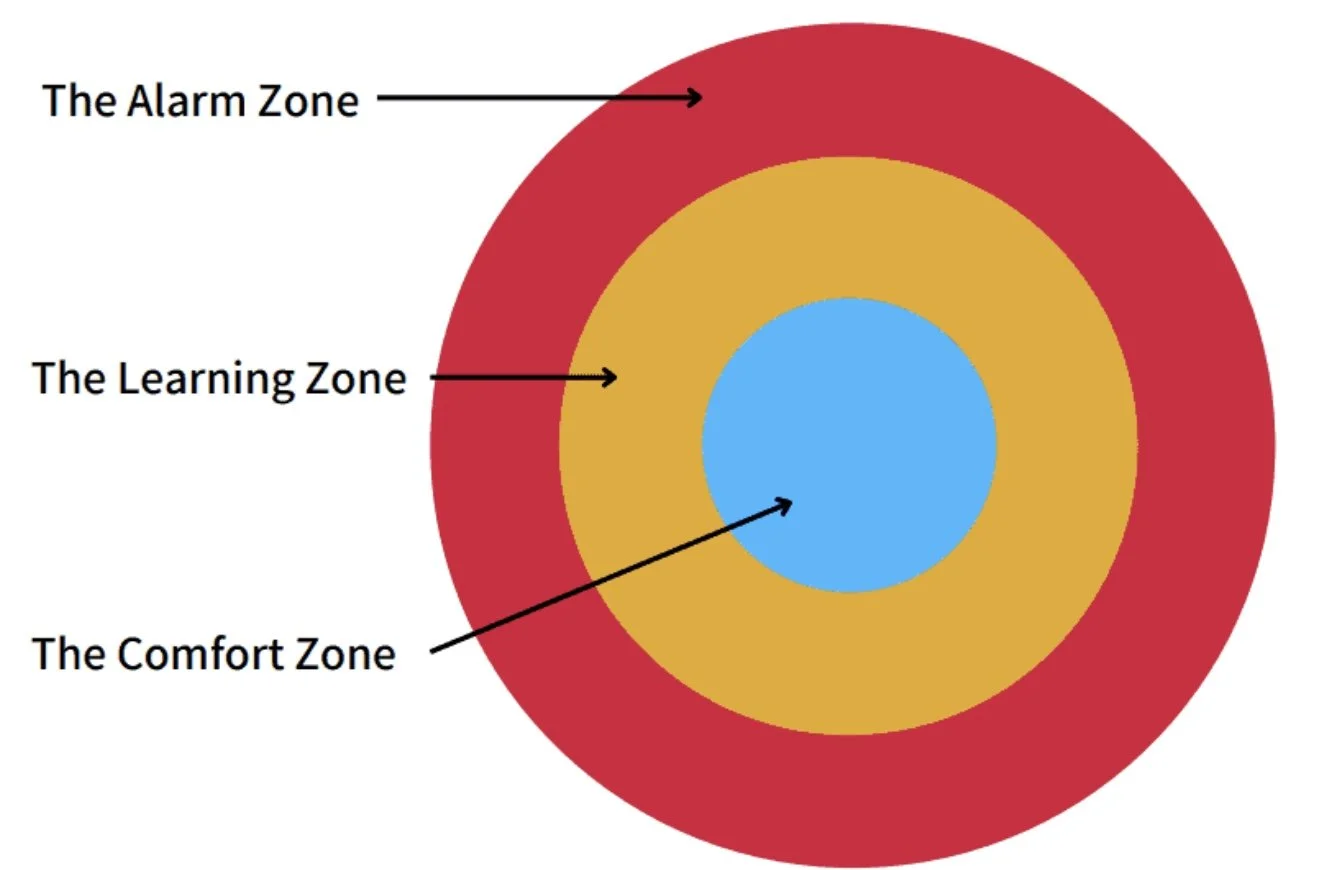
The learning zone model, Developed by Tom Senninger. Courtesy of The Commons Social Change Library.
In the center, there is your ‘Comfort Zone’, which was defined earlier as a zone where you feel the most at ease. Directly surrounding that, there is the ‘Growth Zone’, which is a place where you feel uncomfortable, but not where you feel actual panic. Surrounding the ‘Growth Zone’ is the ‘Alarm Zone’, which is a zone where you are still in an uncomfortable situation, but you also feel extreme stress, anxiety, or panic because of it.
CGS students should move into their ‘Growth Zone’, not their ‘Alarm Zone’. When you are in the ‘Alarm Zone’, your brain resorts to either the modes of fight, flight, fawn, or freeze, which inhibits your ability to learn and build resilience. When going out of your ‘Comfort Zone’, it’s important to know the boundaries of your ‘Growth Zone’, and to know when to stop before you step into an ‘Alarm Zone’.
At its core, where your Comfort, Growth, and Alarm zones are is something that everyone has to figure out themselves, since comfortability is such an individual thing. After all, learning piano may be uneasy for me, but could be completely comfortable for someone else.
What matters, though, is that you are regularly pushing yourself into your ‘Growth Zone’, since it will both build your resilience and reduce your perfectionism. That is why, dear reader, I am encouraging you to step out of your comfort zone. Because I promise you, you will see the positive effects.