
The game that spikes community
By Terra Bailey ‘29
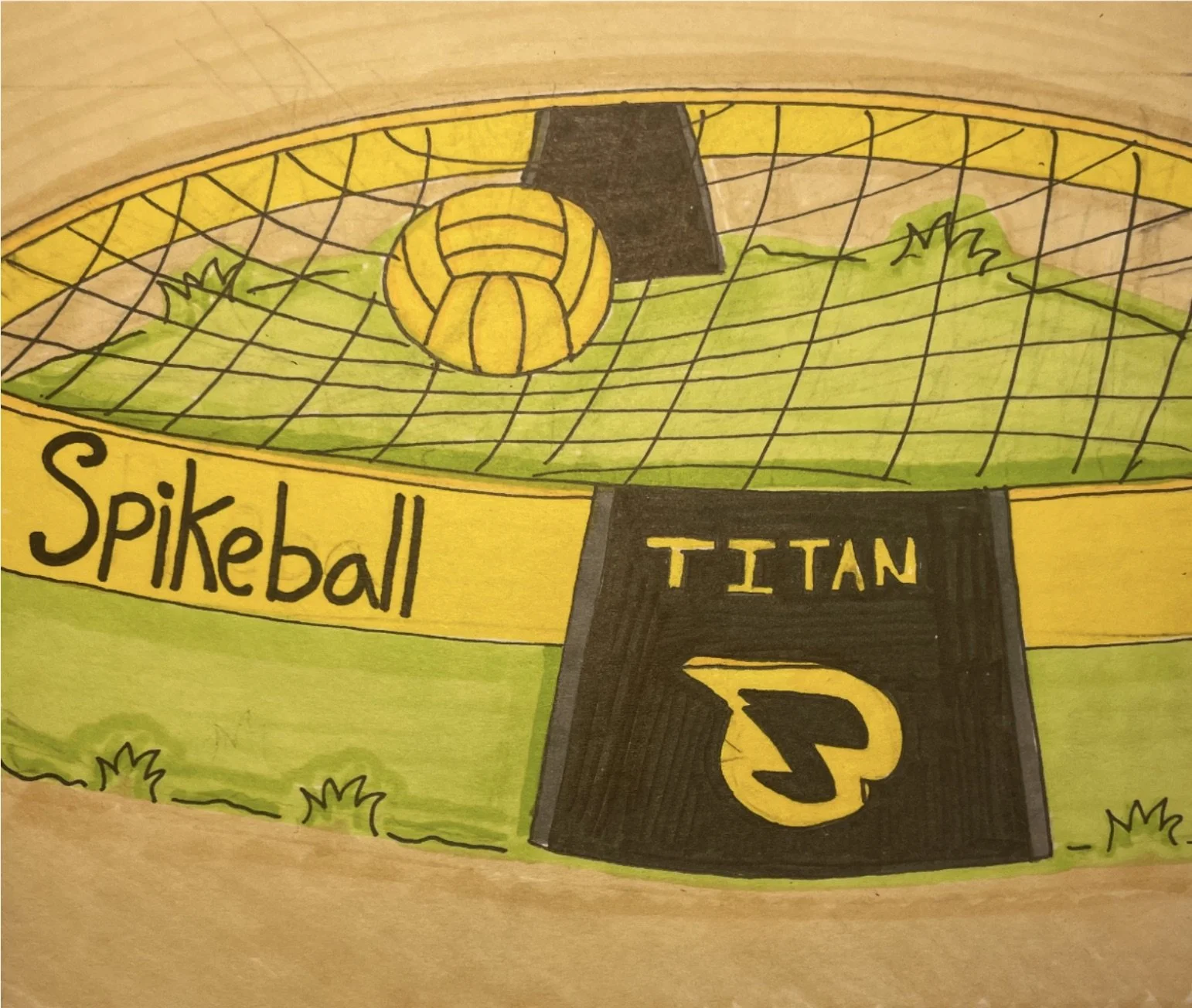
Graphic by Terra Bailey.
First hit: One team serves, the ball flying through the air and hitting the net with a spin. The other team retaliates by sprinting back and hitting the ball up to their teammate, who has a perfect set back. They run in front of the ball as if they are winding up for a big hit, but instead, fakes the other team and hits the ball softly on the net.
The other team dives to the ball, receiving the hard hit while they slam the ball on the net. Despite the sprint and swing of the arm, the ball soars over the opposing team's heads and hits the floor.
Spikeball is a well-known activity many people have grown to love at Catlin Gabel School (CGS). It's a central part of our community and our campus. The solemn dusty ring in the center of the quad is a gathering place for many Upper School students during breaks (or sometimes even in class).
Whether it’s because of the friendship it brings, or the satisfying nature of hitting the ball on the bouncy net, Spikeball is somewhat of an addicting activity.
The game of Spikeball includes a ball and a circular net surrounded by teams of two. The rules are similar to volleyball, where each team gets three total hits before they have to hit the ball on the net. Whichever team fails to receive the ball or misses the net gives the other team a point.
In the quad, there is always a game of Spikeball going on, where you'll hear murmurs of rankings coming from the players. Junior Ben Sirtori stated that the rankings are a simple system made by a group of three CGS juniors; Sirtori, Henry AvRuskin, and Ross Lane.
Sirtori started the rankings because people wanted to have a more formalized way to dictate who is better at Spikeball. He shared that the rankings are made by polling the students who are around the net. Rankings are decided by who appears better at the game; Sirtori talked about how they are measured by “the eye test” and who has more “pizzazz” behind their shots.
Rankings are also a way for the community to have playful competition. Since they were made, Spikeball has grown in popularity and served as a more organized way to build community and friendships through competition.
When asked if the rankings were biased, Sirtori responded, “I would say, slightly.” While they may be somewhat biased, the Spikeball community doesn't seem fazed by bias in the rankings.
Even though the rankings may seem intense to an outsider, there are sometimes less intense rounds being played as well. A common opinion from community members is that Spikeball is such a popular game due to how easy it is to learn and the central position of the net in the quad.
In addition to that, Jason Pedroza, the CGS Grounds Manager, expressed a new upside: that Spikeball is a good game for in-between breaks and it helps people get off their phones. “A lot of people are perfectly fine with filling their spare time or any few minutes of downtime here or there, with just staring at their phones.” Spikeball is a great way to not only reduce students’ screen time, but to build community while doing so.
Even though Spikeball may seem like just a fun game for the CGS community, Mary Braun, the Director of Upper School Enrollment, stated there were other advantages as well. Braun commented that Spikeball strengthens the appearance of CGS being almost like a small college campus.
She said, “On a sunny day at a small college, kids are outside playing hacky sack or nowadays you're probably playing Spikeball. So this just adds to that visual of this [school] is almost like a small college.” Not only does it intrigue students to play a fun game, but Spikeball benefits the view of the school from prospective families and parents.
One of the first appearances of Spikeball came from the Class of 2026, with seniors Teddy Ratliff and Nolan Swaim. The game started as a fun activity that would be played by some people, and now stands as a pillar of our community.
When asked in an interview about the progression that Spikeball might have at CGS, Pedroza stated he was deliberating on a possible permanent Spikeball set up. It would be in the rectangular field next to the pump house.
An amazing opportunity like this could allow students to play during winter and have more formalized tournaments. The lawn would be torn out and replaced with turf or mats with a spray painted circle astound the net.
Throughout the year, I have heard students and teachers converse about the obvious circle in the center of the quad. Even though there is an overwhelming amount of community this game brings, there is still an issue: in sunny months, if the lawn with the Spikeball net is watered, it will turn into a mud pit. This means the irrigation has to be cut off from that lawn.
Its position is affecting the irrigation of the other lawns as well, meaning that the lawn with the two trees over it can't get irrigation and is drying up. By springtime, there will be two yellow lawns if nothing is done about the Spikeball ring. However, Pedroza stated that this is not an issue as long as students and faculty are happy.
Even though many avid Spikeball players would love for the permanent set up to be done as soon as possible, Pedroza stated that the biggest issue with getting the permanent set up done is the approval system it has to go through. It would have to get passed through the school board and Catlin Gabel Student Association (CGSA), which could take a long time.
A permanent Spikeball net could improve the appearance of the lawns, making it easier on the grounds crew while maintaining the benefits Spikeball has on the CGS community.
The overall community benefits from Spikeball because of the friendship and connections it forms. Spikeball seems like such a small part of campus, yet is a very substantial part of our community.