
Portlandia and the Portland that it was
By Nico Igarashi ‘26
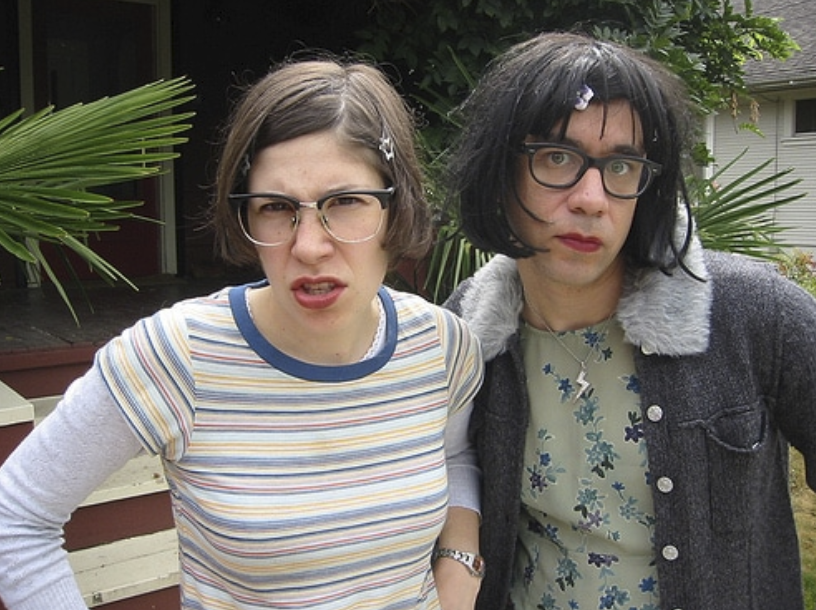
Co-creators of Portlandia, Carrie Brownstein [Left] and Fred Armisen [Right]. Courtesy of Maximumfun.
Walking down the warm streets of Los Angeles, two friends run into one another. After exchanging pleasantries, one looks squarely into the other's eyes, asking: “Do you remember the 90s? … There’s a place where that idea still exists as a reality, and I’ve been there.” His friend leans in, asking “Where is it?”
Portland.
What followed the opening sketch of Portlandia was not merely a joke: it was a love letter to the city. Portlandia is a sketch comedy show that aired on IFC from 2011 to 2018, following Carrie Brownstein, Fred Armisen, and their rotating gallery of wacky and quirky caricatures of Portland residents. Feminist bookstore owners, a fully pierced bike enthusiast, artisan curators of taxidermies and everything pickled, just to name a few.
The show quickly gained steam and attention from Portlanders, even racking a public endorsement from the mayor at the time, Sam Adams, who January 21st, 2011 declared January 21st, 2011 official Portlandia day.
But now the show reads and is experienced in a tone more akin to grief than nostalgia. The city the show documented — weird, unhurried, and convinced of their own self-righteousness — has been tested by a force that no sketch comedy show could satirize: a global pandemic, a summer of unrest, and a city emptied and abandoned, never quite filled back out. To watch Portlandia now is to see a city say goodbye to itself, without knowing it.
But how did we get here?
For the later half of the 20th century, Portland’s existence has been defined by its appeal to artists. From the 1980s to the 2010s, it had relatively cheap rent and commercial spaces, which allured artists, small scale food entrepreneurs, and independent retailers to start projects that they would have been unable to otherwise. It became a breeding ground for independents to pursue their wildest and most bizarre ventures.
In congruence, as stated in Marotta et al’s Where Is Portland Made?, during the era of social media’s infancy, Portland’s ethos as an artisanal and maker economy drove interactions and a certain degree of reverence towards the city as a whole. Its status as a place of creativity and quirkyness displayed on the internet and Instagram fueled hipsters and tourists alike to experience and consume the culture. They then regurgitated it back onto social media through actions like posing in front of Portland’s famous cultural institutions (Salt & Straw, Voodoo Donuts, etc).
And, no doubt Portlandia has had a huge place in this media and internet influence. In its second season, it peaked at 600,000 viewers, not stardom status, but also no small feat. Furthermore, the show has been hailed for bringing in “36 million dollars in direct spending for the state, and 200 annual jobs.”
More than the show's popularity, it captured a really important and distinctive moment in Portland history: the promising land of a society aimed at celebrating slow production and high-quality artisanal craft. In the 2010s, Portland was riddled with these sentiments, reflected in the fact that small, independent, and importantly politically correct, shops selling unique and esoteric goods.
Native Portlander & librarian Derek King, who moved to the city in 2016 said that the culture was imbued with a sense of “make your own. [Portland was] the city of artisanal and weirdness, and hopeful optimism.”
No show better demonstrates this than Portlandia’s ongoing skits about these businesses. The famous ‘we can pickle that,’ or ‘put a bird on it’ exemplified the eccentric and wacky stores that were a direct result of Portland’s rejection of late-stage capitalism.
The influence from Portland is clear: the sentiment of the yippies (a complete rejection of the order and system that govern western culture,) in the 60s, and the internet age of optimism, equality and freedom in the 90s, all formed together to create an amalgamation of the formers, and a city equally strange and progressive.
Portlandia ended in 2018. As Brownstein put it during the final shoots, “it is the end of the dream this season.” And that phrase took on a more literal sense than expected.
In March 2020, Oregon entered lockdown. All of the aforementioned businesses were put on hold; bars, bookstores, restaurants, food carts, and everything in between that define the city’s core were thrown off the proverbial titanic into the freezing waters, struggling to keep afloat.
Pok Pok, Toro Bravo, Paley’s Place, Clyde Common, Blue Hour, Irvine Street Kitchen, and many more establishments closed — all cornerstones of communities, beloved, adored, and irreplaceable, that the show and the city spent years celebrating.
Still Portland had more to face. The summer of 2020 saw the mourning and intense riots over the murder of George Floyd. Protests in Portland lingering longer than most places across the country, lasting well over 100 days.
A survey of 718 retail locations collected from September 1st to 25th of 2020 found over 80 locations were unoccupied or underutilized, and over 20 were permanently closed.
As of Q3 2025, Colliers reported an overall metro office vacancy rate of 26.6%, a result of the city's Central Business District (CBD), and its perimeter subdistricts. These rates are similar to Downtown Seattle’s 35.6%, or San Francisco’s 32.8% — all badly wounded west coast tech-adjacent markets. However, many are skeptical of Portland’s efforts to revitalize the city.
San Francisco has dangerous vacancy rates, but is able to price leasing and rent of over $70 per square foot, charging nearly double the national average for the underlying demand for their premium spaces. This in addition with the recent AI boom in the area means San Francisco has an active market investing in it. Seattle is in the same boat, but has the aid from Amazon — a major corporation able to single-handedly mandate recovery and nurse Seattle's economy to healthy rates.
Portland has neither of these.
User speedbawl on Reddit commented on Portland’s stunted growth on a thread under the subreddit ‘R/Portland’ that the problem is “high taxes/low services combined with an outsized population of addicted or unstable people on the street, and the spillover crime that comes from that.” They added that “We lost employers and professionals because of this, so now we can’t pay for our public services. People with money or ambition have no confidence in Portland.”
In addition, the artisanal haven that Portland propped itself up to be, over the course of the show’s debut to now, has been challenged thoroughly. Small scale artisans, such as Jeanne and Dean Carver, who with their high-desert sheep reach are partnered with Ralph Lauren to provide yarn for the US olympic team apparel.
Or Duane Sorensen, founder of Portland’s stumptown coffee, who sold out to TSG Consumer Partners, a San Francisco equity firm notorious for flipping small businesses and companies.
The show that had put the city of Portland on the map as an urban paradise of progressiveness and hipsterdom is now being held up, by its people and national media, as a cautionary tale. The dream of the 90s is no longer in Portland.
To watch Portlandia retrospectively is not only a means to remember how good things were. The show is special in that it achieved what few other works of popular culture manage: it fully captured and conveyed a way of life through the contrasting lens of unseriousness and genuine reverence.
In hindsight, Portlandia was an early signal of the comedic and cultural mode that is currently dominating the cultural zeitgeist: absurdist, deadpan, and eccentric skits. The show's structural weirdness — non-linear plots following the actions and adventures of recurring characters, and pushing concepts to their limit — can be felt in the surrealist turn in contemporary films, as well as the native absurdist internet culture. Portlandia was ahead of its time, while being perfectly of it.
The biggest feeling you get when watching it is the early 2010s-ness of it all. The world was still open, being just a barista was societally sufficient, you could start a pickling collective or a workshop dedicated to putting birds on things, and it would be enough.
At the middle of the “Dream of the 90s” sketch, the friend looks excitedly at the other, claiming that “Portland’s almost an alternate universe.” As it stands now, she was more right than they ever could’ve known, just not in the way she meant it. Portlandia, a record of everything — the whimsy, overbearing wokeness, and the unbridled optimism — is now a strange and foreign depiction to the place it is today.