
Senior Assassin, under scrutiny
By Krish Caulfield ‘26
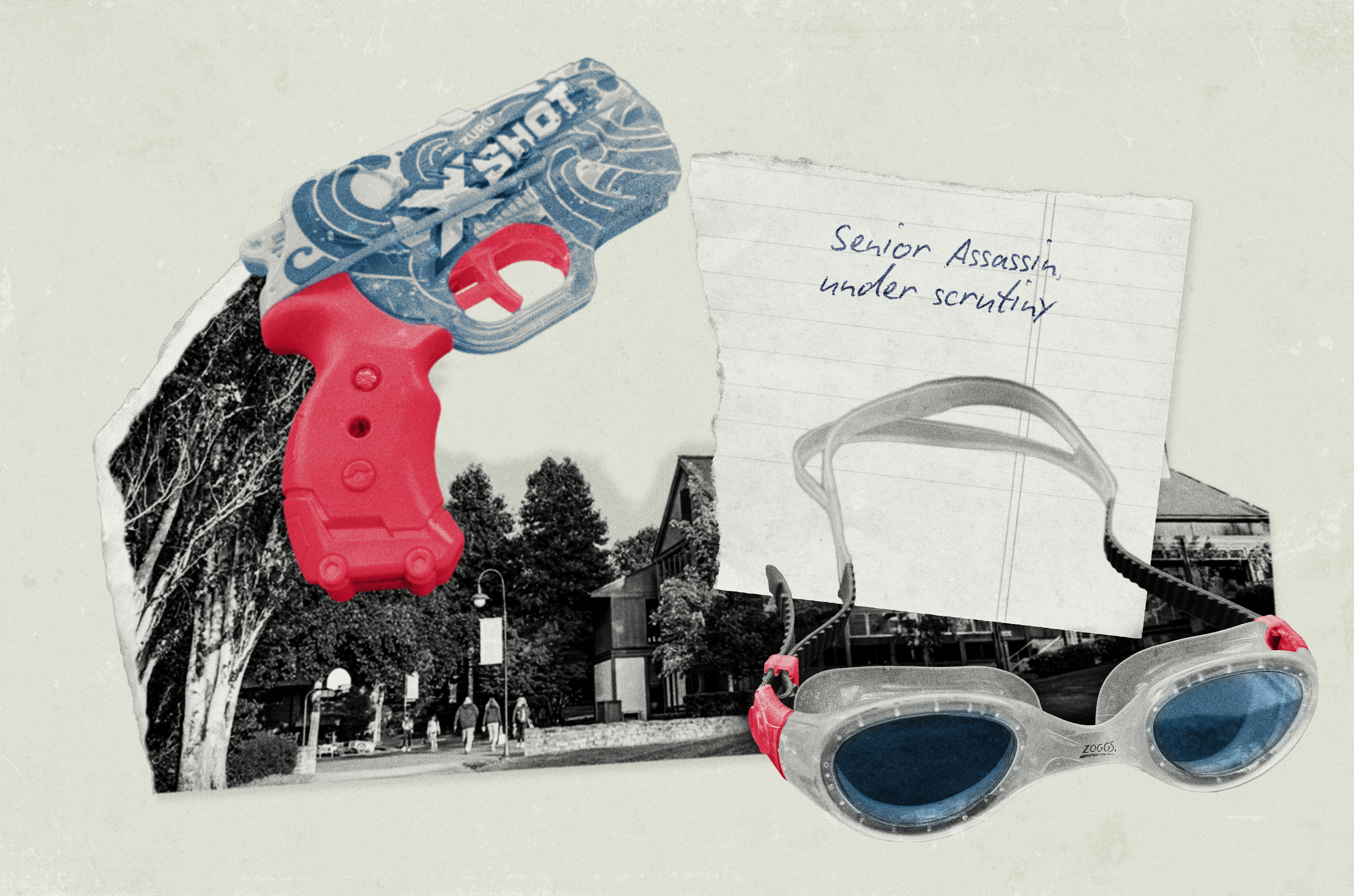
Graphic by Krish Caulfield ‘26.
To play Senior Assassin slyly, a senior stows herself in the dark mouth of a Chevy Tahoe trunk, knees to chest, bearing the rubber heat and waiting to pounce. To play Senior Assassin methodically, a senior combs the far reaches of the internet, becoming a college track coach search-by-search and controlling his target's movements. To play Senior Assassin ruthlessly, a senior steps through the doorway of another, takes off her shoes, and drowns a room full of laughter in SuperSoaker spray.
Senior Assassin, as the Class of 2026 has known it, is a game of deception, treachery, stealth, and, admittedly, some skill. But thus far this spring, the game has begun to feel less like a tradition and more like a question.
In Senior Assassin, Upper School seniors attempt to eliminate one another using water guns, while wearing goggles protects individuals from elimination. Each senior has a target, and the game cannot be played on campus. Generally, students attempt to eliminate each other by tracking their targets down and staking out their homes or extracurriculars.
On April 13, 2026, Upper School Dean of Students John Harnetiaux sent an email out to seniors, primarily affirming that Senior Assassin is not a school-sanctioned event and that the game might actually be an example of a tradition that “has not aged well” and is “a bit tone-deaf to our current moment.” The moment Harnetiaux is referring to is one where school shootings and state violence through enforcement agencies like ICE are all too familiar.
Harnetiaux later explained in an interview that his concerns stemmed from a series of conversations that cohered into a larger reality that was harder to dismiss.
For one, he’d heard around campus that many of the water guns bore an eerie resemblance to actual firearms. On top of that, a few teachers had reached out to share the concern that many students had “what looked like guns in their backpacks,” which they hypothesized were Senior Assassin-related, but had to confirm.
Finally, Harnetiaux had a conversation with a parent that explored the likelihood of a seemingly fun Senior Assassin showdown going south depending on who is involved, as “this game presents different risks for different people based on their identities.”
Harnetiaux made reference to an incident on April 8, where a senior, a student of color, dressed in all-black with a sheisty-style face covering and an Orbeez gun, eliminated another student in a public parking lot before having the cops called on them. “I couldn't shake this feeling that something could go really wrong,” Harnetiaux added, “and if I didn't say something, I would feel like the school would be responsible for it.”
Part of why Harnetiaux felt responsible was that, when the game began, the $200 prize pot was funded from the Class of 2026’s budget, a response to backlash from a decision to reward the winner with a $20 gift card of their choosing. Co-Class Presidents Luna Gonzalez Gonzalez ‘26 and Prisha Garg ‘26 raised the pot with residual money from the class budget while keeping the entry fee free, something they valued for the sake of maximizing inclusion.
This was a detail that Harnetiaux “wasn’t tracking” until later, though his concerns remained focused on student safety rather than on the source of the funding. Harnetiaux admitted that he didn’t actually pay much attention to the game prior to this year, and said, “I knew that there were water guns, I knew that there were goggles, but I didn't really know.”
It appears that Senior Assassin has been surrounded by an aura of uncertainty throughout its play this year. Harnetiaux knew little about the full extent of the game, like August Walrod ‘26, who shared that “there has not been very much clarity about what is allowed and what is not allowed.”
In a game like Senior Assassin, with the risks it entails, “having the organizers be very informed and intentional about rules has been important,” Walrod said.
The game has been orchestrated by Co-Class Presidents Chloe Moreau ‘27 and Rose Hogan ‘27. Hogan shared that “it's been pretty stressful” to run Senior Assassin thus far, simply because of its nature as an “intense tradition” and the competitive fire that has fueled much of the senior class. “Chloe and I have put in a lot of work to try and make it an enjoyable experience,” Hogan added.
Work has also been done by Harnetiaux, Gonzalez Gonzalez, and Garg, alongside many Catlin Gabel Student Association (CGSA) members, to develop and clarify the rules throughout the play of the game.
Gonzalez Gonzalez sent an email to seniors attaching recommendations from the Germantown Police Department in Wisconsin to “[use] brightly colored, clearly toy style water guns, no masks or camouflage, no creeping around private property, and no late night missions. Officers recommend that play stay in supervised, daylight settings where everyone nearby knows what is happening."
Harnetiaux shared that his primary concern lies in the perception of the game rather than its intent, and in how the conditions under which it’s played, particularly at night, can affect those perceptions. “I imagine all the ways that these things could all go really poorly,” he elaborated, “it's the sneaking around, it's the place where onlookers can possibly misinterpret [the game].”
According to Harnetiaux, the loaded imagery associated with the water guns used in the game, along with the name of the game itself, which contains the word assassin, “activates all of these images of killing, and we have enough violence in the world.”
Walrod takes a different stance, as he argued that “when you separate people mentally from the idea of guns being something in a place where there actually are so many guns, I don't think you're helping the issue.” Walrod said that he felt that changing the mechanism for elimination, something that has been frequently floated by CGSA, to water balloons or spoons would not solve the problem, as they dismiss why the game has drawn the traction it has.
“We live in a society that’s not open enough to be uncomfortable and challenged, and I think that having people be uncomfortable in a way of having to think about [the meaning of the game] isn't a negative,” said Walrod.
Walrod also argued that proposals such as the socks or spoons do not fully mitigate the game's risks, and essentially any permutation of a Senior Assassin game will involve some risk. “A spoon is like a dagger,” and any concealed item, even a water balloon, which also increases the chance for disruption because of the volume of water contained within it, can be misinterpreted as a threat.
Harnetiaux put it nicely that “all of those things are not perfect solutions; they can all get misinterpreted, and that's the world we live in.”
None of the changes were actually incorporated, and as of now, Senior Assassin continues to operate under virtually the same set of rules it began with, except for a different funding source and heightened awareness of its play in risky conditions, such as at night.
In its current form, Harnetiaux still recognized the game's benefits and said, “I think it builds camaraderie, and it seems like fun, like people get into it.” Harnetiaux's assessment seems fair, as Walrod shared that “I love strategy, I love deception, and I love real-world games.” Walrod also shared that he loves the ongoing discussions that the game fosters, where students can bond over successfully eliminating their targets in stylish fashion, nearly eliminating them, or even getting eliminated.
The game and the camaraderie that come with it seem here to stay.
For Hogan, it’s not necessarily about choosing between the game's communal value and its implications in the present, but about holding both simultaneously. “I think it's a balance between recognizing the times and also recognizing that traditions are what bring people together,” Hogan asserted, framing Senior Assassin as something of an ongoing negotiation.
That negotiation will appear to be gradual rather than abrupt and decisive. “Going into this next year and going into the future, I think what that looks like might evolve as the years progress based on trying to be more inclusive and less exclusive when it comes to different people's identities and evolve with the times and the circumstances,” Hogan said.
What remains unresolved is whether the evolution of the game will meaningfully alter how the tradition takes shape or simply add a new layer of awareness to a familiar game. Senior Assassin, after all, has long been a game about reading others: anticipating movement, interpreting conversations, or striking at the right moment. Now, it asks students to read more broadly into the social context the game’s actions occupy and how the identities of its participants may affect the perception of those actions.
Whether that awareness will actually reshape the Senior Assassin tradition itself or simply accompany it remains an open question. One that, like the game right now, is still being played out.