
The importance of Catlin Gabel’s athletic fan fervor
By Maya Igarashi ‘28
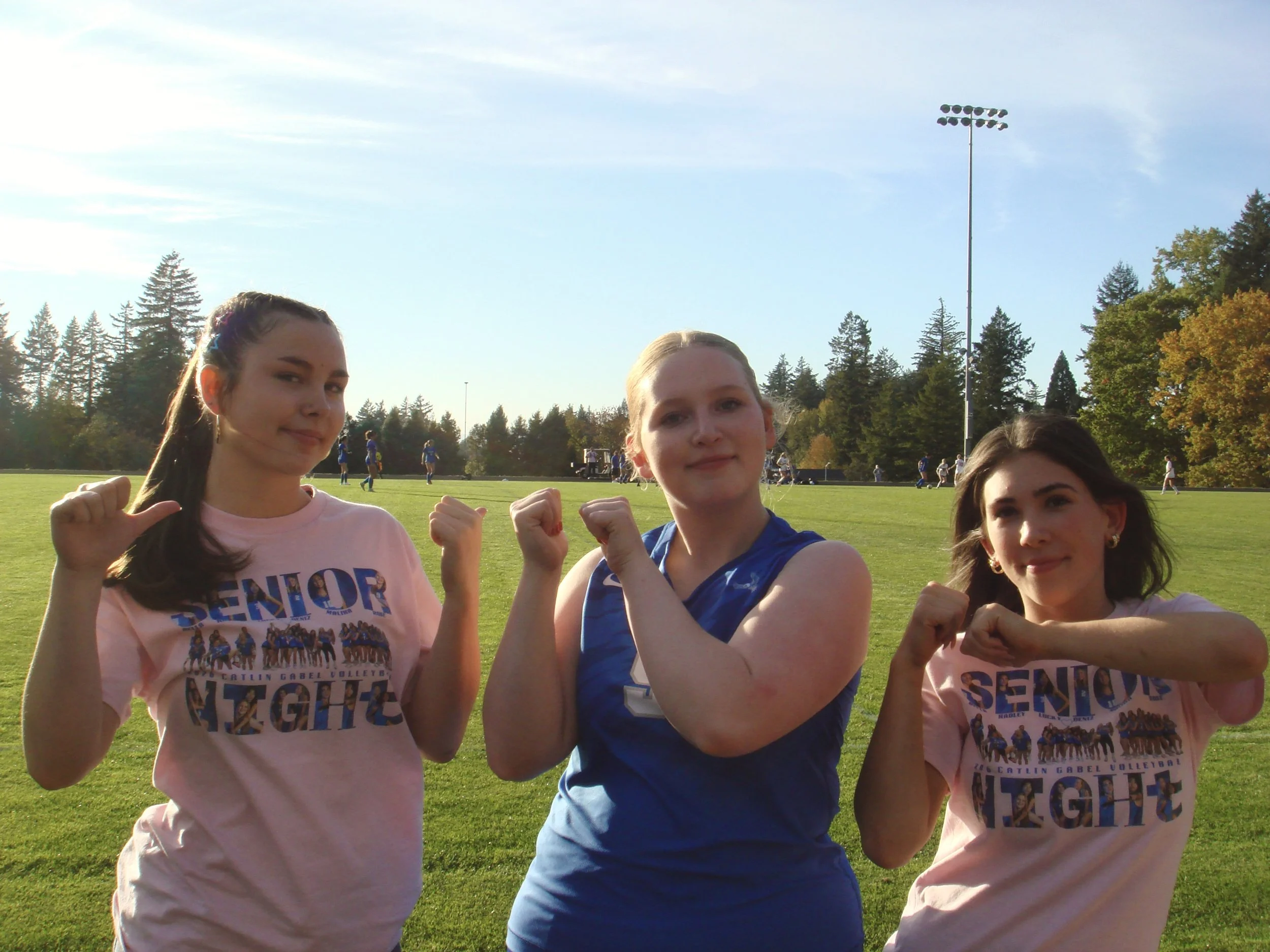
CGS Volleyball players gather to support their girls soccer team. Pictured from left to right, Bella Tremblay ‘27, Rose Hogan ‘27, and Hadley Cress ‘27. Photo by Maya Igarashi.
Since the dawn of time, sporting events have served one great purpose: to regale the people.
From pre-historic cave drawings that depicted early forms of sport, to the birth of organized physical competitions in ancient Mesopotamia; Olympic games in Greece; Medieval Jousting and Archery competitions in Europe; and “modern day team athletics” in Britain, sport has been instrumental in defining, shaping, and bonding communities.
Throughout the ages, athletic competition has been sustained by fans and the vital foundation which they pillar in sport.
From state championships and ranked players, all the way to D1 scholarships, it's no question whether Catlin Gabel School’s (CGS) captivating athletic competitions are filled with talent and passion.
While fans certainly show up for major sporting events such as soccer Homecoming, there's been an observed deficiency in school spirit at more “regular” games.
One captain shared that at home events, “There are usually a few dedicated students who show up to as many games as they can, but overall, the student section can often look lackluster.”
Based on an October 2026 survey conducted with all the fall sports captains, away games typically have no student attendance, with the exception of boys varsity soccer, who estimated only one to five students per game.
Senior Volleyball Captain Maliha Rajan shared that she didn’t think the attendance at away games was inadequate, as the locations are “too far away to be reasonable to drive…with the new league this year.”
CGS Athletic Director Kate Williams highlights positive aspects of CGS engagement with the athletic program. “Our community does a good job showing up for those larger events.” Said Williams, adding on that she felt it would be great to get that same kind of energy at more “general contests.”
Similar sentiments are shared by Upper School students, one of whom anonymously commented that, “Catlin's school spirit tends to favor… popular events like the Homecoming soccer games, and I would love to see more school spirit across all sports.”
CGS students in an October 2026 survey overwhelmingly reported not going to sports games because they were too busy with academics and extracurriculars. Is “lackluster” attendance the price to pay for academic rigor?
While educational obligations may prevent most students from attending games, Junior Nuri Sahavi believes the fanbase relies on the student body traditions.
“Senior class culture influences a lot of what the younger students do,” said Sahavi, further elaborating that “if the senior class is a lot more focused on academics, then, you know, there's sometimes less attendance. And that's something that you can't really control.”
Regardless of its origin, fall sport captains seemed to unanimously agree that attendance at home games is currently insufficient. While it’s yet to cause any major discrepancies in athletic performance, low fan numbers can affect the team's mindset.
Both the volleyball and soccer team captains agreed that games are more fun to play when there is an audience.“Attendance significantly affects us as a team and gives us more motivation to perform. It’s also just nice to see people that care and support you,” said senior Sydney Perlewitz, a Girls Varsity Soccer Captain.
Contributing to the school spirit and showing up at sport games is not just beneficial for the players, but for the fans as well.
The Connecticut Association of Schools shares that students who have more school spirit “are more socially and civically engaged.” Because of active participation and engagement, students can be given a sense of efficacy and importance within their larger community.
This school year, efforts to improve school spirit have already had an effect on CGS athletics.
Captain of Girls Varsity Cross Country, junior Xinyu Luo expressed that at home meets, “There's always a lot of support from CGS students down by the race's finish,” and if there aren’t students who show up, “There are always teammates who aren't racing cheering the runners on.”
Inter-sport patronage in particular has been observed by many to be particularly strong this year.
Williams shared that she sees an increase in “teams supporting one another,” as well as student and faculty representation at games.
When asked about her perspective on CGS’ school spirit, Williams responded with, “I'm really encouraged about the direction we're heading.” She attributed part of the growth in school spirit to a conscious effort from those in the community who are “elevat[ing] student athletes and our athletics program,” explaining that student voice has played a major part in athletics’ promotions.
CGS sports teams have been taking advantage of social media in order to publicize their contests and increase knowledge around athletic events. Efforts around building awareness are especially important and effective in getting people to show up to games, because “a lot of the time, people just don't know that things are happening,” according to Sahavi.
Sahavi is one of the students driving the charge for an improved school spirit. As leader of the Catlin Gabel Student Association’s (CGSA) spirit committee, Sahavi—alongside an enthusiastic team—works to “create pride and energy” around CGS events. He shared that in order to incorporate student voice, the CGSA spirit committee is currently collaborating with Booster Club, a CGS student run group, to create “opportunities for students to engage.”
Student leadership and participation are major deciding factors in a school environment. As CGS students, it's important to think about our role within the community outside of an obligation to academics.
Being able to be a part of such a school, and experiencing the kinship that comes with it is significant. Williams beautifully sums up the value of being there for our community members:
“I do know this community cares for one another deeply… It is really nice when teachers, staff, leadership, students, come out and support one another…It's nice when we show up for one another in that way.”
Rallying together and cheering for the same cause, whether its the crowd erupting in a roaring hurrah after a tiebreaking serve in a neck-to-neck volleyball game, or a ball crashing into the net on a sunset lit soccer field, sport brings people together like no other marvel.
After all, having school spirit just might play a larger role in your high school experience than you’ve ever anticipated.