
A Monument on the Ridge: The Story Behind Catlin Gabel’s Mount Hood Memorial
By Siri Hareland ‘29
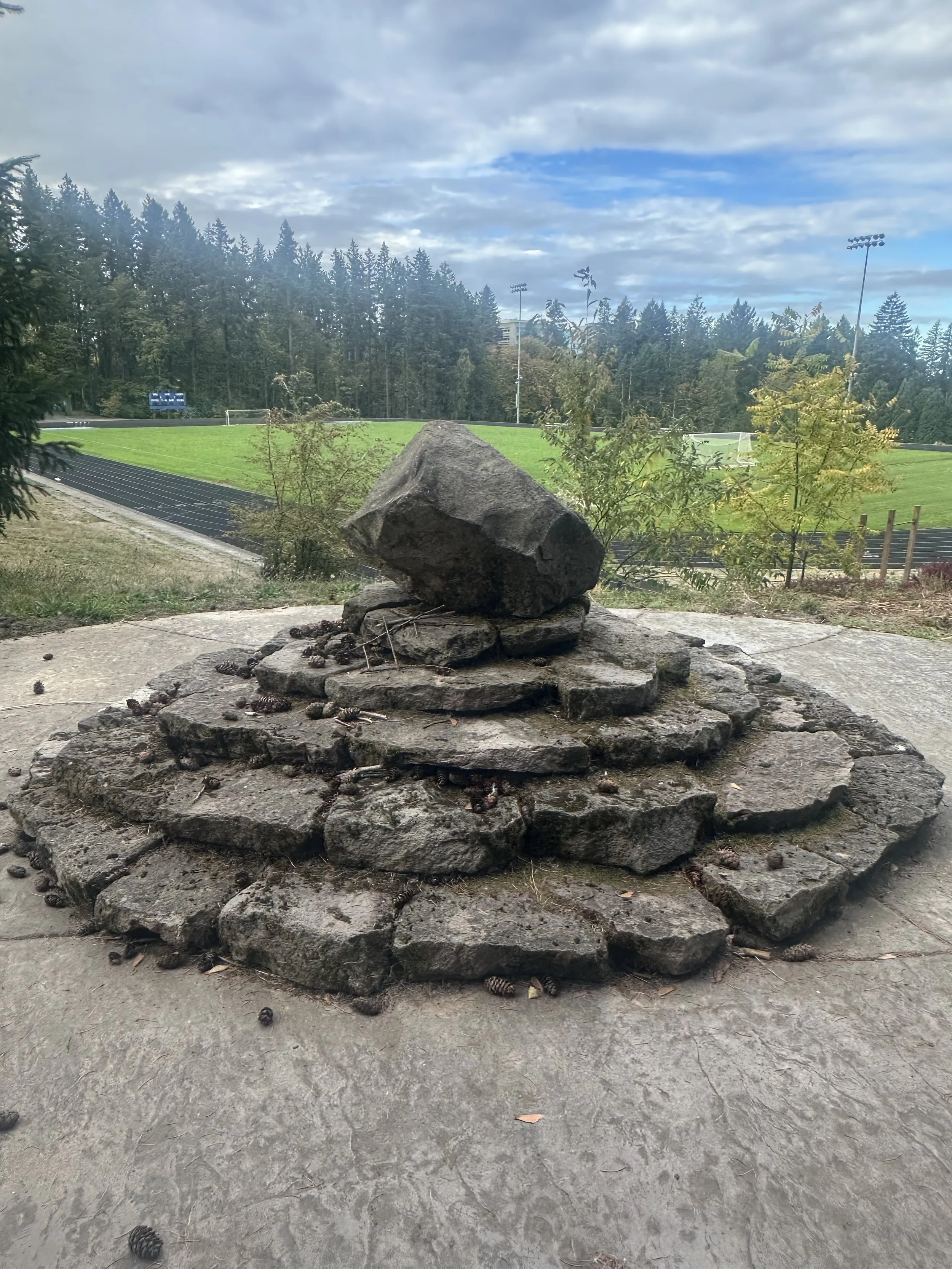
The Mount Hood Memorial. Photo by Siri Hareland.
Up in the woods, overlooking the track, a memorial lies, symbolizing a deep bond of partnership and healing between two rival schools. The memorial honors the nine Oregon Episcopal School (OES) students and faculty who passed on their Mount Hood expedition.
On May 12, 1986, 20 OES climbers set out from Timberline Lodge. They did not anticipate that a fierce snowstorm would trap them in a snow cave for three days, before nine were found and declared dead from hypothermia on May 15.
The trip consisted of 15 students and five adults, two of whom were guides. The trip was a required part of the school's basecamp outdoor ed program. Basecamp means they would stay at a lodge overnight, then hike the mountain in the morning.
Less than an hour into the hike, one student and their mom turned back early due to stomach illness. At 7,000 feet, a student suffered painful cramps, and her classmate headed back with her. Two other students also recognized their own exhaustion and safely headed back to the lodge. The final climber who left early was a guide who suffered mild snow blindness and severe sunburn on the surface of his eyes, causing him to turn back before it got worse.
At this point, there were exactly 13 people left on the mountain. The seven people who left early assumed that they would meet them at the lodge at 6 pm after completing the expedition. Instead, the snowstorm suddenly turned into a large, blinding blizzard that trapped the 13 climbers at 11,240 feet – just a few hundred feet from the top of the mountain.
As the conditions worsened, they began digging a snow cave to protect themselves from the cold. However, they did not have the correct gear to stay overnight in a blizzard, and hypothermia started to set in, making them lose heat faster than they could produce it.
The next morning, one student woke up and decided it was time to find help. He asked a classmate to come with him, but he said he was too cold. Instead, another student came, and they began their descent. They hiked about 2,000 feet downhill and reached Mount Hood Meadows to alert the search and rescue.
Later, three students tried to follow. They believed they could also make it down and were desperate to leave the piercingly cold cave. Unfortunately, they were hit by the blizzard, and soon after, hypothermia. Rescuers found them buried on the snowy slopes on May 14, 1986.
Inside the freezing, pitch-black cave there were still eight people, two adults and six students. The snow cave had become partially buried, which restricted airflow and blocked the entrance. The remaining climbers suffered severe hypothermia and went unconscious.
After the storm had calmed down, the rescue mission began. The search included military helicopters and hundreds searching on the ground level. On Thursday, May 15, the cave was recovered with long avalanche probes.
When rescuers dug into it, they found eight motionless bodies. The rescuers rushed them to a hospital in Portland, where doctors tried to rewarm their bodies, which were at dangerously low temperatures. Sadly, both of the adults and four students were in an untreatable condition.
Only two students survived. However, one of them suffered severe frostbite, which required the doctors to amputate both his legs.
This accident was both heartbreaking and traumatizing for the community, especially family members, friends, and classmates of those who had passed.
Catlin Gabel School (CGS), OES's historic rival school, now has a memorial to honor and remember the students and faculty who died on the expedition to Mount Hood. It is a small mountain of rocks, located at the track on the edge of the forest. Alongside it, a plaque that states, “We remember the lives lost on Mt. Hood in May 1986-constructed by CGS and OES students”.
The tragedy left a deep emotional scar across Portland (PDX), with an impact on both outdoor education programs, and the connection between CGS and OES.
For CGS Alumnus Irfan Tahir, the loss was especially difficult. After attending OES middle school, he transitioned to CGS for upper school. Today, he is a CGS parent of a sixth and ninth grader.
When the students were lost on the mountain, Tahir was a freshman. He recalled the shock of being taken out of class by the headmaster and being brought to his office to be told what was going on.
The search was still active at that time, and when the survivors and victims were found Tahir remembered “Feeling heartbroken, especially for those I knew-the impact on.” He later explained that, “I think my emotions were probably mirrored by most of the folks at Catlin–just a deep sadness and sympathy for what had happened and best wishes to all parties of both.”
Peter Green, the founder of Post 58 starting in 1997, and a leader of Outward Bound trips from Portland, knows Mount Hood well. He has been involved in rescues with Mazamas, and was also the director of the outdoor education program at CGS for 11 years. He has a profound knowledge of how the disaster affected PDX, OES, and CGS, and is also heavily involved in the aftermath.
“The whole thing was just so horrifying,” said Green, reflecting on how the three-day incident affected the entire city. “When the news broke early on Monday morning that they found the last kids on Thursday at one to 5:30, the whole city just stopped. I just can't overstate that everybody had their TV on.”
He recalled the stressful experience of seeing helicopters circle around on the television, knowing that every second that passed, the outcome was getting worse.
In the aftermath, the event that carried trauma and fear changed safety and wilderness risk management at Catlin Gabel and on the mountain. However, the event raised anxiety among parents and students.
Green noted that it is appropriate to be cautious and ask questions. “I can't drop the risk to zero, but by making these choices with respect to weather or with respect to avalanches and timing, I'm trying to reduce the risk to protect your child as much as possible.” This dedication to student safety was also connected with empathy between the two schools.
Following the disaster, OES canceled its upcoming prom due to the heartbreak. As a kind gesture, CGS invited OES students to their prom.
Many years later, Green shared that the campus monument near the track symbolizes shared pain and suffering, but also “empathy and camaraderie” between the two schools.