
What’s written in the stars for 2026? A guide to Astrology and the possibilities of the Zodiac
By Ariana Bajaj ‘26
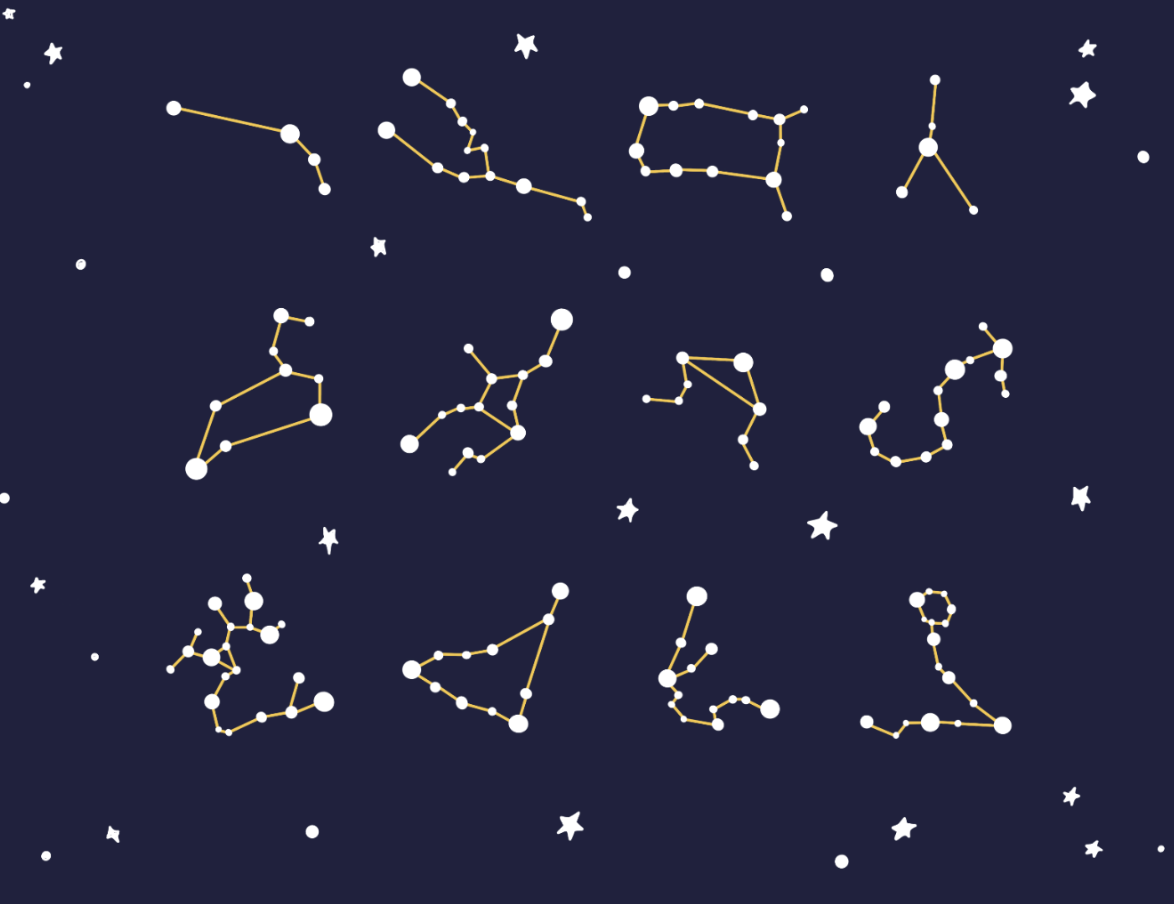
Constellations of all twelve star signs in the Western zodiac. Courtesy of Gracyn Garner ‘26.
Backed by ancient traditions from around the world, the zodiac and sky remain a source of meaning, even now.
At Catlin Gabel School (CGS), it isn’t uncommon to overhear talk about astrology– whether it’s comparing star signs, joking about personality traits, or referencing a horoscope read the night before. While astrology has long attempted to explain human behavior through the observation of celestial bodies, modern lenses offer a different framework for discovering our role in the vast universe.
As 2026 begins, astrology continues to resurface in moments of transition, raising the question: Why does it remain so culturally relevant now?
The practice of astrology first originated in ancient Mesopotamia in the second millennium B.C, where astronomers used planetary movements to mark seasons and events. Later, these observations evolved into the Western zodiac, a system of twelve signs aligned with the Sun’s path, deriving from the Greek phrase zōdiakos kyklos, meaning “circle of animals.”
While the Western zodiac is most commonly known, other global practices have influenced our perception of astrology today. In India, Vedic astrology (Jyotish) developed alongside Hindu religious texts, exploring karma, reincarnation, and planetary cycles known as Dashas. In China, Taoist philosophy shaped the Chinese zodiac, assigning animals to birth years rather than months.
Despite its historical significance, astrology has not been scientifically proven to predict human behavior or future events. Priyanka Bhumi, an Ayurvedic specialist, explains that “astrology focuses on analyzing the movement of planets through the zodiac signs … and helps astrologers assess potential challenges and opportunities, providing guidance rather than definitive predictions.”
To fully understand the zodiac from a scientific perspective, we must distinguish astronomy from astrology. Astronomy is the study of the physical properties of space (gravitational laws, axial tilt, orbital motion, etc.). Astrology assigns symbolic meaning to celestial movements and the Sun's position.
Each zodiac sign corresponds to a moment in the Sun’s path (also known as its “ecliptic”) that is marked by your date of birth. By analyzing each segment of this journey through the twelve astrological signs, we can understand the celestial principles that underlie much of the horoscopic practices and beliefs many observe today.
The Zodiacs
Aries (March 21– April 19) begins near the vernal equinox, which, as explained by Britannica, is the exact separation of the equator where night and day across hemispheres are relatively equal. Being the first zodiac of the year, this clear division was considered the “governing period,” backed by tales from ancient Greek mythology. Thus, Aries has traditionally been associated with leadership, initiative, and confidence– traits that mirror the energy and growth of early spring.
The Taurus (April 20 – May 20) constellation is best seen in the Northern hemisphere during winter and early spring. Characterized by its V-shaped alignment, this zodiac sign is commonly associated with the Bull, representing persistence, reliability, and patience required during this time of year.
Gemini (May 21 – June 21) aligns with late spring, a stretch of time marked by longer days and rising temperatures. Its two brightest stars, Castor and Pollux, represent twins that symbolize duality and balance. Historically, this period coincided with increased trade and better weather conditions, reinforcing interpretations tied to adaptability and connection.
Cancer (June 22 – July 22) takes place near the summer solstice, when the Northern Hemisphere experiences its longest days of the year. Ancient observers associated this peak in sunlight with nourishment and protection, as reflected in Cancer’s symbolic representation as a crab and its hard outer shell. Later, the Cancer zodiac became known for emotional awareness, loyalty, and care for others.
Leo (July 23 – August 22) corresponds to midsummer, when the Sun’s intensity is at its peak. The constellation’s association with the lion reflects themes of strength and authority that have often been linked to the Sun’s dominant presence during this period. Associated with the lion, Leo is often described as confident, expressive, and charismatic.
Virgo (August 23 – September 22) occurs between late summer and early autumn during harvest season. Ancient civilizations viewed this period as productivity and preparation, claiming that its symbol was represented as a young maiden carrying a sheaf of wheat. Thus, Virgos formed a symbolic connection to organization, diligence, and service.
Libra (September 23 – October 23) begins at the autumnal equinox, when day and night once again reach equilibrium. Celestially, the Libra constellation depicts many faint stars and was therefore considered to symbolize Astrea, the Roman goddess of justice. These associations later translated into a perception of Libra as just and fair.
Scorpio (October 24 – November 21) typically falls near late autumn, a period typically associated with decay and transformation in the natural world. As crops withered and daylight decreased, Scorpio became associated with intensity, resilience, and rebirth. In fact, according to Britannica, “The brightest X-ray source in the sky, Scorpius X-1, is found in this constellation.”
Sagittarius (November 22 – December 21) aligns with the transition into the winter months, when communication was forced to survive over greater distances due to travel and seasonal changes. Paul Sutter, a professor and former NASA advisor, described the constellation, Sagittarius A*, as a radio source that was able to “sail through thick clouds of dust with relative ease.” These changes reinforced beliefs tied to exploration, expansion, and communication associated with the Sagittarius star sign.
Capricorn (December 22 – January 19) begins the year when the Earth’s axial tilt produces the shortest daylight period in the Northern Hemisphere. Reduced sunlight during these times has been shown to affect human circadian rhythms and hormone production, thus driving culturally shaped interpretations of strong endurance and restraint.
Aquarius (January 20 – February 18) follows as daylight increases incrementally due to Earth’s orbital movements. This gradual change significantly influences human activity levels and mood, symbolizing innovation, renewal, and prosperity.
Pisces (February 19 – March 20), the 12th and final zodiac sign, occurs in late winter as the Sun approaches the vernal equinox along the ecliptic. Ancient societies viewing this period noted repeated closures in the agricultural and solar calendars, thereby perpetuating interpretations rooted in time-keeping, intuition, and cyclical thinking.
While these associations are not scientifically supported, they reflect ancient human attempts to understand time, nature, and their place in the universe. Rather than forecasting specific events, astrological “predictions” often mirror existing anxieties and aspirations. In this sense, they serve as symbolic narratives that offer people a way to interpret change during moments of transition like the start of a new year.
Within the CGS community, where critical thinking and inquiry are emphasized, astrology is rarely treated as a scientific truth. Instead, it functions as a social and cultural tool that students can use to discuss personality, identity, and uncertainty in an accessible way. Conversations about zodiac signs have continued to resurface year after year because they offer an introspective lens through which students can reflect on themselves and their experiences.
As we move into 2026, an era of rapid technological advancements and scientific discovery, astrology remains relevant not as a source of information but as a cultural outlook through which people continue to seek meaning and connection. Whether approached with skepticism or explored symbolically, the zodiac reminds us that humans never looked to the stars for answers, but for perspective.