
OPINION: Spotify sucks – you can listen to music better
By August Walrod ‘26

Courtesy of August Walrod ‘26.
With Spotify Wrapped 2025 having been released last December, many Catlin Gabel School (CGS) community members, including myself, excitedly opened an annual review of their most listened-to artists and songs. Despite the app’s mainstream appeal, Spotify has been tangled in controversies over its unethical corporate behavior, unfair treatment of artists, and poor service to customers. Marred by many problems, it is time to leave Spotify in 2025 and bring our music listening elsewhere.
Currently, 84% of total music industry revenue comes from online streaming services, with 31.7% of that coming from Spotify. As the largest music outlet, Spotify is currently the foremost platform for artists to be compensated for their art and for listeners to enjoy music.
The company's leaders, though, have made a series of questionable choices. Spotify’s co-founder, former CEO, and current Executive Chairman Daniel Ek, particularly, has faced a series of controversies. In June 2025, he led a 600 million euro investment into a defense contractor, Helsing, which focuses on AI drone technology.
More recently, in late 2025, Spotify ran Immigration and Customs Enforcement (ICE) recruitment ads which referred to “dangerous illegals” and encouraged citizens to join ICE. While the ads are no longer up on Spotify, they reflect the platform’s stance on immigration policy and may serve as a reason for listeners to direct their spending elsewhere.
Spotify’s mission to “unlock the potential of human creativity—by giving a million creative artists the opportunity to live off their art and billions of fans the opportunity to enjoy and be inspired by it” still appears noble despite their administrative errors.
However, contrasting their claim that their focus is to provide financial opportunities to music artists, Spotify has one of the lowest royalty rates. For each time a song is streamed, Spotify only pays between $0.003 and $0.005 compared to sites like Tidal, which pays $0.013 per stream.
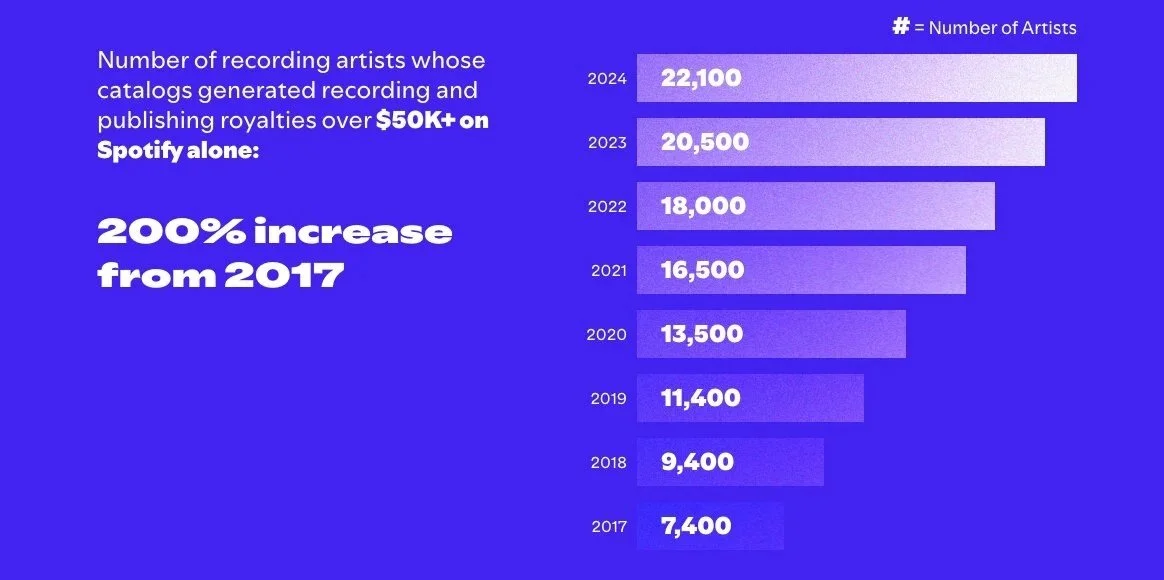
Number of artists receiving over $50k from royalties. Courtesy of Murray Stassen.
According to music journalist Murray Stassen, “22,100 artists generated $50,000 or above in combined recording and publishing royalties from Spotify in 2024, up 200% from 2017.” Artists with a mid-range of listeners are often not able to make a sustainable living off of Spotify compared to the rates they would make on other platforms.
Spotify’s shady use of AI has added to the low payout for artists. Due to how Spotify does not pay royalties to AI-generated songs, they are intentionally promoted in the user's algorithm. This hurts artists because for every AI-generated song a customer listens to, the opportunity for an artist to make money is taken away.
Additionally, Spotify has introduced campaigns that unethically decrease payments to artists. In 2020, for example, Spotify announced Discovery Mode, in which artists could trade royalty rates for algorithm promotion. Spotify would systematically increase how often songs from bought-in artists appear in the user's algorithm, and, in exchange, songs listened to as a result of this promotion would have a 30% cut in royalty payouts.
This system raises concerns that artists may feel forced to participate so they do not fall behind their competition that participates in the program. One Spotify employee confirms that “The boosted plays come at the cost of other artists.” While this promotion trade-off initiative may seem like a fair opportunity for interested artists, it's a “pay-to-play” scheme that disproportionately hurts working artists and independent labels.
The customer is also negatively affected by Spotify’s Discovery Mode, as their listening is now unknowingly affected by profit motives rather than their preferences. This scheme also often limits a customer’s exposure to new artists by artificially recommending songs they have already shown interest in.
Another flaw with Spotify is the poor sound quality. Spotify uses compressed files that lose integral audio information and streams at 320kbps, which is noticeably worse than competitors.
Even with its many flaws, Spotify’s deep catalog, convenience, decent pricing, and personalized algorithm appeal to consumers. It’s true that switching to another streaming service, or even to listening to music through physical means like CDs or a record player do have drawbacks, but there are an even larger number of benefits. Often, the true reason people continue to listen to Spotify is the perceived difficulty of switching and the reliance on established habits.
While physical options are, in my opinion, the best alternative for serious listening, I recommend the streaming service Tidal when listening to music outside your home.
Released in 2014, Tidal has built its brand around high artist royalties and high-quality music streaming. The app uses an artist-centered approach with roughly three times higher royalty rates than Spotify and noticeably higher than other competitors. Priced at $10.99 a month for an individual plan and the family plan costing $16.99 a month, the app matches Spotify’s price points for premium subscriptions.
The app also provides high-quality lossless music listening, leading to a better listening experience. Additionally, Tidal offers users access to more than 650,000 videos and concert live streams. Overall, Tidal has a reputation for its ethical treatment of artists well and quality service for customers.
Now that you understand the flaws with Spotify, which also often apply to other popular streaming platforms like Apple Music, I urge you to consider investing in a record player and to download Tidal. Changing your music routine towards these more ethical sources is not only the right thing to do, it is also a change you will be glad you made.