
Beyond the classroom, Catlin Gabel students' craziest shower thoughts
By Eliana Yoken ‘26
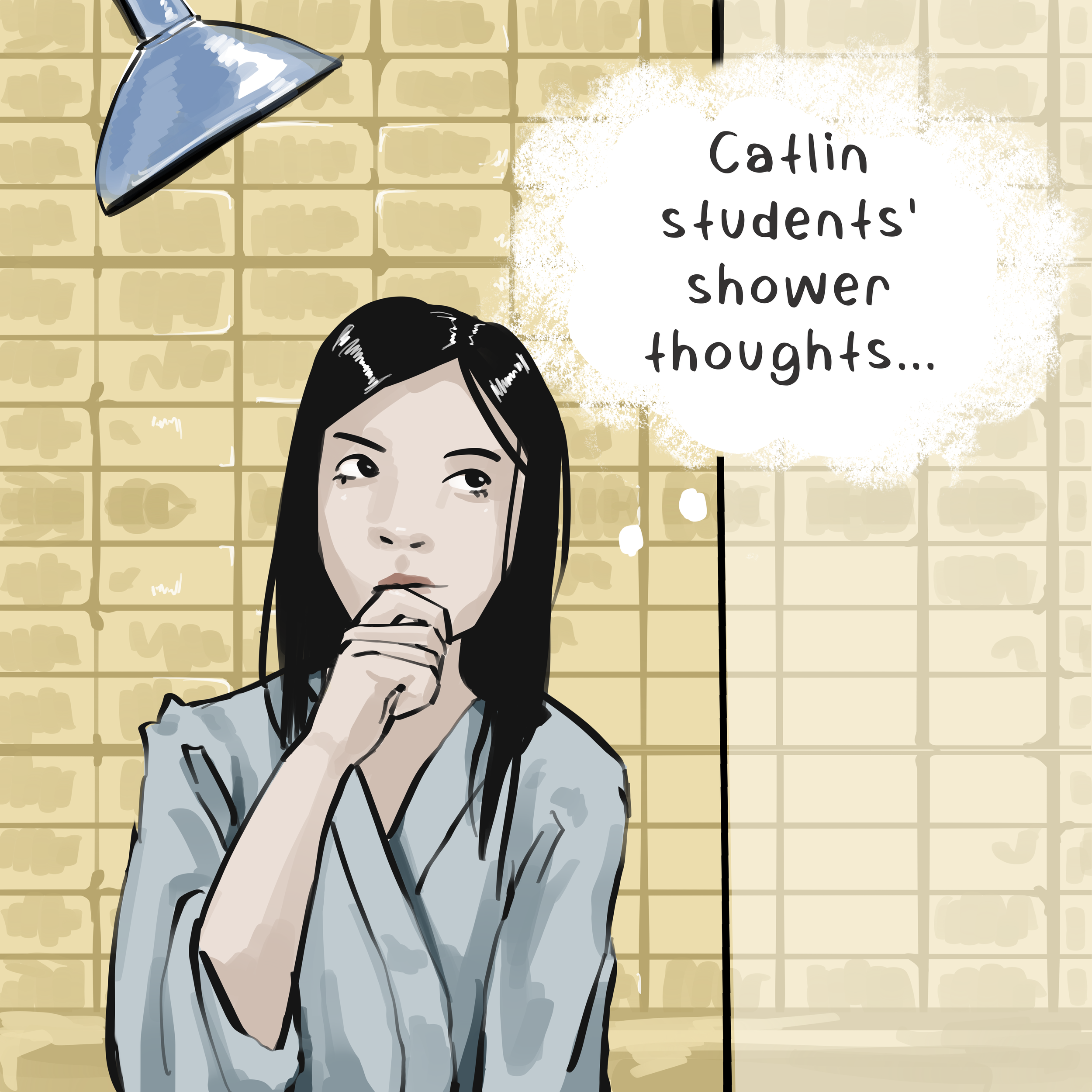
Courtesy of Ila Reynolds-Kienbaum ‘27.
Have you ever had the craziest thought…while in the shower? Well, if you have, then you experienced what is known as a “shower thought.”
Before we dive into the psychology of why these moments spark such wild ideas, I wanted to hear directly from Catlin students. So, I went around campus and asked students to share their own shower thoughts. Check out the video to see what they said.
These moments of creativity give us an outlook into the Catlin community. But there’s something even more fascinating going on. In fact, these moments aren’t random at all.
Sometimes your most creative and inspiring thoughts come from the most mundane moments of daily life. Whether that's walking your dog, sitting in traffic, heating up your food in the barn, or even showering.
This phenomenon is known as “the shower effect” and is a mixture of several psychological experiences that lead to creativity, like divergent and incubated thinking.
Creativity is more than a drawing; it involves several processes, one of which is incubated thinking. Creative incubation involves our brains solving a problem while we aren’t actively thinking of it. However, divergent thinking is just as important for the creative process.
Doctor of Philosophy and regular on ABC news, Dr. Paul Harrison suggests that “Unlike convergent thinking, which involves narrowing down to the most logical solution to a problem, divergent thinking encourages the exploration of multiple possibilities and novel connections.”
That’s exactly what’s going on in the shower. It’s the mental space where the brain feels free to think sideways rather than straight ahead. And, when we have the capacity to think outside the box, we undergo what is called the “aha moment.”
Dr. Harrison describes this drift as positive daydreaming, saying that “creative idea generation requires a balance between focused, linear thinking (which limits originality) and unbounded, random associations (which are rarely useful).”
At the neurological level, this is linked to the brain’s default mode network (DMN), which activates when your mind is at rest. The DMN handles self-reflection, imagination, and memory, allowing you to think of ideas that don’t normally come up during focused studying.
When the DMN is activated, it becomes easier for the brain to synthesize information from different classes, conversations, and experiences, which is why a solution to a math problem or the hook for your English paper sometimes hits you mid-shampoo.
There is also chemistry involved in enjoyable, low-stress activities. During these moments, the release of dopamine is triggered. Dopamine is tied to motivation and enjoyment, but it can also help the brain become more open to creativity.
However, in today's world, daydreaming is often dismissed as “zoning out” or being unproductive. Yet for Catlin Gabel students juggling demanding schoolwork, sports, arts, and other commitments, mental wandering isn’t a waste of time—it’s a critical part of learning and innovation.
If anything, shower thoughts remind us to lean in and relax. As Dr. Harrison says, “In a time that seems to be defined by constant connectivity and productivity, carving out moments for reflection and mental wandering may seem counterintuitive. Yet, as studies seem to suggest, these moments are not only restorative but also transformative.”
What are your most recent shower thoughts? Leave a comment below, but remember to keep it clean.