
The realities of being a young teacher at Catlin
By Meret Pajkic ‘26
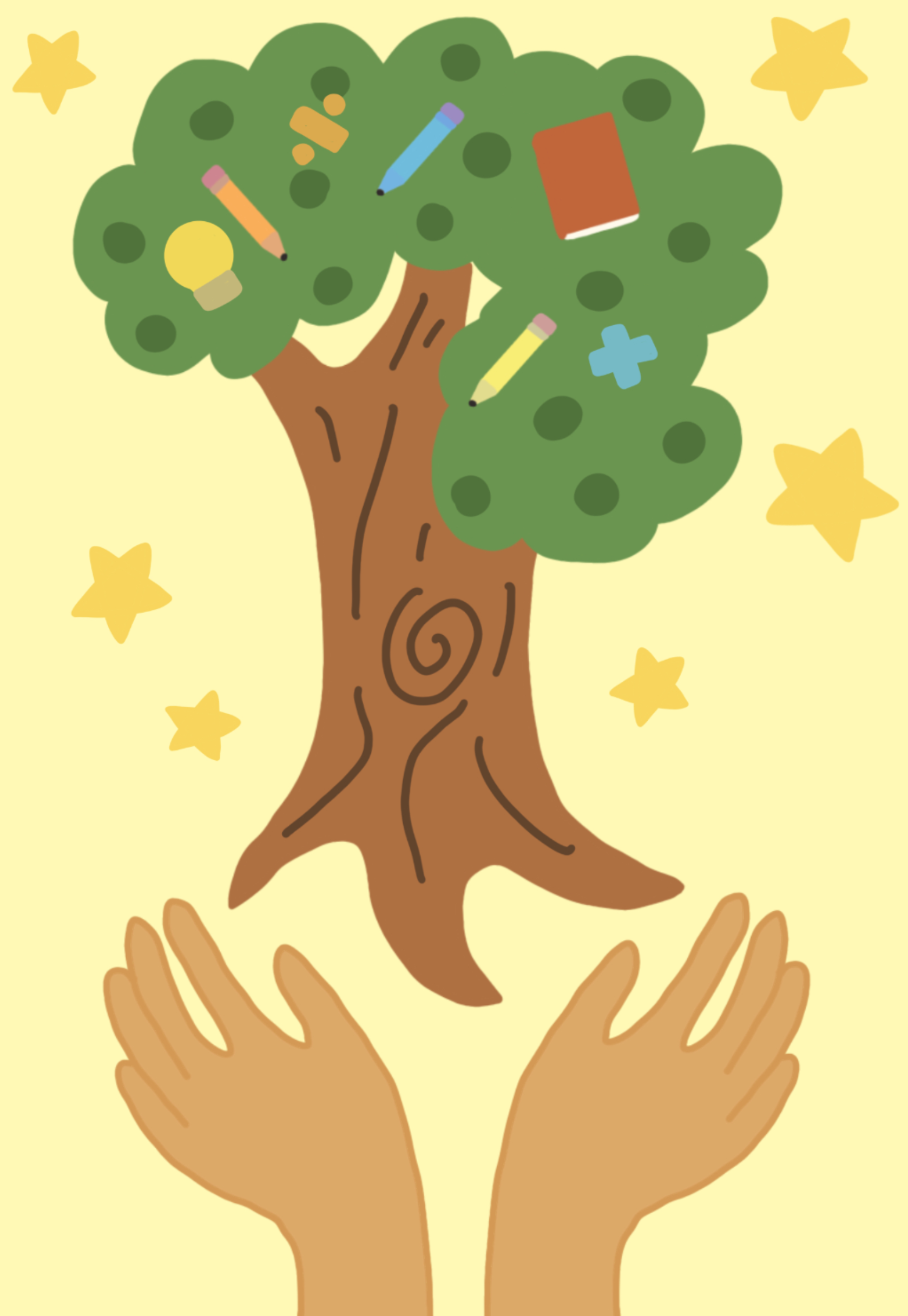
Graphic by Gracyn Gardner ‘26
A commonly perpetuated stereotype when picturing a teacher is someone older, wiser, and distinguished; they are a consistent force within their community, having stood the test of time and cemented their place as educators. But at Catlin, a large number of teachers are just starting their careers. What is being a young teacher at Catlin actually like?
According to the International Teaching Project, the average age of a teacher in the United States is 42 years old. This is a development that impacts classroom dynamics and mentorship resources available for younger educators. Entering the world of teaching can be especially challenging when young teachers feel out of place around their older counterparts.
On average, a teacher's tenure—the amount of time a teacher spends in the profession—is 14 years, while at Catlin, tenure—the amount of time a teacher spends teaching at Catlin—is only 4.4 years, demonstrating that Catlin has recently struggled to retain long-term teaching staff. Furthermore, nationally, teachers retire at approximately age 59, bringing to light the relatively short career span that has become common in the profession of education.
Young teachers are the future of any institution; however, these statistics suggest that fewer and fewer young adults are becoming teachers. It is therefore that much more important to strengthen the pipeline for adolescents who aspire to become teachers. Also, it should be noted that after reaching out to Catlin’s HR, they did not offer any information regarding the average age of teaching staff or age at retirement due to age being a protected class.
Every journey has a beginning, and the field of education is not an exception to this rule. Whether young in age or new to teaching, the path to becoming a successful educator is one of learning and immense growth.
Having a good relationship with those whom you teach is deeply important, and it is often those relationships that sustain a teacher's love for the profession. For Kathy Sloan, a math teacher who has been teaching at Catlin for over 30 years, her love of teaching started when she tutored a classmate in Geometry and ultimately helped him pass the class.
Through teamwork, Sloan was able to explain the Geometry concepts clearly and successfully, as proven by her classmate’s grade, which drastically improved from almost failing to getting a solid B. “He was so proud of himself,” Sloan continues, “I loved the feeling of helping this kid and making it [the math] make sense to him.”
Sloan’s story highlights a critical element of teaching: the relationships built between student and teacher. Often, a teacher's ability to connect with their students can be aided by things such as similar music tastes or a more up-to-date general knowledge of popular culture. Regardless of whether a teacher considers themselves older or younger, the nature of these relationships inevitably shifts as the age gap between a teacher and their student increases.
Younger teachers, in particular, can find a smaller age gap to be beneficial when forming these bonds. Considering the added importance Catlin as an institution places on teacher-student relationships, knowing how to not only cultivate these connections but also maintain them is immensely important.
At the same time, this proximity can often make the line between teacher and friend harder for students to distinguish. Morgan Kerr-Staudinger, who is 31 years old and in her second year teaching in the Catlin science department, notes an example of this, making the argument that being close in age with students also comes with particular difficulties. She cites a specific experience from her time teaching at the college level, when “a student [wanted] to hang out after lab, and [she] had to make clear boundaries about how [she] interacted with [her] college students.”
Additionally, many recommend being wary of the trap that is trying to be the “cool,” “young” teacher. While it might work for some, others implore incoming teachers to avoid it completely, such as Vick, 22, a humanities Teacher from Glasgow, who was interviewed by VICE Magazine. She learned the hard way that “it doesn’t work,” stating that “Teachers and pupils can’t be friends,” because earning students’ respect becomes increasingly more difficult.
This point is reiterated to a certain degree by Kerr-Staudinger, who emphasizes the importance of being yourself when teaching, as students can easily see through a facade. Moreover, Brett Mathes, a 48-year-old English teacher who began teaching at Catlin when he was 27 years old, adds that “your [a teacher’s] greenness or newness to the profession shows,” making it that much more important to “seek professional development regularly.”
An article written by Bryan Goodwin, a former teacher and current head of the McREL Institute at Region 13 from ACSD (Association for Supervision and Curriculum Development), sorts these struggles into three main buckets: classroom management, lack of curricular guidance, and unsupportive working environments.
To mitigate the effects of these issues—such as feeling isolated from more experienced colleagues, having difficulty acclimating and managing heavy workloads, and navigating how to effectively plan lessons—he emphasizes the importance of a mentor in tandem with the creation of support systems to help younger teachers gain their sea legs. Whether it is lessening workloads by providing classroom aids or introducing commonplace lesson planning meetings, Goodwin believes that such additions could “reduce attrition rates by more than half.”
Namely, these attrition rates - the percentage of teachers that stop teaching in classrooms - would be lowered to 18%, from a previous 31% as per a study conducted by two researchers, Thomas M. Smith from Vanderbilt University and Richard M. Ingerson from the University of Pennsylvania. As this data indicates, assisting teachers as they strive to prove themselves within their school community is vital.
Similarly, when Catlin teachers were asked what made their transition into teaching easier, their response largely mirrored the solution presented above. For instance, Cristy Vo, a 35-year-old Catlin English teacher who joined the school community when she was 31, expressed that “the key,” when she started, “was having a mentor teacher” who told “[her] what [she] should or shouldn’t do and how to create boundaries.”
Sloan shared a similar sentiment, fondly recalling feeling “like [their] pet” and that “they [veteran teachers] were training [her] to be the future of Catlin.” It is clear that a lot can be learned from those who came before you and that more seasoned educators are eager to impart such wisdom to their younger counterparts, such as when long-serving Catlin teachers took Sloan “under their wing.”
Although teaching is undeniably difficult, as it is a profession that introduces both emotional and financial strain upon educators, it also allows for immense amounts of personal satisfaction, spurred by knowing that you are bettering the lives of a younger generation, providing them with the tools they need to succeed.
For young teachers, alongside the aforementioned challenges, the experience of entering the classroom is a culmination of personal conviction, idealism, and a unique ability to connect with students in ways that feel authentic and meaningful. If you are considering becoming a teacher, Vo advises to “Do it! We need so many teachers,” and the way “younger teachers connect with students [is] really special.”