
OPINION: Black Star’s life-changing lyrics will reconnect you with the art of music
By August Walrod ‘26
Courtesy of Rawkus Records
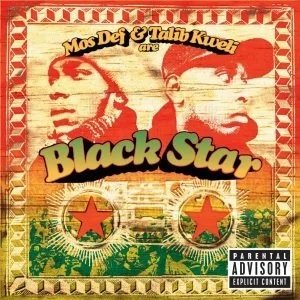
Self-proclaimed “best alliance in Hip Hop,” the pair of conscious-rap MC artists, Yasiin Bey (formerly known as Mos Def) and Talib Kweli created one of the most innovative, influential, and powerful music albums of all time. In Mos Def & Talib Kweli are Black Star, the pair craftfully blends high-quality instrumental melodies with intellectual lyrics that make you “rewind on top your master disk” to enjoy the clever rhyme and provoking message (Black Star: “Definition”).
Since they released their 1998 album, society has shifted from listening to music via a physical device, like you would have with a CD, to a digital one. This is partially responsible for our decrease in active engagement when we listen to music, and instead promotes music as background entertainment. We pick up the vibes and emotions of songs, but we miss their message and creativity.
By approaching music as an artform, your enjoyment of a song will increase because of your newfound presence with the poetry, sound production, and cultural relevance. You will also more clearly hear the artist’s intent and be able to apply the principles of the music into your life.
Black Star’s music is ideal for this purpose, even for non-listeners of Hip Hop, because of the album’s relevant message as well as the duo’s immense musical and lyrical talent.
The message of Black Star is twofold. First, Black Star indiscriminately reveals the injustices within America through an anti-assimilationist perspective. Second, they call each person to action, especially those within the Black community, by preaching self-empowerment through the pursuit of knowledge.
In Mos Def & Talib Kweli are Black Star, Black Star acknowledge that many Black people have been stuck in loops of crime and poverty because of the historical and widespread discrimination against Black people, but they also correct this narrative by replacing vague indictments of racism with anti-assimilationist messaging on the hate crimes still perpetrated today. They also focus on the greatness that resides within the Black community and show people how they can stand up against exploitation.
To test whether my theory that the album is ideal for reconnecting oneself with music, I headed down to the Catlin Quad to conduct some street interviews with Upper School students.
After listening to the song “Respiration ft. Common,” Atef Siddiqui ‘27 said that the lyrics were interesting and that “it felt like there was a lot of commentary on New York and its state.” He picked up that “the message is corruption, poverty, and the highs and lows of a city like New York.”
Gabriel Medhanie ‘29 enjoyed the song’s slow beat and added that for him, “first listen, I am not trying to listen to the lyrics, but I feel I could catch on.”
As Siddiqui and Medhanie found, it is hard to grasp the full meaning of a song in just one listen. Reconnecting with the art of music is a continued process that occurs over multiple listens as we shift from hearing what topic a song is talking about to understanding what the artists are saying about that topic.
Catlin Gabel students specifically should listen to the album because of how it complements the learning in many Upper School classes, with many similarities to U.S. History’s commentary on the efforts of the Black community to forego assimilationist solutions in the quest for better lives.
Mos Def & Talib Kweli are Black Star pulled Hip Hop towards its poetic roots based in community, commentary, and artistic expression in a time when Hip Hop was becoming mainstream and commercially focused. They felt called to refocus Hip Hop as a result of growing up in New York circles where they were inspired by artists like De La Soul, Tribe Called Quest, and Public Enemy, who merged their music with politically-minded commentary.
The head-rocking flow and inconceivable rhymes that are the basis of the sense of pride that Black Star radiates throughout the world can be found in a close listen to "Respiration ft. Common."
In “Respiration ft. Common,” Bey, Talib Kweli, and Common rap about the modern-day realities of city life, specifically in New York. The song begins with a snippet from an ’80s documentary “Style Wars: The Birth of Hip-Hop,” where legendary graffiti artist Skeme talks about a work of graffiti he recently created within a poorer and primarily Black neighborhood. He covers two train cars with the message: “All you see is crime in the city.”

Skeme’s legendary graffiti art on New York train cars that reads “All you see is crime in the city.”
Courtesy of The City in Literature.
At first glance, it may seem like this art is trying to bring awareness to the unfortunate prevalence of crime due to poor living conditions. However, the graffiti emphasizes that the outside observer, “you,” is the one who only sees crime. The purpose of the art is to highlight the narrow-minded and judgmental perspective that many outsiders hold about graffiti art and crime within primarily Black neighborhoods.
Black Star’s verses prompt people to observe with a more nuanced lens, as the next lines contrast the sentiment that crime is rampant by saying “Escúchela, la ciudad respirando” meaning “Listen to her, the city is breathing.” The use of Spanish emphasizes the disparity between outside viewers only “seeing” crime, with the reality that, through listening, you can hear the city breathing.
The rest of the song contrasts that simple view of crime that the graffiti introduces with what Bey, Kweli, and a featured guest rapper called Common observe within the city. Bey prefaces the listener by telling us that “This ain’t no time where the usual is suitable. / Tonight alive, let's describe the inscrutable.” He is referring to the need to look at white-collar crimes like embezzlement that are not visible on the streets.
Bey reveals that the true crime in the city comes from mercenaries who are “paid to trade hot stock tips for profits.” The allusion to “trading hot stock tips” uncovers the corruption within financial districts like Wall Street. Bey juxtaposes these businessmen with the realities that working-class residents feel, as they have “no options;” if they want to stay alive, they have to “pay or die.”
The dichotomy that Bey creates, where working-class people are forced, for example, into either paying or dying, appears in multiple verses of the song. This is a continuation of their statement that people oversimplify reality. Bey is also commenting that this lack of options is the result of exploitation from groups like the mercenaries.
Bey also describes the police, because of their unlawful brutality, as the true and unseen criminals of New York. Bey raps, “No Batman and Robin / Can't tell between the cops and the robbers / They both partners, they all heartless, with no conscience.”
These lyrics contrast those in power, like the police or the wealthy, with working-class people. Viewing the beaten-down state of neighborhoods as the result of active exploitation instead of historical discrimination leads Black Star and Common to call people to empower themselves.
Bey raps that “Back streets stay darkened / While unbeliever hearts stay hardened.” He continues that “My eagle talons stay sharpened, like city lights stay throbbin.'” Keeping his talons sharpened represents his continued search for greatness as an alternative to having an unbeliever’s heart that stays hardened. His line that “The shiny Apple is bruised but sweet” is a reference to how despite the hardships enacted on his neighborhood of New York City, he believes in its goodness.
The thematic richness and clear, universal message keep the album relevant more than two decades later. The production of this album also gained Bey and Talib a reputation within Hip Hop circles, pushing them both towards long and successful careers. Bey produced the hit album Black on Both Sides in 1999, and Kweli came out with Train of Thought in 2000.
The album has been part of a renaissance of conscious rap and showed the music world that alternative rap can have broad impacts. Though the group only has just over 600,000 monthly listeners, the standalone album has had an outsized impact on the music industry. Black Star’s redirection of Hip Hop has influenced current artists like The Roots, Lupe Fiasco, Kendrick Lamar, Joey Bada$$, and J. Cole.
In J. Cole’s 2013 hit song “She Knows ft. Amber Coffman & Cults,” he references “A Black Star, Mos Def, Kweli.” This reference pays homage to the Black Star duo as influential figures of the late golden era of Hip Hop. J. Cole's reference to Black Star here also serves to portray them as a guiding light to him as he deals with the earthly temptations he speaks on in that song.
Black Star’s reputation as the embodiment of conscious-rap within the Hip Hop world shows the value that their music holds as a stronghold of artistic expression. As you consider your own connection to music, I strongly recommend that you begin your journey by jamming out to Mos Def & Talib Kweli are Black Star.