
Catlin Gabel redefines narratives and honors Women’s History Month
By Ariana Bajaj ‘26
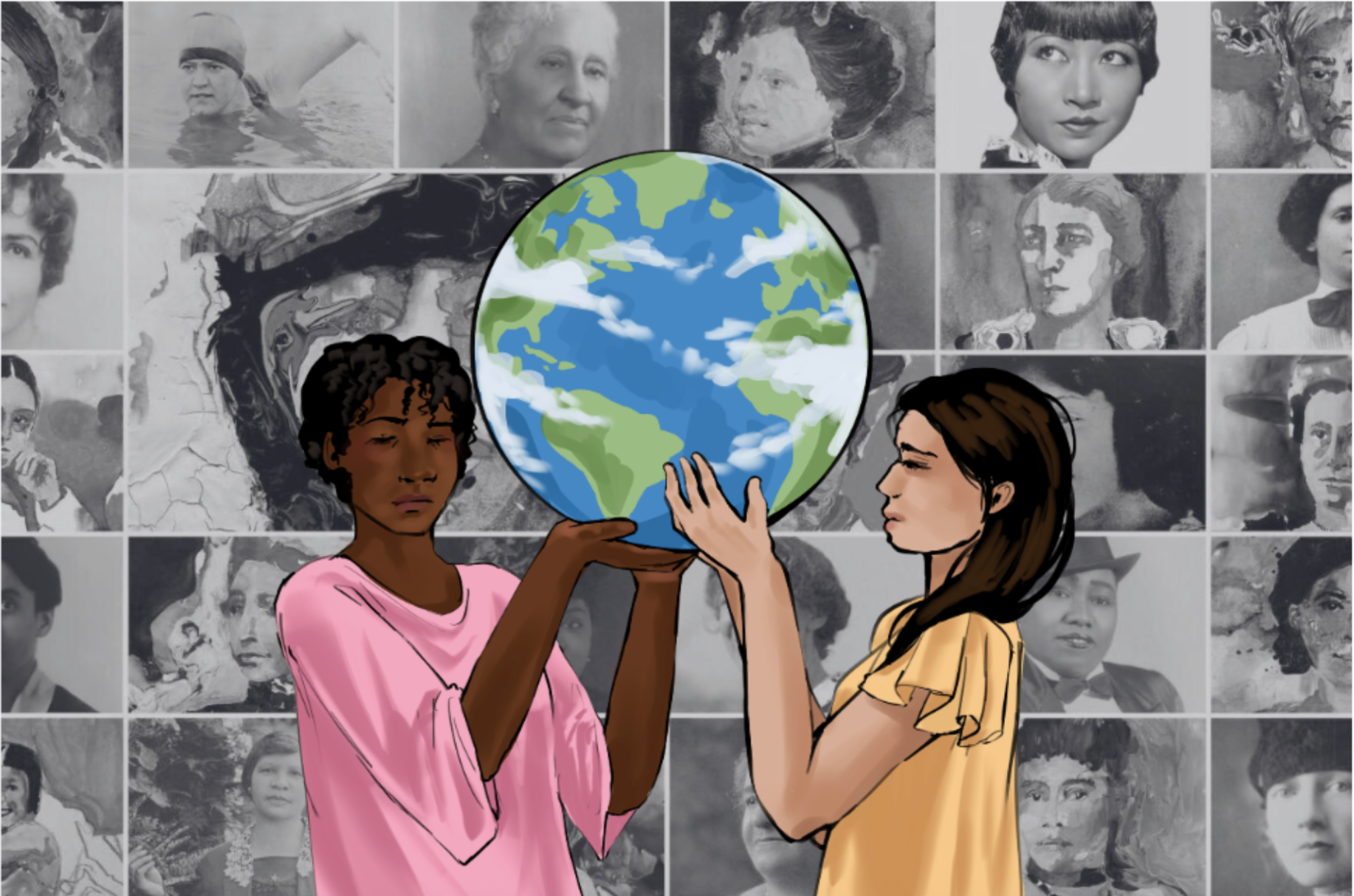
Courtesy of Ila Reynolds-Kienbaum ‘27. Background illustration by National Endowment for the Humanities.
Each March, classrooms, museums, and social media feeds fill with stories of trailblazing women. Names that were once sidelined in textbooks resurface in lessons and assemblies, prompting reflection on who shaped history and who gets to be remembered. At the center of these conversations is Women's History Month, a national observance rooted in both celebration and correction.
Women’s History Month did not begin as a federal initiative. In 1978, the marking of March as Women's History Month began as a local celebration in Santa Rose, California. By 1987, Congress recognized the entire month of March, transforming a local effort into a national celebration.
This month was created in response to a persistent imbalance. For years, history education has largely centered on male political leaders, inventors, and other figures, often minimizing women’s contributions. As Medium, a publication journal, put it, “History is littered with invisible women who, in spite of aspiring to and reaching higher standards than most of their male peers are held to, still stood cast in a male’s shadow.”
According to the National Women's History Museum, the goal was to ensure women’s contributions were recognized as central to history, not secondary.
While the month honors historical progress, many students look up to leaders whom they have grown up hearing about. Activists like Malala Yousafzai show how young women can influence the global conversation about education and their place in the world. Scientists such as Marie Curie, who conducted groundbreaking research on radioactivity, and Katherine Johnson, whose calculations aided space exploration, remind us of the crucial role that women play in developing science and technology.
Artists and filmmakers such as Greta Gerwig, Ava DuVernay, and Frida Kahlo have redefined the capabilities of storytelling through art. These figures demonstrate that women are not just historical icons; rather, they are creators, leaders, and innovators whose influence continues to grow. By shedding light on both past and present achievers, this month encourages women to aspire to new possibilities.
At Catlin Gabel School (CGS), students and teachers view the month as both meaningful and complex. Marguerite McKean, an Upper School science teacher, views it as an opportunity to actively contribute to the dialogue. She explained that she takes pride in highlighting “women and other minority genders in the sciences” who are often left out of mainstream narratives.
McKean added that she previously ran a blog profiling underrepresented scientists. Her goal was to raise awareness about people “who don’t normally get displayed on posters,” especially in fields historically dominated by men. Although the blog is no longer active, she continues this effort in her everyday life and as a teacher at CGS.
She reflected on the general purpose of celebration months. “Until there is systematic change,” she said, they remain necessary to spotlight inequities and disparities. At the same time, she acknowledged that “bucketing it into a single month” can sometimes allow bigger institutions to feel they have done enough.
Still, McKean finds power in celebration. Recognizing achievements can create what she described as “radical joy.” For her, Women’s History Month functions as both a corrective time and an important celebration of progress.
Senior Aston Selley views the month as a time to acknowledge change. When asked about the meaning, Selley saw it as an essential time to “acknowledge all the things women have contributed to society.”
While some argue recognition should be constant, Selley believes concentration makes it more meaningful. “By having it be its own individual, isolated time,” he explained, “it actually has more meaning because it is brought up more.” In his opinion, a focused month places greater emphasis on the efforts.
However, Selley does not think appreciation or recognition should stop in March. He emphasized that gratitude and respect for women should continue year-round. Selley added, “We really have so much to be grateful for; it is a time we can look within ourselves and reflect.”
Another senior, Campbell Young, noticed the impact of Women’s History Month in both the CGS community and the media. She sees it as a time to “celebrate the women in our lives” and recognize achievements past and present. Around campus, she observed small acts of appreciation and kindness.
Online, she notices a shift in visibility. Young noticed that March brings increased coverage of “women in science, sports, and politics” that she does not usually see trending year-round.
For Young, she specifically pointed to sports coverage as an example. “It feels like in March people remember how incredible they are,” she said, “but it shouldn’t take a specific month.”
Ultimately, Women’s History Month at CGS reflects both gratitude and urgency. For some, it is a time to spotlight voices and perspectives; for others, it is a reminder that recognition must continue past March. Across different perspectives, one theme remained clear: appreciation matters.
The month asks the community to pause and recognize the women who shape classrooms, laboratories, households, sports teams, and history books (to name a few). It honors progress while acknowledging the inequalities that remain. Celebration, as McKean suggests, “can be a powerful call to action.”
Balancing the scale does not happen overnight. It happens with each lesson, conversation, or act of reconciliation. By continuing to notice and appreciate the women around us, the CGS community can move closer to a future where visibility is no longer a seasonal effort, but a standard.