
OPINION: Dogs should be allowed on Catlin Gabel’s campus
By Krish Caulfield ‘26
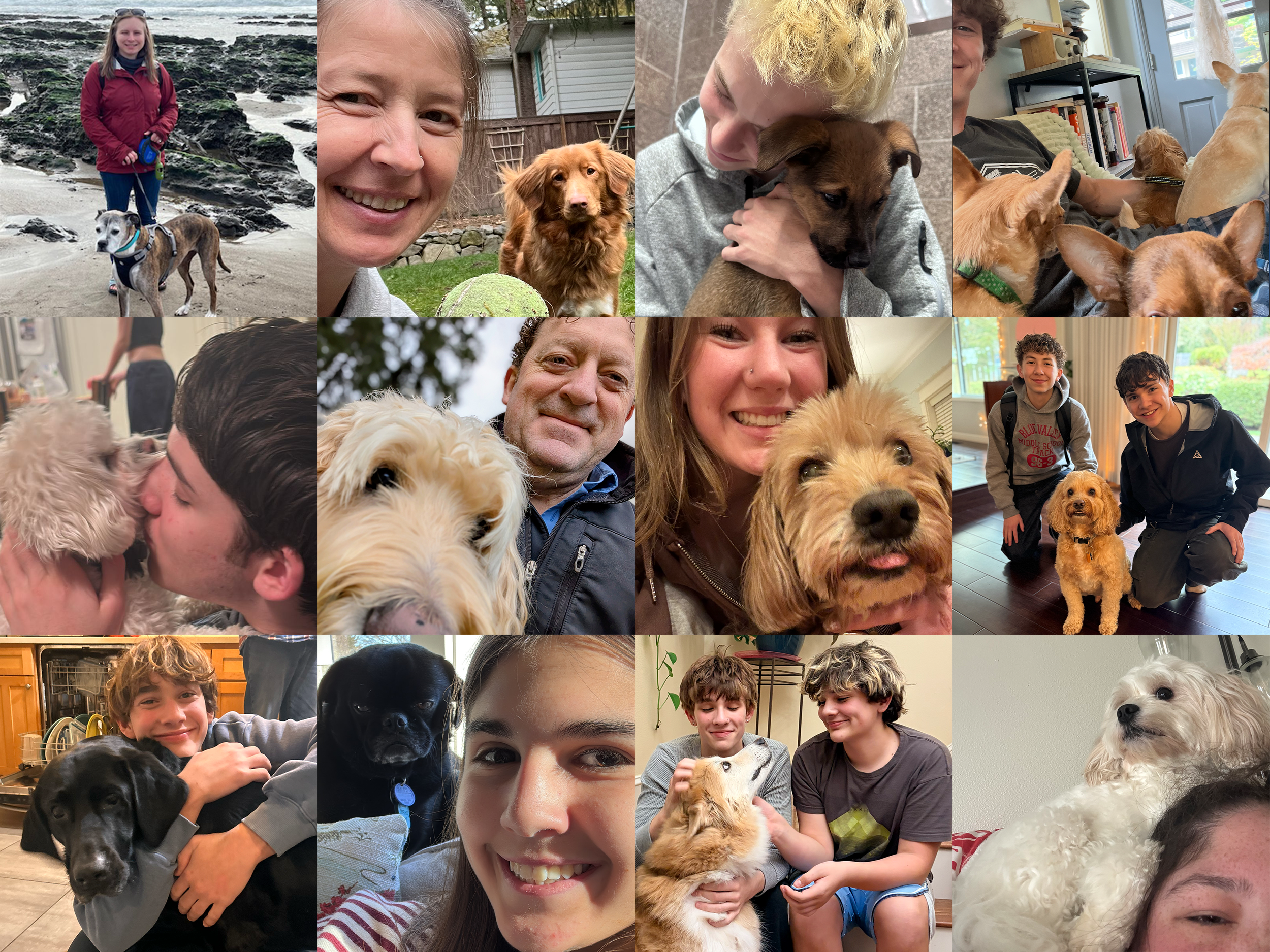
Catlin Gabel School (CGS) community members with their dogs. Graphic by Krish Caulfield ‘26.
It’s a clear March afternoon, the sun glints through the slowly-swaying palisade of Douglas firs enclosing the CGS campus, illuminating the dashing stature of a golden retriever leaping to fetch a frisbee flung over the quad. Imagine, for a moment, the ensuing instant in which paw prints softly percuss on the nearby cement path, igniting the simple conversations only the presence of a four-legged friend can fetch—questions from the arsenal we all possess the keys to, like “aww, what’s his name?” or “how long have you had her?”
This image feels natural—should feel natural, rather—and yet it is foreign on the CGS campus.
Why does this feel so unfamiliar? Well, any avid reader of the Catlin Gabel Family Handbook can tell you that “for the health and safety of all children, dogs are not allowed on campus at any time.” However, “service and therapy dogs are welcome when they are working or in training.”
The concerns that merit this policy stem from relatively practical instincts. To dissect the “health” portion of the school’s policy first, many CGS students (likely between 10% and 20%) suffer from dog dander allergies. This feels palpably misaligned with the ever-present condition of the student body, where inhalers and spray hand sanitizers feel like staples in the CGS student starter pack.
As for “safety,” estimates suggest that about one in five dogs is reactive. Reactivity is defined as “emotional dysregulation” and differs from aggression; a reactive dog is unable to appropriately respond to emotional arousal, whereas an aggressive dog intentionally acts to harm another. Reactivity typically manifests in behavior like herky-jerky leash-pulling, jumping, and/or vocalizing.
It is worth mentioning that great CGS rival, Oregon Episcopal School (OES), even with the aforementioned drawbacks in mind, maintains a distinctly different policy, which prohibits dogs during pick-up and drop-off periods, and restricts their presence around the Lower School, but encourages visitors “to bring dogs to the outside areas of campus on a leash, staying with the owner.” Dogs are, as a result of this policy, a familiar sight on the OES campus, particularly during sporting events.
You might recall dog-dusted dunes surrounding the OES track during their homecoming, where a keen eye could spot Rory Reed Walsh, the prized pooch of Upper School teachers Maureen Reed and Patrick Walsh.

Reed with her dog, Rory. Photo courtesy of Maureen Reed.
Rory is not the only dog in the CGS Upper School. According to my survey of 30 students, approximately half of CGS Upper School households have a dog, and over half of those households would consider bringing their dog to campus, be it in the car or on a leashed walk. Extrapolating that data to the entire 322-student Upper School indicates that, based on the responses, about 161 students (50%) have dogs, and roughly 97 students (60% of those with dogs) would consider welcoming their dogs to campus.
That’s a lot of dogs. The relevance of these doggos is not limited, however, to who owns one. Science—as it often does—has answers on how brief encounters with them might be just what CGS needs.
In a conceptual analysis article in Frontiers in Veterinary Humanities and Social Science, synthesizing multiple studies, researchers affiliated with various universities illustrated the bond between canines and people: “Through the processes of domestication and natural selection, dogs have become adept at socializing with humans.” This socialization, not only with their owners but also with strangers, has benefits to human well-being.
These well-being benefits are often represented using a biopsychosocial model, which—as the name effortlessly suggests—breaks well-being into three buckets: biological, psychological, and social. Interaction with dogs aids all three of these categories.
To begin, studies have found that even short-term interactions with dogs, such as a pet in the quad, can influence heart rate, blood pressure, sweat response, and the positive regulation of neurochemical indicators. Changes in these neurochemicals include increased production of serotonin, dopamine, and oxytocin, as well as reduced cortisol.
Serotonin controls a variety of functions in the body, such as digestion and wound healing, but is generally most notable for its impact, when at ideal levels, on generally feeling more joyful and focused.
Dopamine, in a similar vein, is a hormone that is a part of the body’s reward system, and as you engage in activities that feel pleasurable, your body releases it. On the backend, dopamine is involved in memory, cognition, and even learning.
Interestingly, these two are known as the “feel-good” chemical and hormone, respectively.
As for oxytocin, Upper School science teacher Megan McLain explained that it is “an attachment hormone,” and as you feel more attached to an individual—even across species—its levels rise. Therefore, dogs also release oxytocin when they bond with their close family members or those they’ve met before.
And cortisol? McLain explained that “we tend to release it, especially on long-term, low-lying stresses” that eventually accumulate to cause morbidities like heart disease or obesity. As time is spent with dogs, the body’s stress response cools, in turn lowering cortisol in as little as ten minutes.
All these dog-related mood improvements sound awfully nice in a school with a clear culture of normalized stress, where students gloat about sleep deprivation or go extracurricular-for-extracurricular on the daily.
These well-being benefits are not just theoretical. McLain recalled that when she was teaching International Baccalaureate (IB) courses in Prague, Czechia, there was a therapy dog that would come multiple times a week, and said that she “witnessed [the impact of dogs] firsthand” as for “certain kids, that is the one thing that calms them. It’s pretty special.”
The aforementioned study synthesis cements McLain’s personal experience, as short-term interactions with therapy dogs in youth have been shown to lead to “improvements in specific aspects of learning and cognition,” such as reading and memory, while also reducing stress and psychological aspects vital to academic performance in college-aged adults.
Now, there has been a therapy dog on campus before. You might be picturing the latté-pigmented fur of the English Labrador Retriever, Lucy Stout, who visits campus roughly monthly.
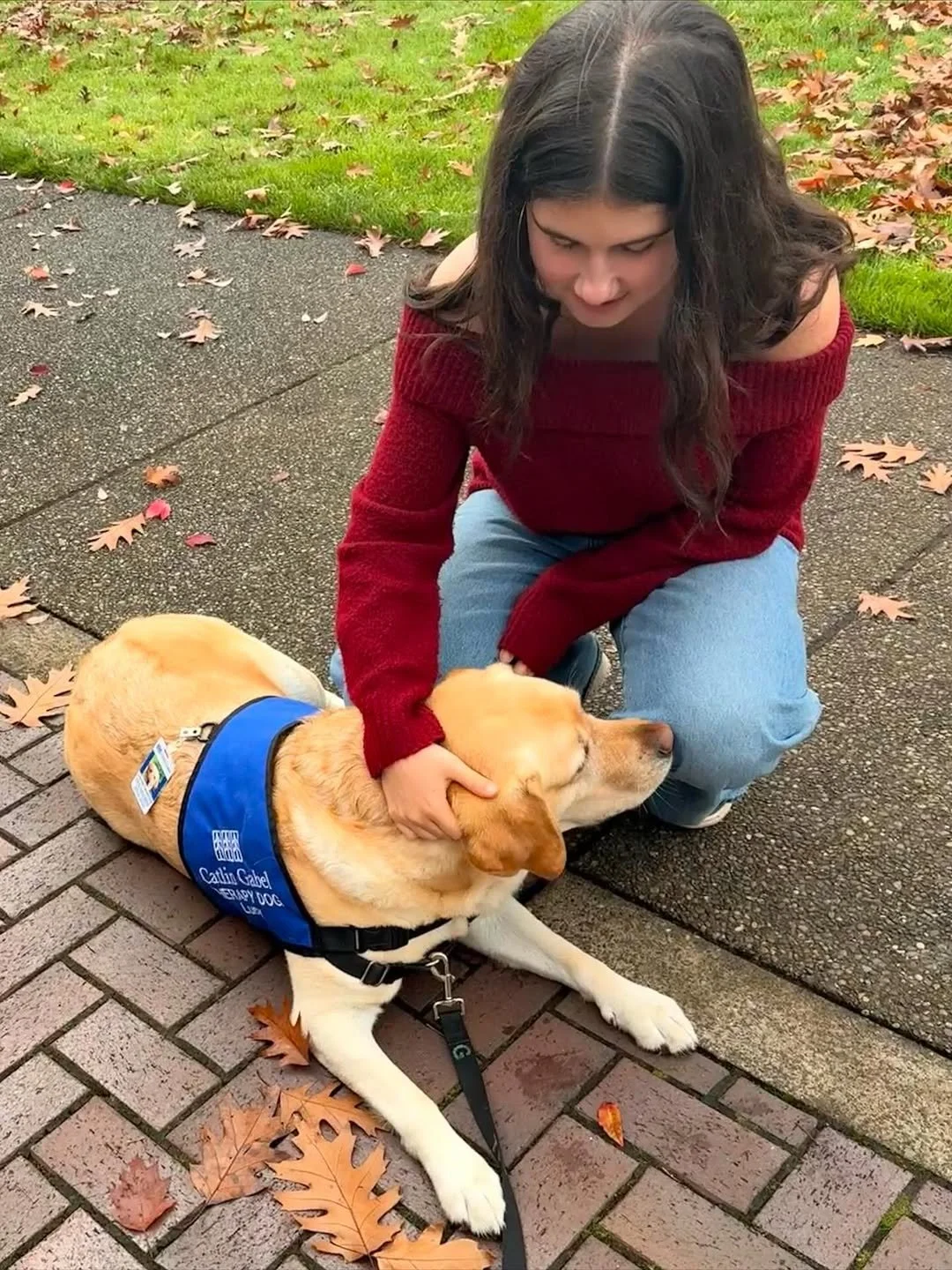
Sophomore Zoe Wittig pets Lucy in the quad. Photo courtesy of LucyLabPDX.
Sophomore Zoe Wittig reflected on the impact Lucy had on her: “I really appreciate the chance to slow down and take a break from the school day, and I think her presence brings a lot of joy to campus.”
So, why ration this joy? If even a brief interaction can markedly alter levels of feel-good and stress hormones, then confining those benefits to a rare appearance undoubtedly leaves a great deal of potential unrealized, particularly in a community already home to hundreds of students who recognize the value of canine companionship.
On top of this, the community—if altered to include dogs—would, in fact, become bigger. McLain explained that a change to include pups “actually brings in the neighborhood community” to play with “their dogs on campus, maybe after hours.” CGS, as an open campus, is already porous, with families and neighbors filtering through; dog inclusivity would simply deepen its commitment not only to the simple definition of an open campus but also to community in general.
Tangible benefits lie in this potential change, as Scientific American reports that “dogs reign king as social lubricants,” with those simple conversations I mentioned earlier or a tail wag from dog-to-dog overflowing with potential for deeper connection.
This all sounds lovely, and we are in possession of fine justification for why it isn’t the reality, but where can we reasonably go? Lucky for you, I have a four-legged proposal.
First, the boring stuff. There need to be clear expectations—reminiscent of OES’s—for anyone who dares bring their pooch on campus: dogs are to be leashed at all times, any business must be promptly cleaned up, and there will be no-dog zones (near the Beginning and Lower School (BLS) and Playground-Fir Grove area). The stability of this novel policy rests on the integrity of the community members who benefit from it, and if there are no expectations regarding accountability in terms of safety and sanitation, then there cannot be a policy.
These expectations cannot effortlessly erase the validity of concerns for students with allergies or fear of reactivity. However, the combination of dog-free zones and leash requirements, alongside behavioral standards for the dogs who come on campus during school hours balance these concerns with the broader benefits dogs undeniably offer the CGS community.
In the next measure, the campus becomes open to dogs outside of school hours (from 4:00 p.m. to 8:00 a.m.). McLain mentioned that many local public schools, particularly those in the Beaverton School District (BSD), function as quasi-dog parks in their off hours. Allowing leashed dogs would enable the neighborhood-centered, socially-lubricated dialogue discussed earlier, with the hour confinement limiting the potential academic disruption of their presence.
It would be naïve to claim that these hours would erase student interaction with dogs, but that is not the point at all. Voluntary interactions with dogs, particularly strangers’ dogs, foster a level of beneficial social courage while redeeming the aforementioned benefits of dog interaction.
More of this glorious dog interaction would come from school-day access for certain dogs from CGS community members (parents, faculty, etc.) awarded the esteemed title of Canine Good Citizen (CGC). CGCs know how to accept friendly strangers and receive pets, maneuver through a crowd, stay and come fluently, and react to other dogs.
McLain explained that after a few training rounds and a 10-step test with a CGC evaluator—a “rigamarole” as she more eloquently put it—a dog can obtain a certification of a behavioral standard. These specially certified dogs, as well as therapy dogs, could then come on campus during pickup times, or CoCu periods, and operate similarly to Lucy, if their owners so wish.
The fourth and final leg of my proposal would be to facilitate a couple of events that support the change in policy. Spring athletic events, such as track meets or outdoor tennis matches, could be advertised as “Bring Your Dog Nights” where a few dogs scatter the hill between the eastern side of the track and the Tiny Forest or the hill east of the tennis courts near the Middle School. These present the truest opportunities for dogs to operate as sources of joy—disconnected from their stress relief-related benefits—and help cultivate new connections within the CGS community.
McLain says all of it plainly: “I love dogs, and I would love to have them, and I get so much joy from petting people's dogs.” Her sentiment reflects a belief that is certainly present in the CGS community. The question, then, lies in whether a community so committed to an optimized and inclusive education is willing to adjust its communal environment with its values in mind.