
How the CGS community is getting involved in political action
By Evan Zhang ‘26
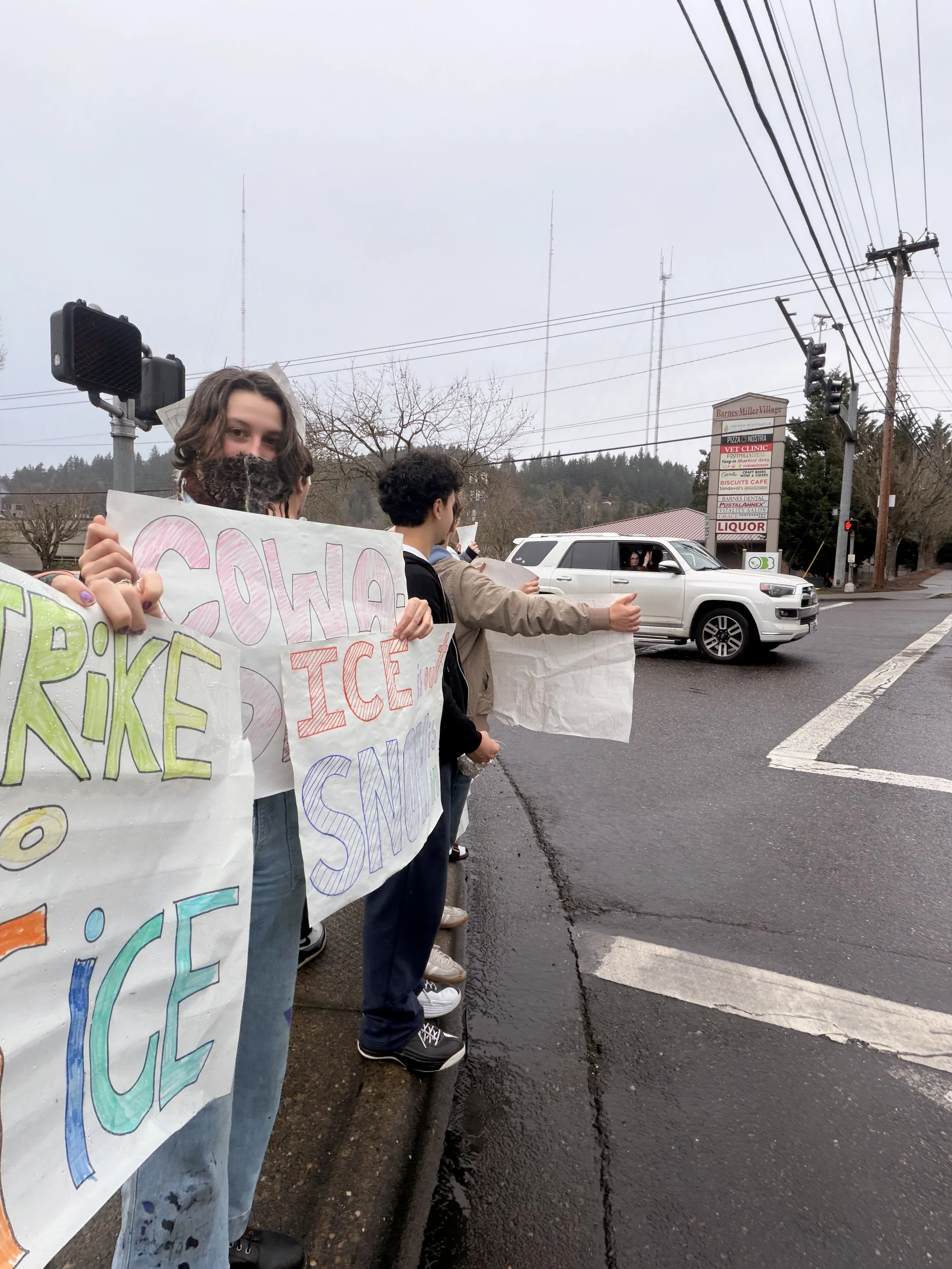
Students protesting ICE outside QFC. Courtesy of Eliza Frank ‘28.
Since January, protests against the Trump administration’s immigration crackdown have swept across the United States. As demonstrators take to the streets in cities like Minneapolis and Portland, Ore., community members at Catlin Gabel School (CGS) are likewise engaged in civic action. On January 30, a student-led walkout took place at QFC to protest Immigration and Customs Enforcement (ICE); on February 13, faculty arranged an on-campus teach-in about immigration policy.
Two fatal incidents involving federal officers and citizens fueled aforementioned demonstrations: the January 7 shooting of Renee Good by ICE and the January 24 shooting of Alex Pretti by Border Patrol. According to PBS News, both Good and Pretti were American citizens, and their deaths — caught on camera — have sparked nationwide outcry.
On Friday, January 30, major walkout-style protests mobilized in many states. The self-proclaimed “nationwide shutdown” denounced ICE, encouraging students to miss school, employees to miss work, and all participants to avoid shopping for the day.

News of the nationwide shutdown spread on social media. Courtesy of nationalshutdown.org.
In Minneapolis, where both shootings occurred, hundreds picketed outside of a federal ICE office, said AP News. The demonstrations were not confined to Minnesota, however. In Michigan, California, and Maine, for instance, high schoolers and adults alike were seen protesting before businesses, churches, and detention centers.
As reported by Oregon Public Broadcasting, Portland saw high levels of participation in the walkout. Although the public school system did not cancel school on January 30, hundreds of students took the day off and gathered locally, with one rally organized in Northeast Portland. Moreover, some small businesses closed up shop in solidarity or donated a share of the day’s revenue to anti-ICE causes.
“National Shutdown” Student Walkout
That same Friday, on the CGS campus, a group of students held their own walkout by a nearby QFC. Organized by Eliza Frank ‘28 and Zoey Carlson ‘28, the demonstration consisted of approximately 15 people — primarily underclassmen — and lasted two hours. Frank not only sent the entire sophomore class an email that morning about the protest, but also spread the word through handmade posters and word-of-mouth.
When asked what prompted them to stage a walkout, Frank described wanting to engage with the shutdown but feeling like they had nothing to do. “That morning, I decided, ‘I’ll make something to do. I’ll organize something,’” they reflected.
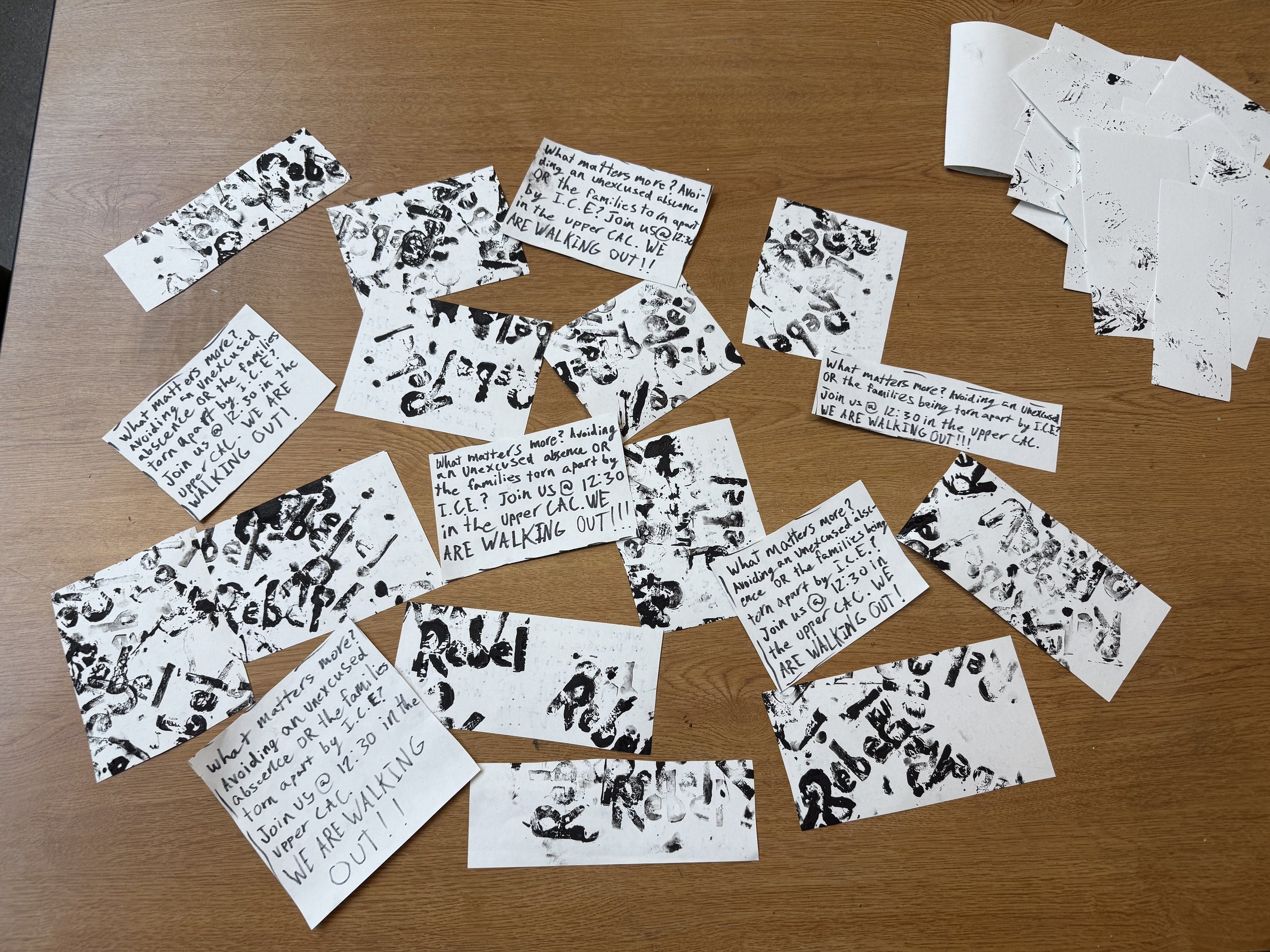
Posters handwritten by Frank and Carlson to promote the walkout. Courtesy of Eliza Frank ‘28.
At the start of lunch, the group met in the Creative Arts Center to make signs.
For inspiration, Andrew Cole ‘28, who attended the walkout, said he and his peers drew upon messages they had seen on social media. His own sign, reading “I like my ICE crushed,” included a slogan from Instagram Reels. Other posters read “Abolish ICE,” “CowardICE,” “Deport the Nazis,” “Secret Pol-ICE,” “Strike to melt ICE,” and “Protect our neighbors.”
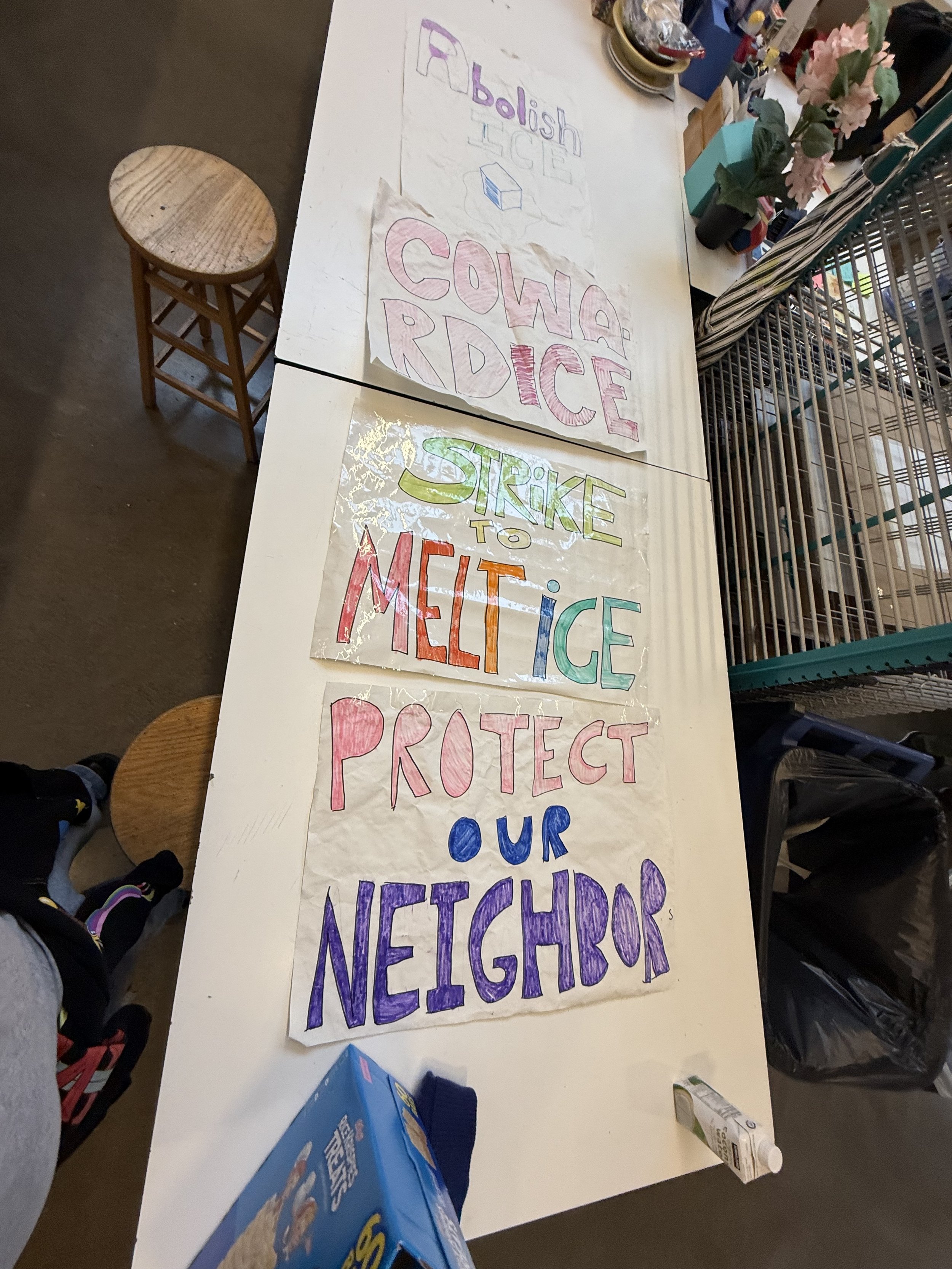
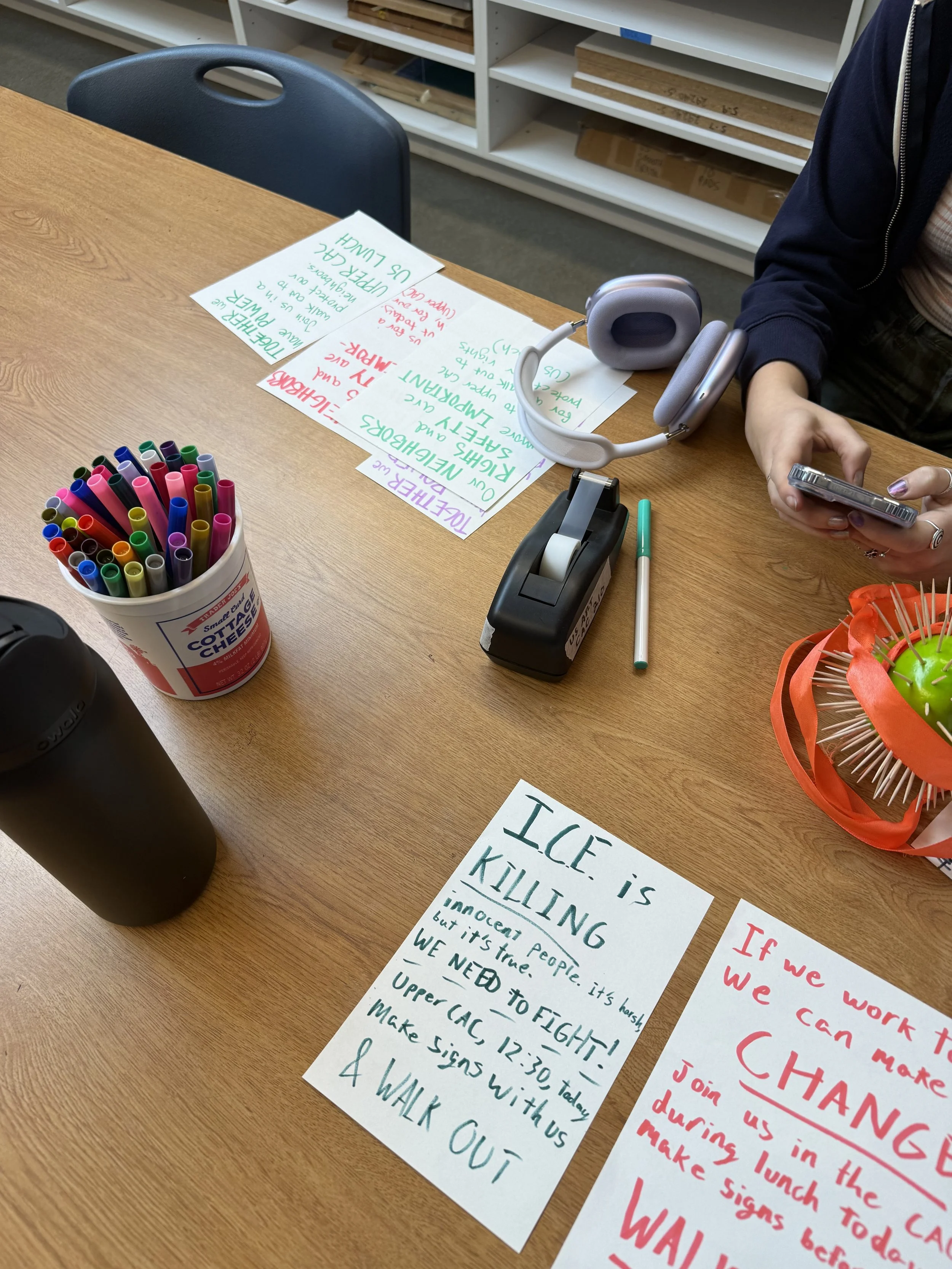
Signs and posters designed by Frank, Carlson, and their peers. Courtesy of Eliza Frank ‘28.
After lunch, the group traveled off-campus to the nearby QFC on Barnes Road, where they protested from Block 7 until dismissal. During those two hours, students repeated two different chants to onlookers. According to Frank, thes
e were “Spread love, not hate” and “Say it once, say it twice, Portland does not f### with ICE.”
In general, the students were greeted with encouragement by passing cars and pedestrians. “We just got…lots of, you know, honking, cheering,” Cole recalled. Additionally, two Upper School (US) faculty members honked or waved as they drove past.
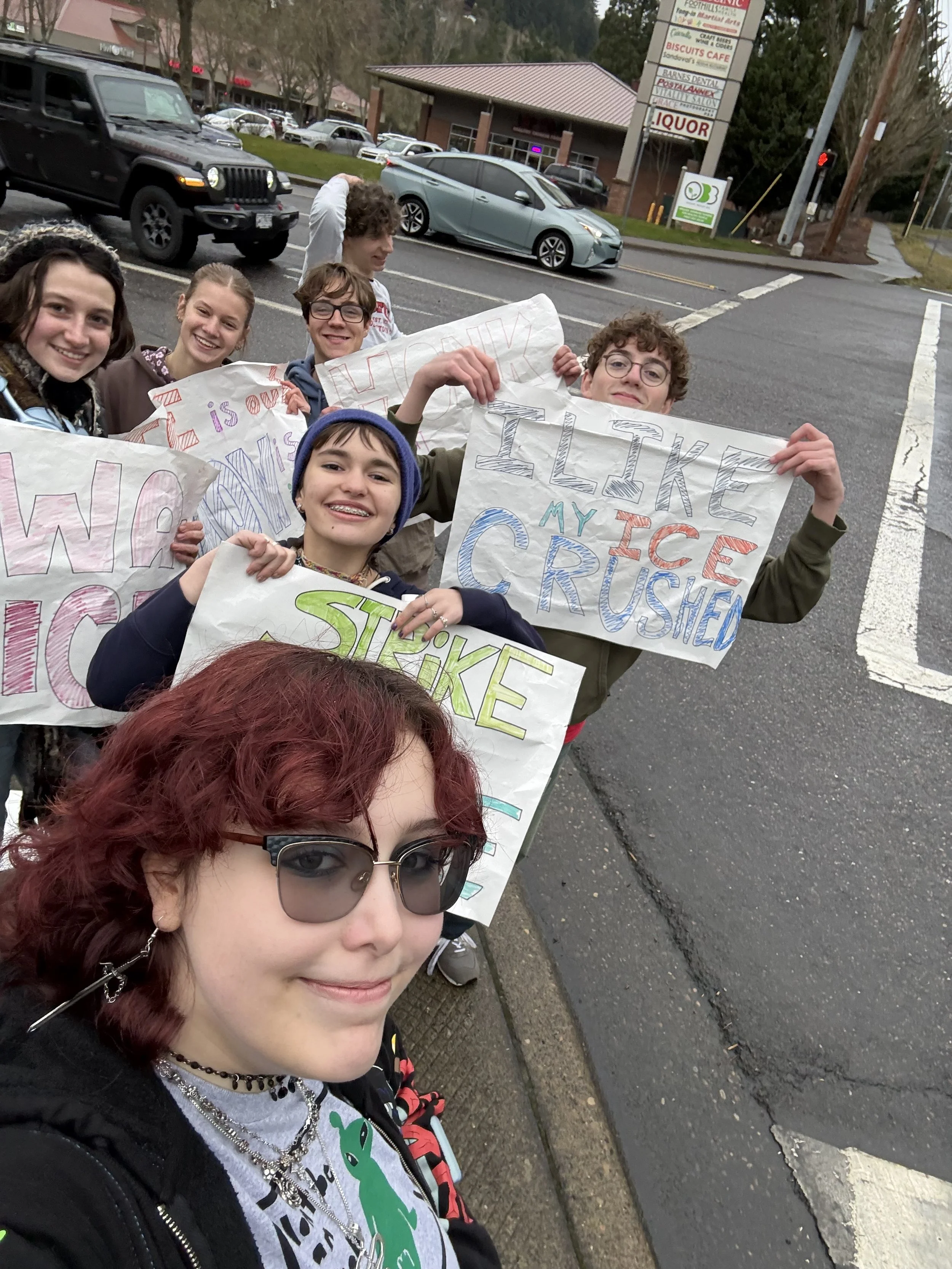
Frank, Carlson, Cole, and other students pose with their signs by QFC. Courtesy of Eliza Frank ‘28.
This support was not limited to verbal gestures. The demonstrators were handed coconut waters, cookies, Welch’s Fruit Snacks, and Rice Krispies Treats by strangers, as well as sparkling water from a US teacher who stopped by shortly before the walkout ended. One man even took the time to shake each student’s hand, thanking them for their participation.
However, not all reactions were positive. “There were, I’d say, about five cars who saw us protesting and then flipped us off through the window,” Cole remarked. That said, such displays were few and far between, with the protest being largely well-received.
Overall, both Frank and Cole found the experience rewarding. For Frank, who deems themself an introvert, the protest was a way to use their leadership skills. “I love being able to organize things and bring people together, even if it's hard for me to talk to them,” they stated.
Unlike Frank, Cole had never gone to a protest before. He commented that “being a part of that protest [and] seeing the support of just random people…driving by was really powerful.”
Immigration Teach-In
Two weeks later, on February 13, US English teacher Maureen Reed led an hour-long teach-in on immigration policy. Four days prior, Reed had sent out a student input survey asking for suggestions of “historical and recent events related to political conflict in the U.S.” Along with six other faculty members, she then assembled a slideshow and presented that Friday afternoon in the US Library to an audience of at least 22 students and nine faculty spectators.
While the survey proposed a wide range of topics, Reed stated that the teach-in focused on immigration enforcement because “that was the overwhelming topic…that came up.” Moreover, a common thread among student responses was the question of how to help or be involved in civic action.
At the start, students and faculty went around in a circle, introducing themselves and explaining why they had come to the teach-in. Some reasons mentioned were feeling uneducated and having personal ties to families affected by ICE.
All in all, speakers covered the events in Minneapolis, the history of American immigration policies, new developments within ICE, the role of Constitutional amendments in these events, and the September Supreme Court ruling authorizing ICE to racially profile detainees.
Outside of speaking time, students were also allowed to raise questions as they came up. At one point, they were asked to form small groups and to brainstorm, on paper, a question they were interested in hearing answered. However, Reed emphasized that, in the survey, “activities was the [approach] that people consistently ranked less of a priority,” so the teach-in was more discussion-oriented.
The presentation concluded with a slide about ways for students to get involved, such as by contacting their local representatives. A longer list was also provided via QR code with the contact information of Congressional officials, Constitutional rights, and the webpages of community organizations.
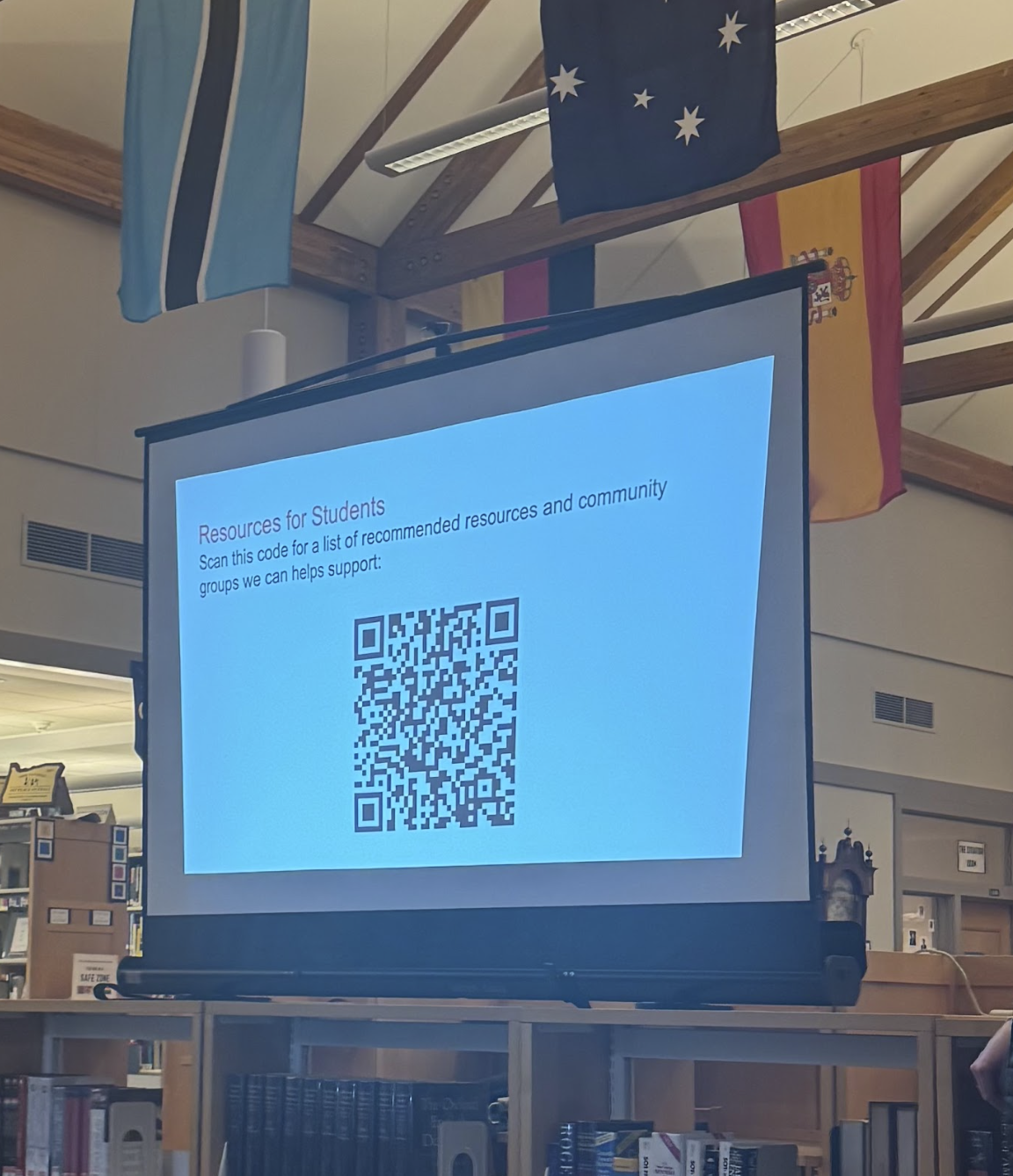
A QR code provided at the end of the teach-in linked to further resources. Courtesy of Gracyn Gardner ‘26.
Although the teach-in only lasted an hour, Reed hopes it was a stepping stone for students to gain awareness of the world around them. “One thing I heard was students wishing they knew more or feeling like they should know more. And so I hope that this hour was a way for them to make some progress towards that goal,” she declared.
Future Events
News of another nationwide shutdown, beginning March 7, has spread online. On February 26, Frank sent out a schoolwide email outlining them and Carlson’s plan to hold another protest in accordance with the shutdown. Since the original walkout, Frank has gained permission from US administrators to use the mass email chain and was also invited to speak with Carlson at a faculty-led listening session on March 2.
Reed has been thinking of other ways to bring social awareness into the school. She says this could manifest as another teach-in, but also hopes of “[including] it in assembly or C&C discussions.” As mentioned, faculty recently hosted a civic action listening session, and a second teach-in is scheduled for March 13 about a similar topic.