
Music as a cognitive tool for focus and learning
By Ariana Bajaj ‘26

Graphic by Gracyn Garner ‘26.
Bloodshot eyes, viscerally tweaking from their latest Redbull, and music blasting so loud it leaks past even the thickest headphones – this is the average Catlin Gabel (CGS) Upper Schooler’s fall night, where caffeination becomes survival and time is of the essence. Students cling to glowing screens as they race the clock to submit their latest Honors Chemistry lab, due at 8:00 am the next morning.
To investigate whether music affects cognitive function and productivity, I turned to the CGS Upper School student body.
According to a CGS survey sent to 21 Upper School students in November, 76.2% of students listen to music while studying. Even though so many students participate in this study practice, is listening to music truly a boost in productivity, or just another avenue of distraction that undermines efficiency?
Several music genres have been ranked among those used by the student body (such as jazz, lo-fi, pop, etc.). However, Jeffery Silverstein, the Upper School Learning Specialist, believes instrumental or familiar music “is the most impactful for studying and productivity.”
“Sometimes having music with some consistent rhythm can help a student – when the music creates some sort of momentum,” Silverstein adds.
Lo-fi, a genre of music dedicated to boosting productivity, was created when an electrical engineer named George Owen Squier founded a company that transmitted music through packaged, sold wires. Interestingly, according to Study Breaks Magazine, “[background music] possesses the ability to evoke all types of emotions, actions, and memories, permeating the human subconscious and influencing decisions, making it a secret weapon for brands everywhere.”
As explained in The Oxford Scientist, the sounds we hear are transformed into electrical signals, which are processed in a region of the brain called the auditory cortex. In turn, researchers found that slower tempos and lyrics-free songs reduced stress and anxiety, while boosting cognitive function and concentration.

Diagram of the different regions in the brain and the impact music has on them.
Courtesy of Guardian Nurses.
Dr. Teresa Lesiuk, director of the music therapy program at the University of Miami Frost School of Music, found that music has a positive effect on productivity in the workplace. Contrary to popular belief, Lesiuk’s research found that productivity was at its lowest when there was no music in the workplace. The study also showed that music has a positive effect on the participants in the workplace.
In a CGS upper school survey, 61.9% of the 21 students who responded reported that music improved their personal productivity, while 38.1% disagreed. Many survey respondents who say they benefit from music, enjoy Taylor Swift and Frank Ocean, citing that their music is calming and allows them to “immediately lock in.”
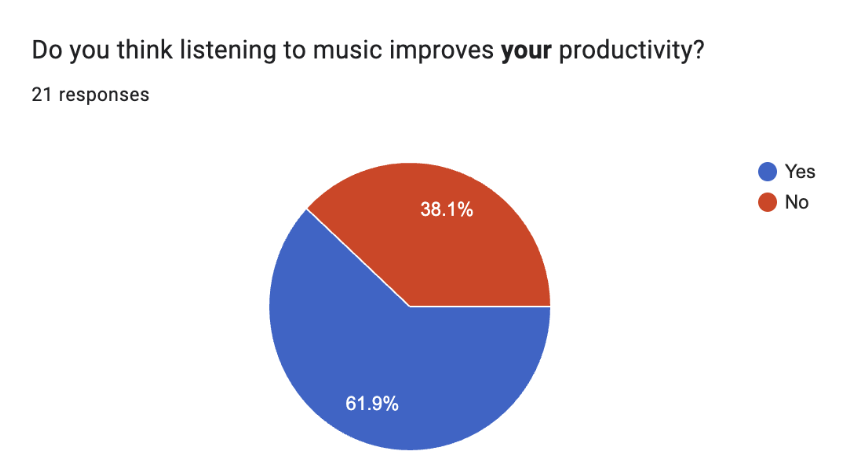
Results based on a randomly stratified survey of CGS Upper School students conducted in November 2025, of 21 Upper School students.
Courtesy of Ariana Bajaj ‘26.
For Campbell Young ‘26, the right type of music can completely transform a study session. “I like making studying fun by going someplace new, like a new coffee shop, or changing up locations and getting a new drink while listening to fun music,” Young shared.
At the same time, Young stresses that the surrounding environment and consistent habits are just as important as music itself. “When I'm home, listening to music enables me to study more productively, and makes the time go by faster,” she added.
Students who indicated they do not use background music prioritized taking breaks frequently and isolating their phones to achieve optimal concentration. As stated by a CGS Upper School ‘26 student, “I use YouTube timers to track the duration of an hour (or so) and work till it's over. So the motivation in that is knowing that the clock is continuously ticking.”
Ultimately, study habits such as listening to background music are largely personal and tailored to your unique preferences. While lyric-free music is shown to support concentration, the most effective routine is the one that encourages you to stay on track and turn in that lab on time.
So don’t be discouraged if silence isn’t quite cutting it. Consider hitting play on those Lofi beats or soft-tempo music (here's a playlist to get you started) to find a constant and practical routine that will help you thrive this New Year – happy studying!