
OPINION: Environmental education needs to go far beyond Earth Day at CGS
By Ariana Bajaj ‘26
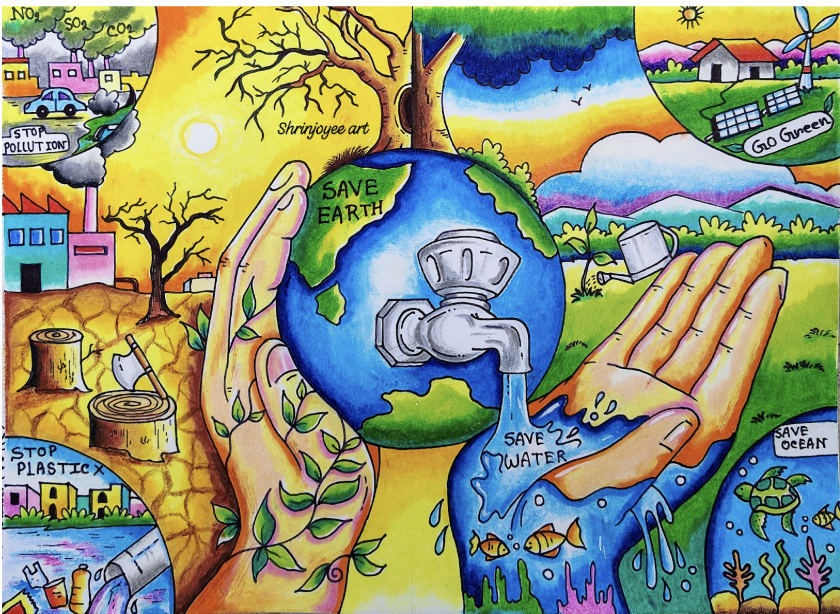
Courtesy of Shrinjoyee Halder.
As rakes clear the weeds in time for spring and seeds are pressed into damp soil, communities around the world celebrate Earth Day. Initially established following the 1969 Santa Barbara oil spill, a platform blowout that devastated the California coast, Earth Day (on April 22) serves as a global reminder to care for the planet.
At Catlin Gabel School (CGS), Earth Day often means community engagement and service. Dedicating April 21 as community engagement clearly reflects the great physical strides the CGS community is making towards this cause. However, teaching students climate awareness is equally important and should be better emphasized at a school like CGS.
Simply put, climate change is not seasonal, and our response shouldn’t be either.
The real opportunity for growth lies in our very own CGS classrooms. Environmental education should not be confined to science electives or special events, but integrated across all disciplines. At a school like ours, this kind of interdisciplinary learning is not only possible but can also be incredibly impactful.
In many science classes today, CGS students examine climate systems, biodiversity loss, and explore renewable energy solutions. However, these topics can develop even more depth and relevance when reinforced in other classrooms. Humanities classes could explore environmental justice and policy, or teach the historical roots of climate inequality.
Even math and economics classes play an important role in this intersection. According to an article written by Boston University, skills like data analysis and cost-benefit analysis can “support more sustainable and equitable outcomes across the world with detailed attention to policy solutions.”
By learning from these diverse subject areas, CGS students would develop a sense of civic duty. Students would learn how to better use their voice in the democratic process. These perspectives would help students understand that climate change is not only a scientific issue, but also a problem rooted in social and political factors.
When sustainability is woven into a multitude of subjects, it becomes a constant lens of thinking rather than an unfamiliar concept.
CGS Sustainability Coordinator, Atharva Deepak ‘27, believes that Earth Day itself still lacks depth. “It hasn’t always been taken very seriously as a holiday,” he said, noting that it often lacks the traditions and education that give other holidays deeper meaning. For him, the central issue was making environmental education and action more tangible and consistent throughout the year.
Each year, Earth Day is assigned a theme to focus the celebrations. This year, the 2026 theme is “Our Power, Our Planet.” The message clearly demonstrates the importance of consistent effort and progress.
Here at school, many students feel frustrated or powerless when faced with climate change on a larger scale. As one student explained, “I want to make a conscious effort to drive change, but I often feel unfamiliar or unsure about where to start, and it’s hard to know if my actions really matter.”
In response, Deepak ‘27 highlights that while students might not be able to “take down major oil companies, we [the students] can control what happens around our own community with the information we are taught.”
This sense of uncertainty is common, but it also clearly highlights why consistent environmental education and opportunities for action at CGS are so important.
In fact, increased education on environmental action has consistently been proven to promote student agency. When students encounter environmental issues with nuanced backgrounds, they begin to see them not as distant or abstract problems, but as challenges they are equipped to address. As stated by the United Nations, “Knowing the facts helps eliminate the fear of an issue which is frequently colored by doom and gloom in the public arena.”
Individually, students learning about the economic impact of environmental issues or investigating potential policy changes may seem small but over time, these efforts will foster a culture of true understanding and effort.
CGS already has the foundation to expand on its environmental efforts. Nevertheless, classes across disciplines need to seamlessly integrate sustainability into everyday learning. Now more than ever, new and innovative perspectives are exactly what this issue needs, and beginning conversations about interdisciplinary environmental learning can start right here in our classrooms.