
Saying goodbye to Mark Amasuga, Becky Wynne, and Sue Phillips
By Andy Han ‘26
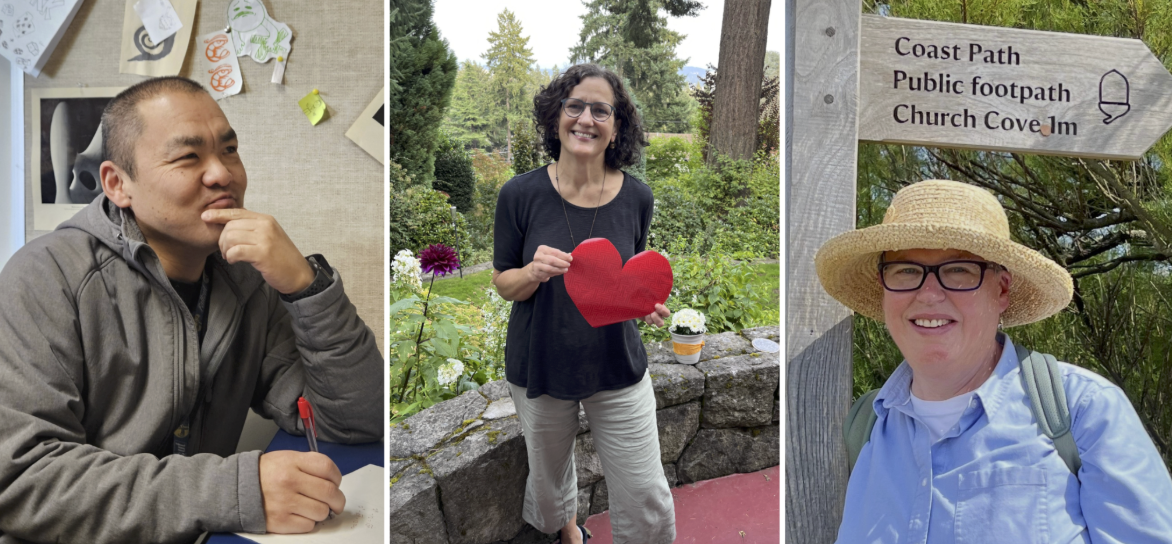
Photos courtesy of Mark Amasuga (left), Becky Wynne (middle), and Sue Phillips (right).
As the school year rolls to an end and students settle into the easy warmth of summer, we must once again say goodbye to some of our beloved faculty as they part from the Catlin Gabel School (CGS): Mark Amasuga, Becky Wynne, and Sue Phillips.
Perhaps you’ve seen them in math or science cafes, on global trips, or in student clubs and affinity groups. Perhaps their faces are ones you see every day in class or just when you’re strolling on campus. They’ve left their marks not just on grade books and reports; they’ve come to define the spaces students come to time and time again, whether those be the classroom, lab, or library.
In ways both seen and unseen, they’ve shaped the rhythms of daily life at Catlin—from the big wins to the quieter moments in between—and have each played a unique role in molding our community into what it is today.
I spoke with Amasuga, Wynne, and Phillips to hear about their time at CGS, what they are looking forward to doing post-CGS, what they will miss, and what they would like to leave with the community. But before we get to the teary-eyed goodbye, let’s start at the beginning, one more time.
How long have you been at Catlin, and what did you do before? What are the roles you’ve held?
Amasuga:
“This is my third year at Catlin, and I was teaching for 21 years before that at 4 public schools…I taught pre-Calc, Calc 1 honors, and then Calc 2 honors during my three years here. I've also been involved with a couple other things, like I was on the search committee for the science teacher last year and led the personal finance immersive.”
Wynne:
“I first started being associated with Catlin in 1994 when I was volunteering with Robert Medley in the theater. I was then working on research at OHSU doing fetal cardiac development research, but it was just me and a sheep in the basement, which I hated, so I came to volunteer with Robert in the theater. So then in the 1998-99 school year, I was hired for half-time to be the other half of the physics teacher who was retiring.”
“And after that, the following year…when he completely retired, they gave me the choice of a full-time job or no job. I chose no job because I was about to give birth. So, for the following five years, I was taking care of my little kids…and then I came back as a regular member of the faculty in 2007, and then since, I’ve been on the faculty in various roles, teaching math and science and being director of global ed and department head, and now I’m lab manager slash science teacher.”
Phillips:
“I've been the US Librarian at Catlin for 22 years, which is the longest I've worked at any location. My roles here have included stints as a freshman class advisor, senior class advisor, judicial council member, leader of a Rummage Sale dept., summer reading committee member, and advisor to several clubs and affinity groups, including two decades advising SAFE, and later AQE.”
“Prior to Catlin, I worked in Cambridge, Massachusetts, for several years for a progressive labor union at a major university, and helped two other colleges/universities work to establish their own unions in Massachusetts and Vermont. I've also done community organizing for a nonprofit in Portland, and served as an academic librarian at two Oregon universities.”
Why did you initially come to CGS, and what made you stay?
Amasuga:
“Oh, to be honest, I was considering quitting teaching altogether after public school, because it was burning me out, but I thought to myself, I still enjoy teaching, and I haven't tried private school yet, so I'll give that a shot, and I was lucky enough to get a job here.”
“The kids here really care, and they're just genuinely good/kind kids, and the faculty here are great, too. The public school teachers weren't mean, but they had their little cliques, and I didn't really feel super comfortable joining those, but at Catlin I feel like I can go up to any teacher and just start having a conversation; it’s nice.”
Wynne:
“Well, I initially came because I was teaching, and when I was in Seattle, I taught at a school called Lakeside, which is another independent school, very much like Catlin, although a little bit bigger. And when I moved to Oregon, there were really only two similar schools to that.”
“I also had a job at OMSI for three years as the chemist in residence, helping develop the chemistry lab at OMSI. But I thought I would love working at a science museum, and I did enjoy it, but it's a very different relationship with students. I like having sort of a longer-term relationship.”
“I knew I wanted to work in independent schools because I don’t care what kind of kids you throw at me, but I want small classes. That was a driving force for me being at a school like this. And I was looking for the opportunity to get onto the faculty.”
Phillips:
“After finishing graduate school in my 30s (proof that you don't have to have your career figured out by the age of 18), I was waiting for a tenure-track librarian position to open at the Portland State University library when this job opened at Catlin Gabel.”
“I thought, "A high school library? I don't know if that'll be a fit.” Upon interviewing, when meeting the students and clapping eyes on the gorgeous library, I was smitten. It’s the lively, smart students, the collegiality of my colleagues, and the latitude to run a program housed in such a glorious location at the center of campus that have kept me here.”
Why are you leaving Catlin, and what will you be doing post-CGS?
Amasuga:
“I have ‘enough’ to step away from working full-time. If I were to keep working past that, I’d be trading my healthy years in exchange for money that I probably won’t even use, and as much as I love working here, that’s not a trade that seems wise to me!”
“I've always wanted to, for example, learn how to play guitar…I also haven't seen too much of this country…whatever strikes my fancy - just wake up in the morning and think, hey, let’s go to Memphis or something random like that, and then just go.”
Wynne:
“I'm retiring. Yeah, it's time.”
“I don't have anything super specific yet, but one of the main driving forces is that I can travel not during school holidays. So I've been restricted to only traveling when everybody else is traveling. So now I can travel off-season, so that’s a bonus.”
Phillips:
“I just turned 60, and am excited to have more time for my own interests and projects throughout the year, rather than just during the summer break. I want to go camping in the San Juans in September and spend extended periods of time traveling, which is untenable on an academic schedule. I'm a member of other kinds of communities outside of Catlin that I can now offer my best time and energy.”
What will you miss most about Catlin?
Amasuga:
“Just everything. The students, my coworkers. Even the administration here is great, which is rare.”
“I like how it’s such a calm atmosphere here. In some of the public schools I’ve been at, some kids don't like each other, they're just getting into fights all the time and you can feel the tension on campus. But here everyone seems to just get along.”
Wynne:
“I'll miss the students and my colleagues and having a routine to work with.”
Phillips:
“That one's easy: the humor and kindness of the students is what I'll miss the most. I'll miss the conversations about your lives and what's most important to you.
“I'll miss the friendly colleagues and my treasured perch in the library for watching the winter fog roll in, shrouding the windows in gray mist, and the buttery sunshine streaming into the library on bright days. Seriously, I've got the best views on campus beneath these strong wooden beams and through these enormous windows.”
What are some memories that will stick with you?
Amasuga:
“Playing in the faculty and student basketball game my first year, that was fun. Even just the overnight trips, the class trips, or the senior trips. Those are really enjoyable, to interact with kids in a non-school, low-pressure setting.”
“Mainly any setting where everybody's just sort of relaxed, especially on the senior trip, where grades are basically done. You can just really enjoy that last day or two before everybody has to go their separate ways.”
Wynne:
“I mean, the global trips have been a highlight, for sure. The other reason, besides small class sizes, why I like to be at a school like this is that I get to do more than just being in my classroom; I get to interact with students outside my classroom in a lot of different ways.”
“I should also mention that I also, for two years, taught an art-slash-science class with Chris Mateer. We did a structural design and engineering class. That was cool, too.”
Phillips:
“My best memories derive from establishing a trusting rapport over time with a student and watching that student grow in self-confidence and strength as they realize how capable they are. I’ve witnessed this again and again, and it never grows old. There are all the good memories of conversations on class trips that have deepened friendships and respect for my colleagues.”
“Finally, I loved the wild roar of flames from the old tradition of bonfires behind the Dant House on Homecoming night after the late game. Those huge fires put a sparkle in everyone's eyes, and inevitably resulted in an anxious call from St. V's to the fire department, who'd pay us a visit, partake of a donut, and leave without squelching our community's joy.”
What do you hope students remember about you?
Amasuga:
“I'm hoping they'll just remember that I tried my best, that I was competent, that I knew what I was talking about, and that I cared about them in some way or another. I don’t want any kid coming out of my class thinking they just sort of fell through the cracks, and that I didn't really know anything about them. I’d like to think I got to know at least a little bit about every student that I've ever had here.”
“I hope they remember that in life, you get out of it what you put in. That even though Calc or whatever class it was seemed hard initially, when they put in the time and effort, they could succeed.”
Wynne:
“I hope that they remember that learning science was fun, that it was engaging.”
Phillips:
“Years from now, I would be delighted if a former student smiled or chuckled when they think of an interaction we've shared that helped them in some way. Maybe they're better at research because of my help, or perhaps they felt better understood or valued at a difficult time during high school. I won't know about it, but they will, and that's enough for me.”
What is one thing you would like to say to the student body and faculty?
Amasuga:
“That I've really enjoyed working here, I enjoyed working here so much, I’ll come back and sub just to still hang out here and see some of the kids and faculty.”
Wynne:
“Always be curious. Ask good questions. Make good observations.”
“I think right now, in today's political climate, where science has been downgraded somewhat by some people, that it's more important to make sure that you are basing claims on evidence and also that you're looking globally, that you look outside this country, because there's a lot of really cool stuff going on in the rest of the world.”
Phillips:
“Take care of each other as if everyone in the community matters. Look past the easy, comfortable friendships to discover the quirky and delightful qualities that make all the individuals here so worth knowing.”
Remember that you create the culture at the school, and if you invest your energy in kindness and mutual support, you'll be part of creating an experience that will help you feel optimistic and hopeful about the future, wherever you might go or choose to live after high school.”
Is there anything else you would like to say?
Amasuga:
“I guess I would say just as a final thing, it’s good to not just focus on school all the time or focus on your job or money once you get out of school. It’s good to stop once in a while and smell the roses a little bit, take your time, maybe take a different route to school…maybe try a drink at Starbucks you haven't tried, otherwise what's the point? You're just doing the same day over and over.”
Wynne:
“I had a great time teaching here, and I will miss a lot of people. And I hope that everyone enjoys themselves going forward.”
Phillips:
“Yes—I'd remind students to choose optimism, and to keep choosing it. In this moment, it's easy to slide into skepticism, irony, and negativity. And you will slide--but put on the brakes! Just remember to own your power to make change, especially when it feels difficult.
“Find your allies, know your values, choose a few causes you care deeply about, and get to it. This is the secret to a happy life, and a life enriched by the admiration and love of others who see you and are inspired.”
Conclusion
Though we will soon have to say our goodbyes to these three remarkable individuals, we should also remember to appreciate these last few hellos we’ll exchange when we pass them on campus. In these final weeks, let’s cherish the time we have left together, honor the years they’ve given to our community, and send them off with good wishes for their new journeys ahead.