
OPINION: We need to stop comparing US History/English 11 and American Studies
By Maddie Snyder ‘26
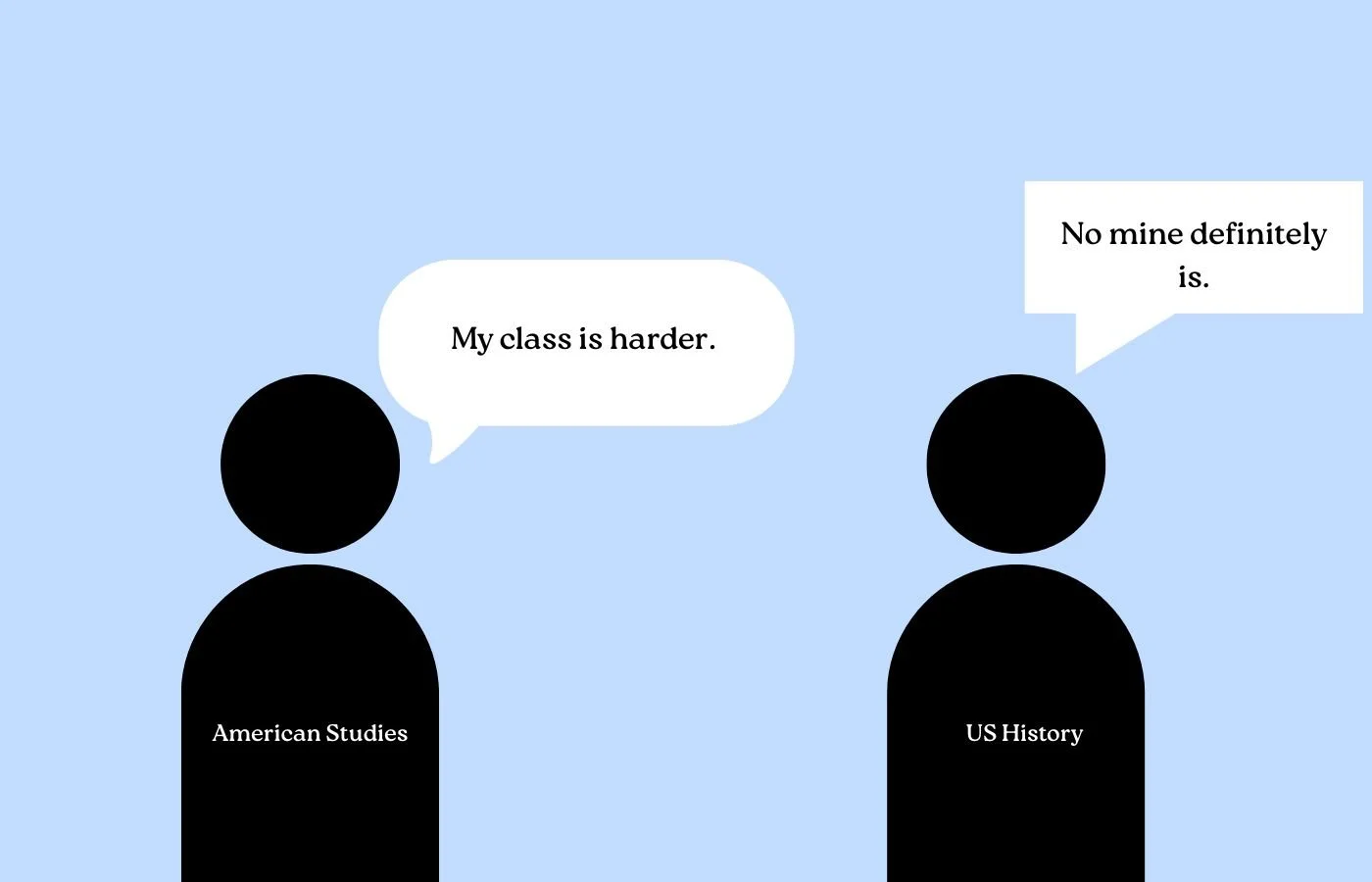
Image courtesy of Maddie Snyder ‘26.
Two juniors walk into the Upper School library, one with a binder of US History readings and the other holding an American Studies book. They compare their readings and workloads while a senior tells the US History student, “I told you that class was harder.”
It's a tale as old as time, or well, the ten years that the Catlin Gabel Upper School (CGS) has offered both American Studies, English 11, and US History. Upperclassmen, both juniors currently in the class and seniors who have taken one of the classes, draw comparisons between the two, often centering around their difficulty and usefulness.
Last year, I took US History and English 11, and they were some of my favorite classes I have taken at Catlin, but those essays I wrote were difficult. In those moments when I was stressed, it was very easy to channel it into “how come they aren’t doing that?” But just because I was struggling didn’t mean that no one else was, or that I was somehow superior because of it.
This year, I have seen the same comparisons repeated by the new junior class and my own. The discussion about the two classes feels draining and unending. I think it’s long overdue that, as a community, we realize just how unhealthy that comparison can be.
For one, it influences the choices that underclassmen make when forecasting, and not always in the most beneficial way. Students’ decisions can be made as a choice between a perceived easier and harder difficulty, instead of as a choice between teaching style and content.
To understand those differences correctly, though, we have to go back a couple of years to when American Studies didn’t exist yet.
Up until 2015, Junior English and history at CGS operated more similarly to other humanities classes at Catlin, with two teachers teaching US History and English 11 in different blocks. Then, ten years ago, teachers and administration decided to create American Studies.
American Studies English teacher Maureen Reed joined Catlin after the new class had been planned but not taught. She learned from former CGS English teacher Amanda Lighthiser that the course had been created to target “institutional goals for promoting interdisciplinary and project-based learning.”
Workload was a concern that administrators and teachers had at the time, but according to Reed, that concern was centered around wanting the workload of students to be worth every minute, instead of purely time-consuming. Instead of overhauling the curriculum of the current classes, the creation of American Studies was the solution to those goals.
Reed recalled that in the first two-three years of the courses, all eleventh-grade teachers would meet to add up the number of pages read and the number of pages of writing assigned to keep the workload even. Still today, both English courses read some of the same core texts, including the Constitution, Frederick Douglass’s memoir, and The Great Gatsby.
All 11th-grade humanities classes also focus on the same skills, which, for English, Reed named as reading skills, critical thinking, analytical writing, collaboration, and creative writing skills. However, English 11 and American studies differ in which skills they emphasize.
US History teacher Peter Shulman said that at the end of his course, he would want students to “write intelligently, speak convincingly, and research valid sources.”
Shulman acknowledged American Studies’ focus on more collaborative skills and emphasis on group projects. “I would say I’m less intentional and oriented around some of that [collaboration skills], although I think of that as sort of an everyday thing.”
Shulman’s classes typically center around lectures, with periodic short peer discussion and then class shareout, which is the everyday collaboration he is referring to.
In terms of content, Shulman said that his class places “more emphasis on political parties and how that structures outcomes” as well as “how coalitions are built and how they fall apart.” He said that by learning about structures like banking and government, he hopes students will “just be interested” in making decisions in our political system, like voting, for example.
He says that although there are definitely expectations, “all policies are really done through parties and party coalitions, to neglect that is a huge error in understanding how policies come about.”
Students in US History complete assignments like the infamous Jefferson vs. Hamilton essay, which asks students to compare the two founding fathers' political philosophies in creating the Constitution. Or the FDR to Regan paper, where you have to explain how the US political and cultural climate changed from FDR’s administration to the election of Ronald Reagan in 1980.
Similar major writing assessments are completed in English 11, taught by Tony Stocks. Some examples are the “What is an American?” personal essay at the beginning of the year and the Analytical American Literature essay at the end.
In American Studies, writing is still a central part of the skills English teacher Maureen Reed hopes to improve on, but it is also complemented with other creative and collaborative efforts. For example, the call and response nature art project, which asks students to write a poem based on an original text, then respond to a peer with a piece of art.
Reed says those projects are meant to emphasize analysis and collaboration rather than synthesis. For Reed, the benefit of collaborative and project-based learning is that it makes learning a community activity, but also“creates ways to have the kinds of conversations that come about when you're not just analyzing texts but thinking about what I can build from that.”
In the debate between American Studies and US History/English 11, American Studies typically gets the label of the “easy class” because of this emphasis on collaboration and projects instead of heftier analytical essays.
A study done by the National Library of Health says that “Several decades of empirical research have demonstrated the positive relationship between collaborative learning and student achievement, effort, persistence, and motivation.” But observations like that often fall short when students are stressed about an essay that someone in the other class doesn’t have to complete.
At CGS, we have a tendency to quantify achievement with academic suffering. We are competitive amongst ourselves, which is a natural occurrence at a school like ours, but that doesn’t give us an excuse either.
So, to all you sophomores out there, I encourage you to think through your decision for next year in the spring. Choose which one you are genuinely interested in and whose teachers match your learning style, not which one you think will lighten your homework load on any given night.
Comparison is necessary to make a decision between the two, but for my fellow upperclassmen, I encourage that we start to do so in a more productive manner. We need to focus on teaching style and content as opposed to difficulty, as the way in which we compare the two right now contributes nothing positive to our community.
No CGS student will ever take both classes or be required to take AP US History, which confines students to a standardized curriculum and assignments. We have the opportunity to choose what is best for our learning and what we want to study.
So instead of taking that choice for granted by designating “good” or “bad” choices, or “easier” or “harder” classes, why not instead be grateful that the choice exists at all?