
The hidden life of Leonardo da Vinci
By Andy Han ‘26

Courtesy of Andy Han ‘26.
In 2005, behind a hidden staircase in the Santissima Annunziata convent of Florence, Italy, researchers of the Military Geographical Institute reportedly uncovered what may have been Leonardo da Vinci’s secret workshop. For many, this was an exciting discovery in and of itself. Still, for some more conspiracy-minded individuals, this was just another step down the rabbit hole of Leonardo da Vinci’s shrouded life.
A true polymath and defining figure of the “Renaissance Man," Leonardo was a brilliant poet, mathematician, artist, philosopher, and scientist. Publicly, Leonardo is known for his breathtaking artworks, such as the Mona Lisa and The Last Supper, yet his private journals reveal diagrams of unrealized designs for machines of war and eerily accurate sketches of human anatomy, filled with discoveries that would not be confirmed until centuries later.
But where could he have gotten such a breadth of knowledge? According to American paranormal writer David Wilcock, “It clearly seems that Leonardo da Vinci was privy to a series of secrets that had been handed down for many, many thousands of years…he may also have actually been contacted by human-like extraterrestrials, who either spoke to him in person or perhaps telepathically.” To truly understand the source of Leonardo’s genius, we have to look for clues in the story of his life.
Leonardo was born in 1452 in the small Tuscan town of Vinci. In his childhood, Leonardo received no formal education; instead, he spent his days wandering the foothills of the Apennine Mountains near Florence and learned by observing nature. When he was fourteen, Leonardo was mentored by master painter, goldsmith, and sculptor Andrea del Verrocchio to learn art.
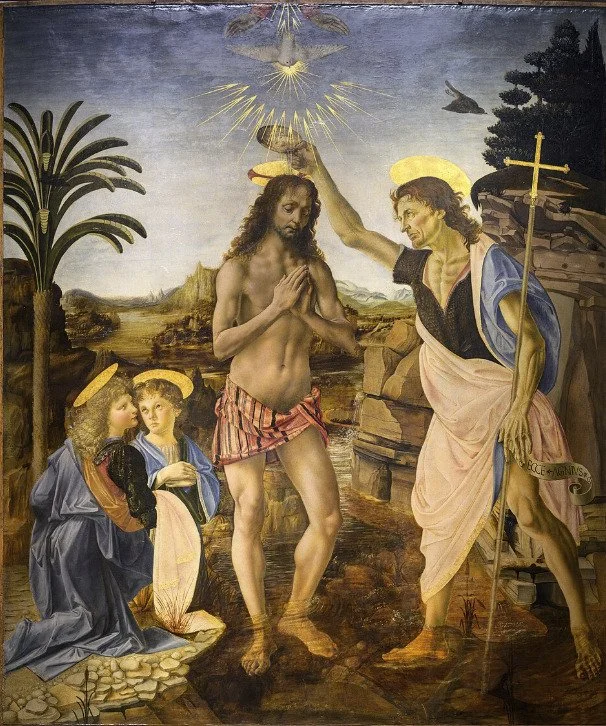
The Baptism of Christ (Verrocchio and Leonardo). Courtesy of Wikipedia.
Around 1468, Verrocchio was commissioned by a church to create The Baptism of Christ, which depicted Jesus Christ’s baptism by Saint John on the banks of the Jordan River. Leonardo was asked to assist his mentor in painting an angel holding some garments to the left of the frame. According to legend, Verrocchio was so impressed by Leonardo’s mastery of color that he vowed never to paint again.
Despite Leonardo’s extraordinary artistic prowess at a young age, he was not permitted to enter the prestigious Platonic Academy of Florence because he was born out of wedlock, was not fluent in Latin, and lacked the elite social connections to gain access to this private intellectual circle. Nevertheless, Leonardo excelled even without schooling, leading some to believe that he was perhaps blessed with forbidden knowledge from aliens.
In 1482, when he was 30, Leonardo left Florence to work under the Duke of Milan, Ludovico Sforza. For the next seventeen years, he served as a military engineer and court artist, designing weapons of war and sketching in his notebooks instruments like scythed chariots, giant crossbows, and multi-barrel guns that resemble the modern shotgun. He also painted The Last Supper during this time.
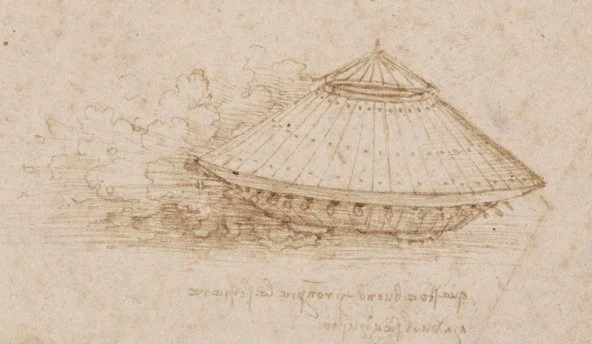
A sketch of Leonardo da Vinci’s fighting vehicle. Courtesy of Wikipedia.
One of Leonardo’s most infamous military designs was his so-called “tank.” The sketch features a circular armored vehicle reinforced with slanted wooden panels and lined with light cannons around the perimeter. Manned by a crew of four men on the inside and powered by cranks, the machine could move across the battlefield while firing in all directions at once.
Though an impressive work of (theoretical) engineering, exponents speculate that Leonardo designed weapons of war not because Sforza commissioned him but because aggressive aliens were trying to give him weapons to destroy life on Earth.
According to William Bramley, author and alternative historian, “It [Leonardo’s tank] looks kind of like a UFO.” Although this theory is possible, it is more likely that Leonardo drew inspiration from turtles and copied the design of their slanted shells for his tank.
However, Leonardo’s curiosity did not stop with the mechanics of war machines. Determined to understand how the human body worked, he would go on to tackle another demanding subject: anatomy. Through extensive dissection of over thirty human corpses, Leonardo studied the mechanics of the body with the same precision he approached his engineering or artistic work with.
Somehow, even without modern medical equipment like MRIs and CT scans, Leonardo made discoveries that would not be fully confirmed until centuries later, though he encountered many barriers. According to Joey Grissom, a Body Systems & Kinesiology instructor at Catlin Gabel School (CGS), one major limitation was time and preservation.
“There wasn’t really preservation,” and for smell and short-term preservation, “the best thing they had was alcohol, wines, and distilled things, not like now with formaldehyde,” explained Grissom. In other words, Leonardo needed to work quickly under pressure before the tissue decomposed, thereby limiting his period of observation.
Another problem was access, as “human dissection was very taboo; even in university settings, it was very rare,” said Grissom. With limited cadavers to dissect, Leonardo also couldn’t rely on references, as anatomical atlases didn’t exist at the time. “A lot of anatomical study is not looking at pictures—it’s looking at diagrams and medical illustrations,” Grissom elaborated.
However, despite these obstacles, Leonardo’s findings were astonishingly precise. As Grissom noted, “In terms of accuracy… they’re very accurate. He was pretty meticulous… but there are some inaccuracies.”
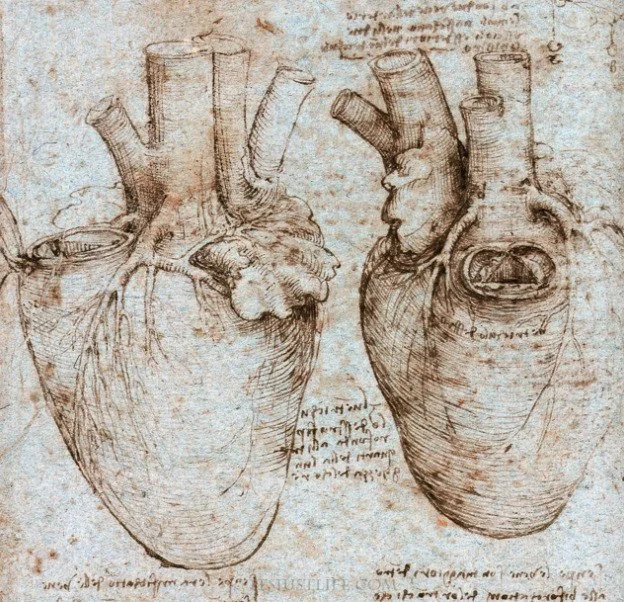
Leonardo da Vinci’s illustration of an ox heart. Courtesy of Medievalists.
For example, Leonardo accurately depicted a fetus in utero, capturing the curled fetal position and its connection to the placenta; mapped the spine’s natural curvature; and discovered that the heart had four chambers with valves that directed blood flow in a single direction.
To understand how these valves worked, Leonardo injected molten wax into a bull’s heart to form molds of the aortic valves and chambers, then used those casts to create a transparent glass model. By pumping a mixture of water and seeds through the model, he observed how turbulent vortices closed valves.
Extrapolating his findings from his dissection of pig, ox, and cow hearts to humans, Leonardo arrived at conclusions so advanced and accurate that the earliest confirmation of his theory was in the 1960s and found using hydraulic models and fluid dynamics—a fact that somewhat justified the conspiracy theories surrounding him.
Curiously, Leonardo recorded many of these observations in notebooks written in reverse. Writing backwards—a skill known as “mirror writing”—was one of Leonardo’s famous traits, and he could even write with both hands simultaneously. Some argue that mirror writing was a skill he developed to avoid smudging ink, as Leonardo was primarily left-handed.
Still, others posit that he did so to hide his scientific discoveries from the Catholic Church to avoid accusations of blasphemy, a crime punishable by exile or torture. Then again, church officials also could’ve just used a mirror and tortured him anyway.
Because of Leonardo’s prominent use of his mirror writing technique, some speculated that the same technique could be applied to his paintings. When researchers placed an inverted version of Saint John the Baptist next to the original, a humanoid alien face seemed to appear in the middle. Other examples of these disguised alien figures include the Mona Lisa, The Virgin and Child, and The Virgin of the Rocks.
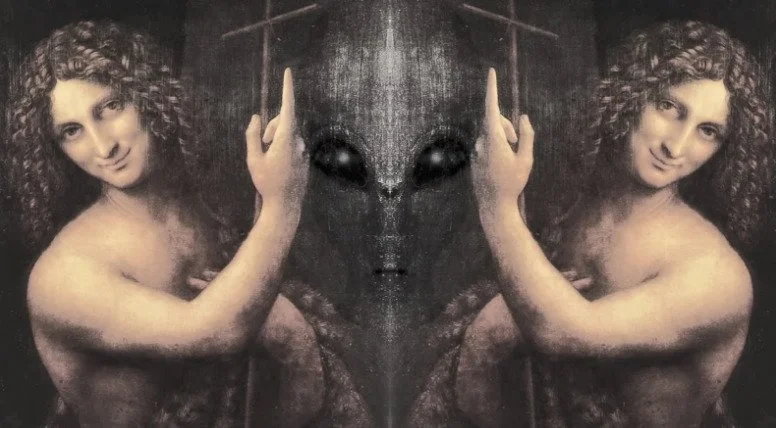
Saint John the Baptist (Leonardo) mirrored. Courtesy of HISTORY.
Theorists claim that these additions were intentional and highlighted Leonardo’s connection to higher beings. However, the appearances of these alien figures are wildly inconsistent, and such extraterrestrial-looking figures can probably be manufactured by applying the mirroring technique to any other painting that features human faces.
When asked about his thoughts on the theory, CGS art teacher Chris Mateer responded, saying, “I don’t think Da Vinci put aliens in his work… but when you start mirroring and manipulating images, you can find whatever you’re looking for.”
After acknowledging the fact that he didn’t believe in the alien theories, Mateer admitted that “even if you’re a skilled painter, there’s still a barrier where his [Leonardo’s] work feels almost otherworldly." When there’s no easy way to explain how such “otherworldly” art was even created, “it’s amazing where people drift to try to explain it,” said Mateer.
Adding on, Mateer commented, “When I’m faced with something I don’t understand, I can either stop there or I can sit with being in awe, even without all the answers. It’s like seeing Jesus in burnt toast—if you’re looking for a thing, you’ll find a thing.”
Observation is a powerful tool. Some may use it to find obscure connections to try to prove fringe extraterrestrial theories, while others, like Leonardo, may use it to create a body of knowledge that surpasses anything known before. Observing birds, turtles, and rivers taught him how to make flying machines, model tanks, and revealed the inner workings of the human heart.
Frankly, the claim that Leonardo himself was but a conduit and that his work was the result of a simple transmission by aliens is nothing short of an insult to his intelligence. Rather than just a middleman who happened to live during the Renaissance, Leonardo da Vinci was a true Renaissance man, a forever exemplar of the boundless potential of the human race.